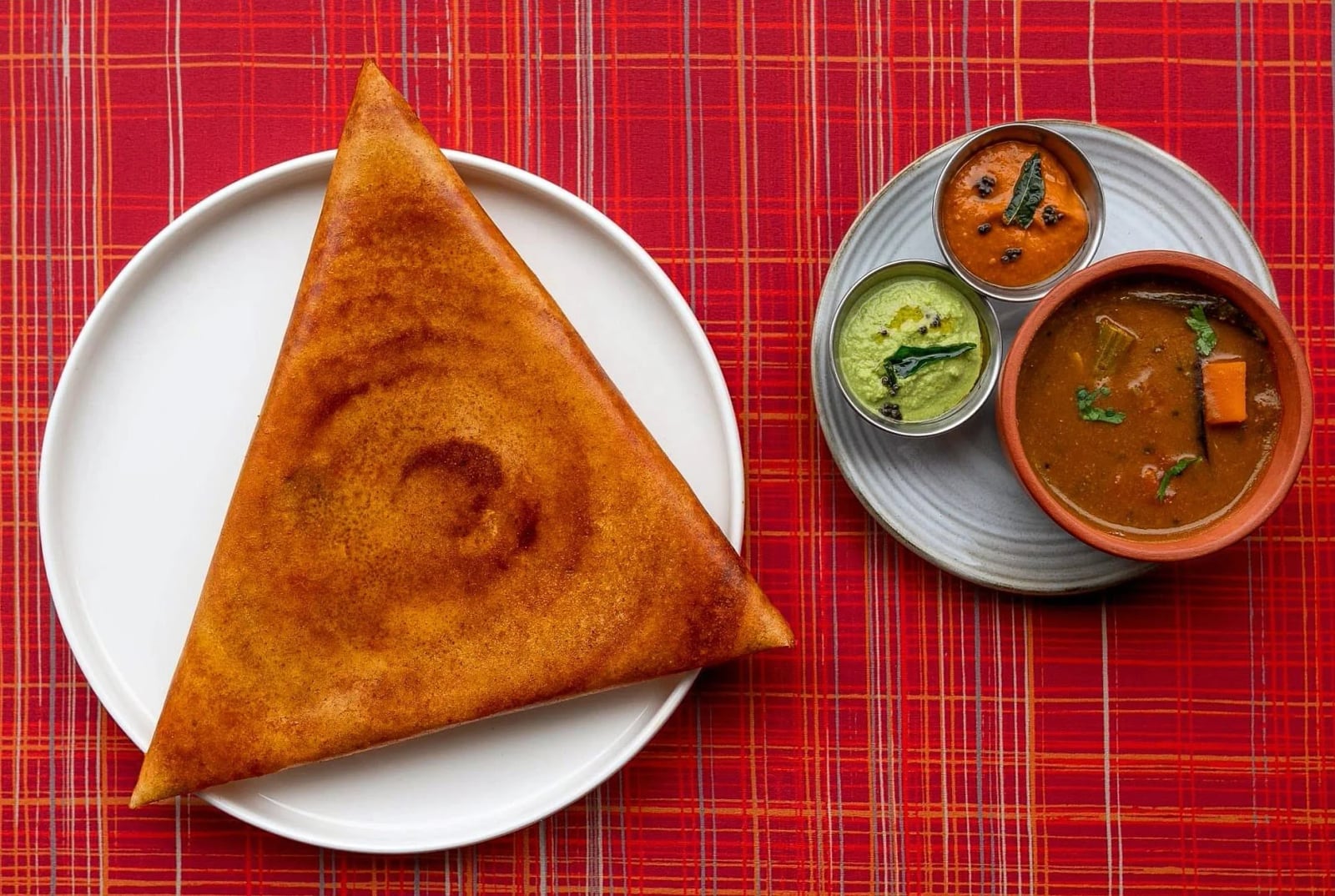

In Paul McDonough's photograph, Semma's Gunpowder Dosa looks like the fast part of dinner. The crepe is crisp enough to stand in a neat triangle, the potato masala is hidden inside, and the surrounding bowls wait like punctuation. What the still image cannot show is that this apparent instant begins days earlier, with fermented rice-and-lentil batter, and ends only when the griddle, ghee, spice powder, server, runner, and diner all meet at the right temperature.[5][7]
Bon Appétit's 2024 film spends an afternoon and the first wave of dinner service with chef-partner Vijay Kumar. It is a compact kitchen documentary, not a victory lap. The camera finds batch cooking, inventory counts, tasting spoons, test dosas, a pre-shift huddle, and the pass before it finds glamour. That emphasis has aged well: the Michelin Guide still lists Semma with one star, and the James Beard Foundation named Kumar Best Chef: New York State in 2025.[2][6]
Watch the film less as a portrait of one celebrated chef than as a study in transmission. Kumar's childhood food from Tamil Nadu reaches a Greenwich Village table through a chain of people and checks. The restaurant's achievement is not that it miniaturizes home cooking into tasting-menu ornaments. It is that it protects assertive spice, hot food, and recognizable dishes while serving a crowded room at restaurant speed.[1][3]
Lunch Prep Makes Dinner Possible
Around 0:43, the film introduces the person who makes its whole argument plausible. Chef Suresh, Kumar's longtime friend from cooking school, works several curries at once. Kumar explains that the kitchen prepares food for that day rather than carrying finished batches into the next one. The scene is visually modest—pots, steam, quick tastes—but it complicates the romance of “cooking from memory.” Memory does not portion itself, watch four pans, or decide when a sauce has reduced enough. A skilled cook does.[1]
The next passage, beginning near 2:16, turns dinner into arithmetic. Preordered crabs have to match physical inventory. Expected dish sales become prep quantities. Kumar checks what the system says against what the cooks can actually see in the kitchen, then circulates the count. The film mentions roughly 230 covers across the restaurant's seating pattern as a general operating scale; at that day's pre-shift meeting, the team names 174 booked covers. Those are snapshots from filming, not current promises, but together they explain why estimation is culinary work. Underproduce and a signature dish disappears mid-service. Overproduce and “made today” becomes waste.[1]
This is fine dining without the usual visual signals of tweezers and hushed tasting-menu choreography. Precision appears instead as the relationship between a reservation book, a batch of curry, and a dining room that orders à la carte. The kitchen must be generous without becoming vague. It needs enough food to let a table share, yet enough control that the last serving retains the first serving's intent.
The Griddle Is A Measuring Instrument
At about 5:56, Kumar tests the dosa station. He draws three rounds of batter on the hot surface, using their color and texture to read the griddle. Too cool and the crepe will not brown correctly; too hot and it will set before it can spread evenly. The circles are not decorative rehearsal. They are calibration marks made from edible material.[1]
Then come the small judgments that make “crispy” specific. The batter must be spread to an even thickness. Ghee must lubricate and flavor the surface without flooding it. The lentil-and-chile gunpowder absorbs fat, so an amount that looked sufficient a moment earlier may leave the finished crepe dry. Eater's separate demonstration of the dish clarifies the construction: a fermented rice-and-urad-dal batter becomes the crepe; a roasted lentil, chile, and curry-leaf mixture supplies the gunpowder; potato masala fills the fold; sambar and chutneys complete the plate.[5]
The long fermentation and the brief griddle pass create opposite demands. Batter develops on biological time, with temperature and microbes changing what the cook will meet. Service happens on ticket time, with no pause available once the crepe begins to set. The cook's real skill is not merely knowing a formula. It is recognizing what today's batter and today's iron are doing quickly enough to preserve a brittle edge and tender inner surface.
That is why the title's three days matter without becoming a fetish for slowness. Kumar says in the film that many dishes require two or three days of preparation, using dosa as his example.[1] The duration alone does not create quality. It creates a responsibility: every earlier stage must arrive at the griddle in a form a line cook can finish repeatedly, under pressure, without turning fermentation into inconsistency.
Memory Travels Through A Brigade
Semma's public story is deeply personal. Kumar has described the menu as rooted in childhood, from food cooked by his mother and grandmother to snails gathered around family rice paddies. Michelin's profile connects the mung-bean salad to his mother and the snail dish nathai pirattal to his grandmother; Bon Appétit's interview adds tactile details about ponni rice and a preference for mortar-ground spices whose texture and aroma can be lost in an overheated blender.[3][4]
The film adds a necessary correction to the lone-author version of that story. Kumar can trust Suresh with sauces because their knowledge is shared. Prep cooks peel and season potatoes. The dosa cook reads the griddle. Runners carry hot plates. Servers decide pacing with guests. At the pass, cooks repeat calls back so the person expediting knows they heard the same order.[1]
None of this diminishes Kumar's authorship. It shows what restaurant authorship requires. A memory becomes hospitality only after it can be taught without being flattened. “Authenticity” is often treated as a static property of a recipe, but the video suggests a more useful test: can a team reproduce the intended heat, texture, and generosity through different hands? Semma's answer depends on training and trust as much as on refusal to tone down spice.
The most revealing staffing detail comes during prep, when Kumar points out cooks who began as dishwashers and moved onto the line. In the film's own account, one now handles pastry and can expedite in Kumar's absence.[1] Advancement does not erase the hard labor underneath a busy restaurant, and a short branded documentary cannot tell us everything about a workplace. Still, the sequence makes a concrete point: preserving a cuisine at scale requires creating more people who can exercise judgment, not keeping judgment trapped in the chef's hands.
The Pass Protects The Bite
The pre-shift huddle begins around 7:17. Covers, dietary restrictions, and preordered crabs are spoken aloud before the doors open. Minutes later the dining room fills rapidly. Kumar checks the room, warns the line about the wave coming toward it, warms plates, reads ticket age, and asks cooks to repeat calls. When a dosa comes off the griddle too dark, he treats the lost dish as preferable to sending a compromised plate.[1]
This section is where the dosa's delicacy becomes operationally interesting. A crisp crepe is perishable in a way a reservation system cannot solve. Steam from its filling, time on the pass, and a slow trip to the table all soften the structure the griddle cook just built. Hot curry on a cold plate loses energy before a runner can cross the room. The film's food runners are not an afterthought to cooking; their speed is one of its final ingredients.[1]
Semma's menu format makes that relay more complicated, not less. Guests may want a dosa early, or ask for it with the main courses. Servers coordinate the sequence because shared South Indian dishes do not naturally obey a rigid European tasting progression. The kitchen's task is therefore not to impose one prestigious order. It is to preserve each dish while allowing the table some control over how the meal unfolds.[1]
Look again at the finished dosa. Its triangle is not simply photogenic geometry. The fold gives a broad, fragile crepe enough structure to travel, encloses the potato, and leaves crisp surfaces exposed rather than buried under sauce. The sambar and chutneys remain separate so the diner, not the pass, decides when crispness gives way to saturation.[5][7] Presentation here is not disguise. It is a short extension of shelf life.
That is the film's most satisfying fine-dining lesson. Luxury can be an ingredient no one else can buy, or a room polished into unreality. At Semma, it is also the harder promise that a food associated with home, fermentation, bare hands, and appetite will arrive without apology and without sloppiness. The camera begins with heritage and ends in the heat of the pass. Between them lies the real craft: making one intensely personal taste repeatable without making it generic.
Sources
- Bon Appétit, “Inside NYC's Only Michelin Star Indian Restaurant | On The Line,” November 14, 2024 — the embedded YouTube video following preparation, inventory, dosa calibration, pre-shift, and service at Semma.
- The Michelin Guide, “Semma — New York” — current restaurant listing, inspector description, cuisine, address, and one-star designation.
- The Michelin Guide, “Inside One MICHELIN Star Semma, a Taste of South India in Manhattan” — profile connecting Kumar's menu to his mother, grandmother, Tamil Nadu childhood, and labor-intensive dosa.
- Kate Kassin, “Meet the Tamil Chef Whose Southern Indian Cooking Is the Hottest Ticket in NYC,” Bon Appétit, May 2, 2022 — interview on Kumar's background, ingredients, mortar work, rice, and Semma's cooking.
- Terri Ciccone and Eater Video, “Chef Nyesha Arrington Makes Gunpowder Dosas at One of NYC's Hottest New Restaurants,” Eater, March 16, 2022 — step-by-step account of Semma's batter, gunpowder, potato masala, griddle work, and accompaniments.
- James Beard Foundation, “The 2025 James Beard Award Winners,” June 16, 2025 — official record of Vijay Kumar's Best Chef: New York State award.
- Semma, official restaurant site — current restaurant information and the Paul McDonough photograph of the Gunpowder Dosa used as this article's image.