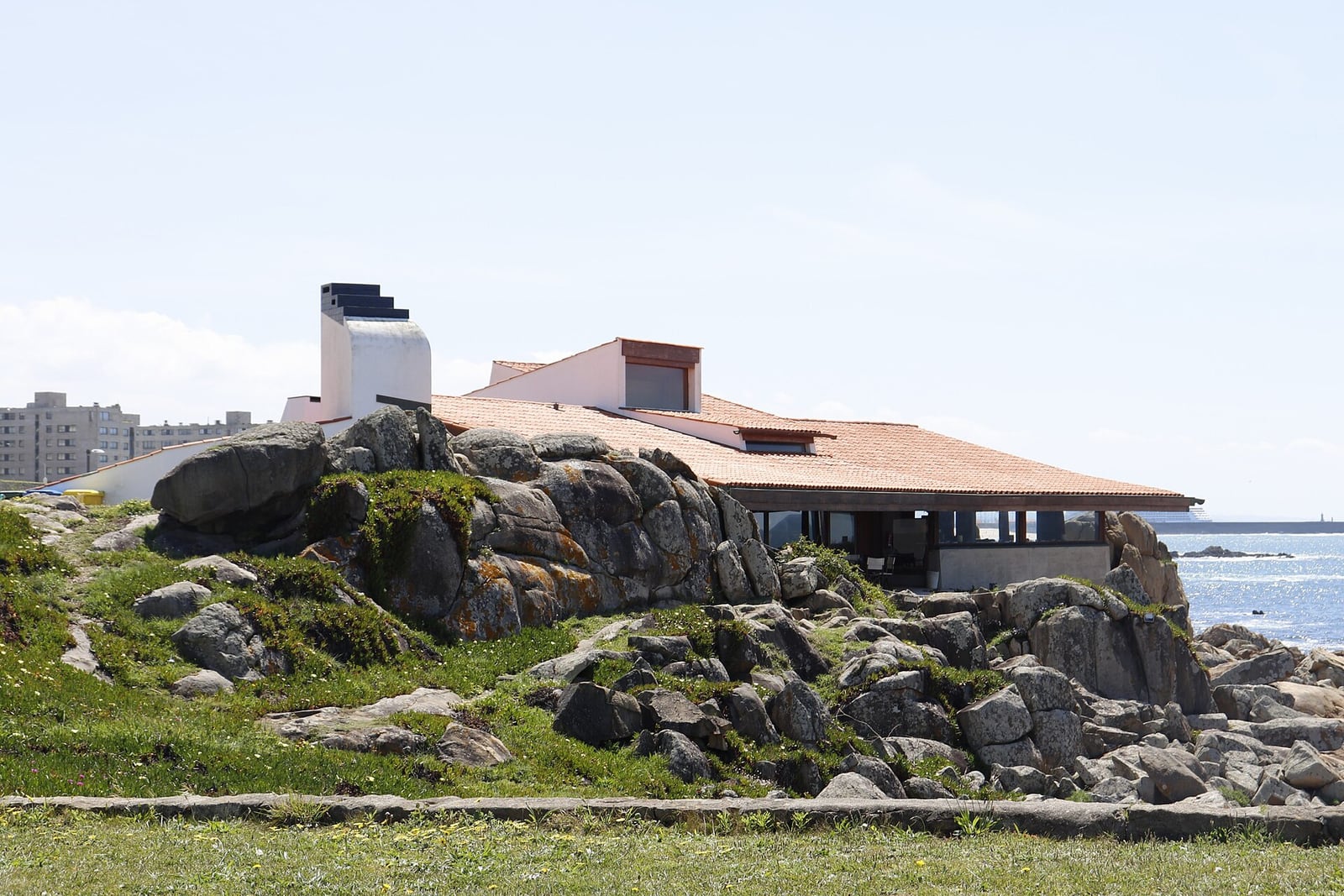
Before the first sea urchin reaches the table, Casa de Chá da Boa Nova has already served rock, salt light and horizon. A documentary photograph from the landward side shows Álvaro Siza's tea house refusing the usual posture of a destination restaurant. There is no tall façade announcing luxury. The red-tiled roof drops behind granite, the white chimney rises like a compact sail, and the building stretches low enough for the Atlantic to remain the largest object in view.[6][7]
That setting could overwhelm a lesser menu. At Casa de Chá, it supplies the opening grammar. The current English menu offers six, 12 or 21 “takes”; Michelin calls the tasting sequence Cantos, linking it to The Lusiads and its voyage “through seas never before sailed.”[1][3] Chef Rui Paula and executive chef Catarina Correia do not need to invent an oceanic theme after the fact. Their harder task is to stop the very real ocean outside from turning every course inside into scenic merchandise.
The full sequence works on paper because it treats the sea as a progression, not one repeated flavor. It begins with specifically named marine ingredients, widens into spice and bread, tightens around a run of seafood and vegetables, then lets marine language slip into dessert. This walkthrough follows the published 21-take order available in August 2026. The restaurant does not identify which takes disappear from the six- and 12-part versions, so filling those gaps would be invention rather than guidance.[1]
The first five establish a coastline
Take I is “Sea urchin / White prawn from Algarve.” Take II answers with “Cockle / Azores pineapple,” and Take III reduces the wording further to “Seafood / Corn.”[1] The ingredients arrive on the page almost as coordinates: a spiny coastal animal, a southern Portuguese prawn, island fruit and a cultivated grain. The menu does not disclose the techniques or proportions, so its firmest early signal is one of contrast: marine products are repeatedly named beside something beyond the catch.
This matters in a room where “taste of the sea” would be the easiest possible cliché. Michelin describes the cooking as focused on Atlantic fish and seafood, presentation, texture and modern technique, but the menu's first movement does not read like a parade of unaccompanied premium specimens.[3] Cockle is written with pineapple; the broad category “seafood” is written with corn. Even before the plates reveal how those pairings taste, the sequence defines marine flavor through relationships.
Take IV, “Spice trade,” is the first title without a named central product. It opens a route beyond the view. The restaurant's own “Maritime Charter” describes its cooking as culturally rooted but open to influences without geographical limits, provided the product's genuine taste survives.[2] That statement creates a useful test for the course: spice should widen the sea's history without turning the plate into a costume of exploration.
Then comes Take V: “The Bread.”[1] The definite article gives it comic confidence after four compressed titles, but the placement is serious. Bread interrupts three seafood-led openings and the abstraction of the spice trade. In a reported 2025 visit, Folha de S.Paulo described water bread fermented at the table, baked before the diners and served with butter prepared in view.[4] That account documents an earlier iteration, not a guarantee of today's choreography. It does show how Casa de Chá has used bread as an event rather than a basket: grain, fermentation and heat briefly bring the voyage indoors.
Coconut broadens the middle
The next five takes thicken the sequence. Lobster meets coconut; amberjack is joined by local crab and jalapeño; oyster meets tuna; sea bass appears “in its habitat”; then comes the deliberately opaque “Snow egg.”[1]
Read only from the menu, this movement keeps changing the form of the pairing. Lobster is written with coconut. Amberjack is joined by crab from the coast and jalapeño. Oyster and tuna compress shellfish and fish into the same title. “Sea bass in its habitat” expands outward again, naming not just an animal but an environment. The menu does not disclose what constitutes that habitat, and the phrase should not be reverse-engineered into an imaginary plate. Its narrative job is clear enough: by Take IX, the kitchen wants the diner to consider context as an ingredient.
“Snow egg” at Take X is a hinge. Its name withholds even more. On the page it could be savory, sweet, cold, warm or theatrical; the public menu does not say.[1] That uncertainty is useful. A 21-part dinner needs blank space as much as information. If every title listed provenance, technique and garnish, the voyage would become freight.
Five marine courses, five different edges
Take XI returns with unusual precision: scarlet shrimp, chawanmushi and lemon. Take XII pairs crawfish with Jerusalem artichoke. Take XIII sets sea bream against broccoli and kaffir lime. Take XIV is Squid “Chanel,” while Take XV gives John Dory endive.[1]
This is the menu's clearest sustained crest. The seafood changes every time, but so does the ingredient language around it. Scarlet shrimp is paired with the custard form of chawanmushi and lemon; Jerusalem artichoke follows crawfish; broccoli and kaffir lime accompany sea bream; endive meets John Dory. “Squid ‘Chanel’” alone keeps its supporting cast secret. The sequence avoids the flattening effect of five consecutive titles that all promise the same generic fish-and-sauce construction.
It also shows the advantage of the tasting-menu form when the subject is narrow. An à la carte diner might reasonably choose one fish and ask it to be the evening's summit. The long sequence can put crustacean, cephalopod and three fish preparations in succession without demanding that any one plate represent the entire Atlantic. Whether the kitchen makes those anatomical differences vivid is a judgment only an actual meal can settle. On the menu, repetition at least creates the conditions for close reading.
The room reinforces that attention. The Canadian Centre for Architecture's Álvaro Siza fonds dates the project to 1958 and 1959–63 and preserves sketches, interior studies, furniture and door-handle details, and photographs of the completed tea house.[5] The restaurant now inherits a space designed to control how the body meets the coast. ArchDaily's account describes an approach that hides and reveals the horizon, then a dining room oriented to the water behind glass that can slide into the ground.[6] This is not a generic “view”; it is a choreographed encounter with the real water beside every culinary version of it.
Dessert lets the sea become a metaphor
The final six titles loosen their grip on taxonomy. “Late harvest” leads to “From Algarve with love,” “Milky way,” white chocolate with plankton, coconut with pineapple, and finally “Ferrero Rocher.”[1] Only one title explicitly keeps a marine organism in the frame, yet the voyage does not abruptly end.
Plankton is the crucial bridge. Its pairing with white chocolate explicitly carries a marine ingredient into the sweet sequence.[1] Folha's 2025 report likewise described plankton chocolates at the close of its meal, alongside coconut-lime and cheese-based desserts, followed eventually by tea from the Azores.[4] Again, that visit should not be treated as a photograph of the current menu. It is useful evidence of continuity: the pastry section has previously carried the ocean forward rather than cleansing it away before sweets.
The other names change tone. “Late harvest” borrows the language of ripeness and wine. “From Algarve with love” turns a region into an affectionate sign-off. “Milky way” leaves the coastline for the sky. “Ferrero Rocher” ends with a mass-market reference recognizable far beyond Portugal.[1] After sea urchin, local crab and John Dory, the finale's vocabulary moves toward familiarity rather than another display of rarity. At least on the page, the last title punctures the pressure of a long luxury menu.
Choosing the length changes the argument
The published prices are €205 for six takes, €245 for 12 and €295 for all 21, before drinks.[1] Those are not three interchangeable portion sizes. The full route has room for bread to interrupt seafood, for “Snow egg” to create uncertainty, for five marine-led takes to accumulate small distinctions, and for dessert to travel from late harvest to plankton to a confectionery joke. The shorter menus may be more comfortable or more appropriate for a given diner, but the public document does not reveal their edits. Ask the restaurant what kind of arc each version preserves; do not assume the six-take menu is simply the first six lines.
The 21-part version makes the strongest conceptual promise. It asks the building, the menu and the service to tell the same story without repeating the same sentence. Folha observed waves holding diners' attention, a comic arriving in chapters with the courses and the occasional invitation into the kitchen during its 2025 visit.[4] Such devices can tip into overproduction. Here their best justification is structural: each moves the guest between looking out, looking down and looking behind the pass.
Casa de Chá da Boa Nova therefore starts its tasting menu before food appears. The rocks make the Atlantic physical; the early shellfish make it edible; spice and bread turn it historical and domestic; the middle courses examine its textures; plankton lets it survive the border into pastry. Siza's low building never allows the kitchen to claim it created the sea. Paula's sequence is more persuasive when it does something humbler and harder: it changes how many seas the diner can taste in one view.
Sources
- Casa de Chá da Boa Nova, current English menu — the 21-take sequence, six/12/21 menu options, prices and pairing tiers.
- Casa de Chá da Boa Nova, “Maritime Charter” — the restaurant's official account of its culturally rooted, globally open cooking philosophy and product-first boundary.
- MICHELIN Guide, “Casa de Chá da Boa Nova” — current two-star listing, chef and executive-chef context, Cantos format and account of the Atlantic-focused cooking.
- Hanuska Bertoia, “Sabores marítimos desfilam delicados pelo menu do chef Rui Paula.” Folha de S.Paulo, August 1, 2025 — reported visit covering the room, course choreography, bread service, desserts and tea-house return.
- Canadian Centre for Architecture, “Casa de Chá, Restaurante da Boa Nova, Leça da Palmeira, Portugal (1958, 1959–1963)” — catalog of the project records in the Álvaro Siza fonds.
- Ramzi Naja, “AD Classics: Boa Nova Tea House / Álvaro Siza Vieira.” ArchDaily, April 5, 2013 — account of the approach, rock-set plan, horizon reveals, windows and relationship between the dining room and ocean.
- Wikimaster919, “Casa de chá da boa nova.jpg.” Wikimedia Commons, photographed April 25, 2023 — source and CC BY-SA 4.0 license page for the real exterior photograph used here in a resized version.