At Sikwa, an oyster arrives sharpened with cashew chile. Purple pujagua corn becomes a crisp toast under cucumber jam and tuna. Beef meets charcoal and mole. These are polished restaurant gestures, but the most consequential thing on the table may be the name above the door. In Bribrí, sikwa means an outsider: someone from beyond the community, a non-Indigenous person.[1][3][4]
That is an unusually productive name for a fine-dining restaurant. Prestige kitchens often turn research into possession: a chef travels, learns, edits, and returns as the author. Chef Pablo Bonilla has built his San José project around a more unsettled proposition. Sikwa can interpret foodways, buy ingredients, and introduce diners to unfamiliar tastes; its name still refuses to let the interpreter become the source.
The distinction matters more now that the room has recognition to spend. Sikwa was Costa Rica’s first restaurant to enter Latin America’s 50 Best Restaurants and stands at No. 43 on the 2025 list. The guide currently describes a Tuesday-to-Saturday dinner service in Los Yoses and an average spend of US$52.[1][4] A small research project has become a nationally symbolic dining room. The question is what that visibility does once it leaves the plate.
What follows is a reported Q&A synthesis, not a newly conducted interview. The answers are written in the third person from Bonilla’s published interviews, local reporting, the current restaurant listing, and—crucially—reporting that also records Indigenous producers and researchers in their own names. No first-person reply has been invented.
Why call a restaurant “outsider”?
Because honesty about position is more useful than a claim of authenticity.
Bonilla is Costa Rican but not Indigenous; the published profiles identify his work with Bribrí and Cabécar communities. The name makes that boundary part of the restaurant’s operating system. Diners cannot read Sikwa simply as “Pablo Bonilla’s ancestral cuisine” without running into the word that says otherwise.[2][3][4]
It also changes the romantic shape of the chef-researcher story. Bonilla began travelling and documenting oral culinary traditions through the Jirondai project in 2014, according to 50 Best; he opened Sikwa four years later.[1] National Geographic Traveller describes him spending weeks with Bribrí and Cabécar communities, fetching wood and doing household work while learning ingredients, techniques, and recipes.[2] Time and participation may build trust. They do not transfer authorship.
That last sentence is an interpretation, not a guarantee found in a contract. The public record establishes Bonilla’s stated method and several named relationships; it does not give an independent audit of every recipe, permission, payment, or benefit. Sikwa’s name is therefore not proof that the ethics are solved. It is a promise that can be tested.
What does “research” mean when the archive is a kitchen?
It means access must be earned slowly—and that access itself has a history.
The strongest local reporting on Sikwa comes from El Colectivo 506, which begins beyond the chef. University of Costa Rica researcher Alí García Segura recalls how Indigenous food was actively demeaned: in one school episode, boiled vegetables were dismissed as animal food and bread was presented as what humans ate. The report says such pressure helped make some families wary of showing outsiders how they actually cooked.[3]
Against that history, entering a home kitchen is not the same as finding an undocumented recipe in the public domain. It is being allowed into an intimate practice after institutions have taught people to hide it. The useful unit of research is therefore not “dish discovered.” It is a relationship with a person who can grant access, correct an interpretation, and remain visible afterward.
One example is Sikwa’s sweet corn tamal. Bonilla identifies his teacher as Natalia, a Bribrí cook, corn-and-cacao miller, singer, and midwife. The dish stayed on the menu for years, but its restaurant life did not erase the woman who preserved the preparation.[4] Naming Natalia does not settle every question of control or compensation. It does prevent the common fine-dining trick in which a community supplies “inspiration” and the chef alone receives a biography.
Where does a tasting menu meet a producer’s working day?
On the road from Talamanca—and the road is long.
Bribrí cacao grower Leonardo Buitraga gives the supply chain a human scale in El Colectivo 506. He reported travelling from Talamanca to San José every two weeks, an average of six hours each way and sometimes as many as ten. Selling to Sikwa and other customers brought more stability; training helped his family turn raw cacao into higher-value paste and bars.[3]
The important detail is not that one restaurant bought a heroic ingredient. It is that Bonilla tried to add buyers. When a producer arrived with more of an unusual crop than Sikwa could absorb, he contacted neighboring restaurants and helped brainstorm uses. The restaurant also offered producers a place to meet other customers, reducing the need for separate city-market trips.[3]
That is the difference between a picturesque supply story and infrastructure. A menu can consume only so much cacao, palm fruit, amaranth, or purple corn. If the chef’s influence creates demand only for a signature course, the producer remains exposed to that menu’s next edit. If it creates several buyers, processing skills, and direct relationships, the value can outlast one plate.
The evidence still has limits. Buitraga’s account is one producer’s experience, not a survey of the 24 Indigenous territories discussed in the report.[3] Sikwa cannot stand in for their very different communities, and a San José restaurant cannot repair the distances, market access, or historic dispossession that made the chain fragile. Its credible ambition is narrower: make one route less extractive, then invite other buyers onto it.
How can the kitchen translate without flattening the source?
By keeping both flavor and dependency legible.
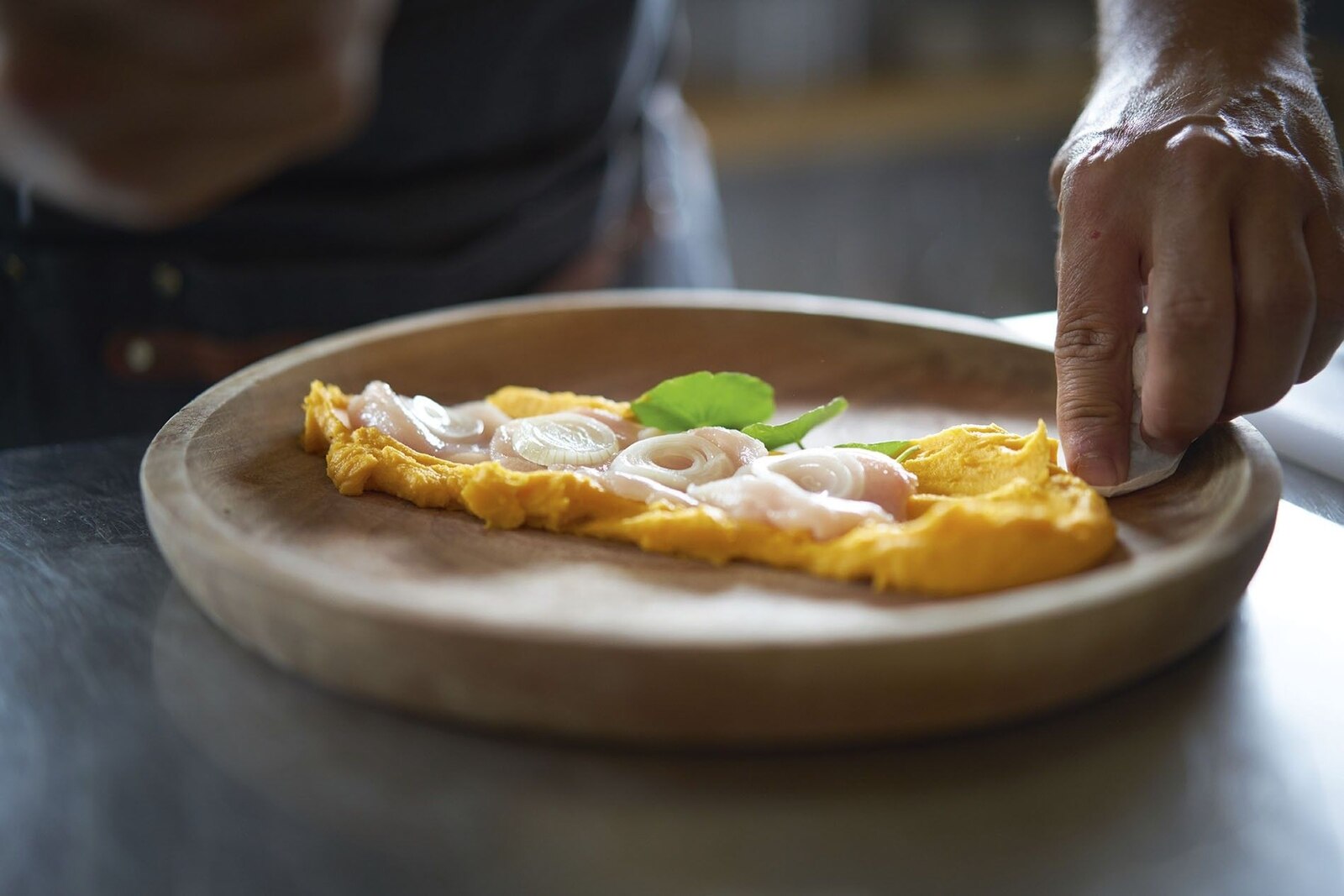
The food is not presented as ethnography plated unchanged. Bonilla’s menus put ancestral preparations through his own restaurant vocabulary and his training abroad.[2][4] A smoked palm-heart pâté appears with corn meatballs; fermented pejibaye accompanies white fish cured in banana vinegar; the menu draws on Nicoya oysters, Guanacaste corn, and Central Valley fruit.[4] The current 50 Best description adds hand-eaten oysters with cashew chile, pujagua toast, and charcoal-grilled beef.[1]
The pleasure matters. Smoke should cling to the palm heart; corn should crack; vinegar should make the fish feel brighter rather than merely more instructive. A restaurant that serves a lecture with indifferent food has not honored a technique. It has made the diner pay attention to the chef’s virtue.
But deliciousness does not cancel attribution. A careful translation keeps at least three layers in view: who maintained the knowledge, who produced the ingredient, and what the restaurant changed. Natalia taught the tamal; a producer grew or processed the corn; Bonilla’s kitchen decided its place, proportion, pacing, and service. Calling all three acts “the chef’s creativity” would turn collaboration back into extraction.
This is where the word outsider earns its place. It lets Sikwa be inventive without pretending to be origin. The restaurant’s authorship lies in selection, interpretation, purchasing, and hospitality—not in retroactively owning the culture that made those acts possible.
Does fairer sourcing make the meal expensive?
It makes the price explainable, which is not the same thing as making every claim verifiable.
In a 2022 interview with Costa Rica’s El Financiero, Bonilla said Sikwa had once sourced roughly 85 percent of what it used from Indigenous communities, before pandemic disruptions pushed some growers out of production. He also described paying a cacao producer’s stated price rather than a much lower commodity offer and rejected the idea that a ranking alone justified raising menu prices.[5] Those are Bonilla’s reported statements, not independently inspected invoices, and the sourcing share was explicitly historical rather than current.
Still, the mechanism is concrete. A dish costs more when a producer sets a viable price, when a crop travels a difficult route, when the kitchen spends time developing a preparation, and when cooks execute it in service. That is a better account of value than charging for the glow of a list. The current 50 Best listing’s US$52 average is useful context, but it cannot tell a reader what any producer receives or whether the arrangement is durable.[1]
The honest answer is therefore double. Yes, Sikwa has publicly connected its price to labor, development, and producer terms. No, a diner should not treat the bill—or an award—as certification that every exchange is equitable. Transparency has to keep moving from story to names, terms, repeat orders, and alternative buyers.
What would success look like beyond one celebrated room?
The word “outsider” would remain necessary, while the restaurant became less central.
Sikwa’s rise from a 12-seat space to a larger Los Yoses house, and from a research project to No. 43 in Latin America, has already changed who sees Costa Rican food as worthy of a serious restaurant.[1][4] Yet rankings are the least interesting endpoint. The stronger outcome would be more Indigenous producers selling nearer home and to several buyers; more Costa Rican cooks learning the country’s many food traditions without compressing them into one national brand; and more named teachers able to decide what travels, what changes, and what stays within a community.
Fine dining is good at focusing attention. It is less reliable at giving attention away. Sikwa is compelling because its best ideas point beyond the dining room: the producer introduced to another chef, the teacher whose name stays attached to a tamal, the restaurant name that refuses to become a certificate of belonging.
So the title above the door should never graduate from outsider to owner. It should become a more demanding job description. Listen long enough to be corrected. Pay enough for production to continue. Make the translation delicious. Keep the source visible. Then use prestige to widen the table rather than claim its head.
Sources
- 50 Best Discovery, “Sikwa” — current San José restaurant entry covering its 2014 research origins, 2018 opening, 2025 ranking, producer-network claim, representative dishes, schedule, location, and average spend.
- Ella Buchan, “Forging new culinary traditions in San José, Costa Rica,” National Geographic Traveller, updated May 12, 2023 — reported visit covering Bonilla’s community research, restaurant aims, and the Sean & Genna Davis portrait used as the cover image.
- Katherine Stanley Obando, “Una cocina que libera: las raíces de la gastronomía costarricense y sus productores,” El Colectivo 506, May 6, 2022 — local Spanish-language reporting centered on Bribrí producer Leonardo Buitraga, researcher Alí García Segura, market access, travel time, and the meaning of Sikwa’s name.
- Corina Briceño, “Pablo Bonilla, el cocinero que pone en valor la gastronomía de Costa Rica,” 7 Caníbales, March 26, 2024 — interview-profile covering the move to Los Yoses, Bonilla’s outsider position, named teacher Natalia, representative dishes, and restaurant development.
- Francisco Ruiz León, “Pablo Bonilla, chef propietario de Sikwa: ‘Habrá quien suba los precios porque entró en una lista, yo no’,” El Financiero, November 25, 2022 — direct Q&A on restaurant economics, pre-pandemic sourcing share, producer-set cacao pricing, menu development, and the limits of awards as price signals.