There are easier ways to build a luxury restaurant around Chinese cuisine in Tokyo. One option is replication: import the signals of grand Chinese dining as faithfully as possible and let prestige do the work. Another is fusion shorthand: loosen the cuisine into a cosmopolitan blur and call the result contemporary. Sazenka matters because it refuses both shortcuts. The restaurant's core promise is harder and more interesting. It treats Chinese cooking in Japan as an act of translation, with Chinese structure and technique moving through Japanese ingredients, Japanese spatial discipline, and a tea program that is not decorative but central to how the meal is read.[1][5][6][7]
That promise is visible in the public record, not just in romantic restaurant talk. The official concept page frames the house through wakon kansai, the old phrase for Japanese spirit joined to Chinese learning, then turns it into a culinary brief: the chef aims to draw out both the bold deliciousness associated with Chinese cooking and the deeper, quieter savor associated with Japanese cooking, using Japanese ingredients and sensibility to create a new expression of Chinese cuisine.[1] The chef page fills in the timeline: Sazenka opened in February 2017, won two Michelin stars in the Tokyo 2018 guide, and reached three stars in the Tokyo 2021 guide, while also entering Asia's 50 Best in 2019 and climbing as high as No. 11 in 2022.[2] The current 50 Best Discovery profile places it at No. 21 in Asia's 50 Best Restaurants 2026.[5] Put bluntly, this is no longer an intriguing experiment. It is an established model.
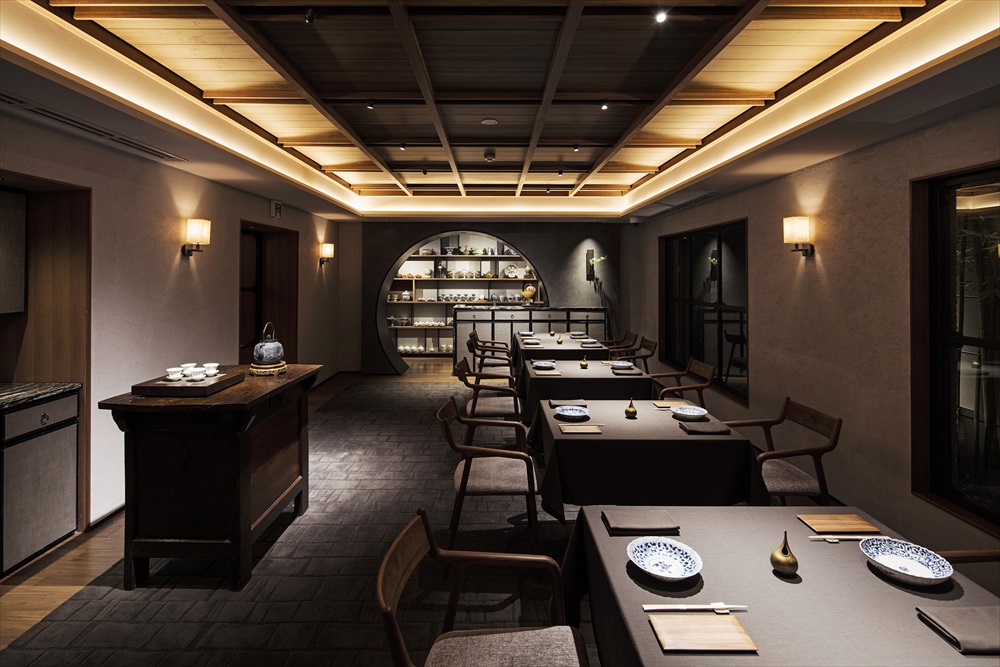
Image context: the lead image uses Sazenka's official dining-room photography rather than a plated dish because the restaurant's argument is not only on the plate. The room itself matters. Sazenka is trying to make Chinese luxury feel intimate, measured, and translated through Tokyo rather than imported whole from somewhere else.[3][5]
Wakon kansai is not branding copy. It is the kitchen rule.
The most useful way to read Sazenka is to take the house philosophy literally. On the concept page, wakon kansai is not presented as vague East Asian harmony. It is defined through a working kitchen problem: how to draw out Chinese cuisine's force while adapting it to Japanese ingredients, climate, and taste, then send that result back into the world as something coherent rather than imitative.[1] Savor Japan's interview with Tomoya Kawada clarifies why this mattered to him. After training in Chinese cuisine and traveling in China, he concluded that simply duplicating Chinese dishes in Japan left something unresolved because Japanese ingredients behaved differently; learning Japanese cuisine at Ryugin taught him more exact treatment of product, temperature, stock clarity, and forms of grilling that could make domestic ingredients speak with greater vividness.[7]
That distinction matters because Sazenka is easy to misread as a fusion restaurant, and Kawada explicitly pushes against that reading. In the same interview, he says his goal is not to merge Japanese and Chinese cuisines into a hybrid genre, but to advance Chinese cuisine with Japanese elements.[7] That is a narrower, more demanding ambition. It asks the kitchen to remain answerable to Chinese culinary form while changing the ingredient logic and the sensory finish. You can see the result in the dishes that recur across the public descriptions: pheasant wonton soup, jellyfish salad, spring rolls filled with seasonal seafood, and other preparations that keep recognizable Chinese shapes while shifting the emotional center toward Japanese product precision and restraint.[5][6][7]
The chef page suggests the same story through career sequence. Kawada did not start in Japanese cuisine and add Chinese technique later for novelty value. He came up through Chinese cooking, then deliberately moved into Japanese fine dining before opening Sazenka in 2017.[2] That ordering is important. Sazenka is not using China as an accent on a Japanese base. It is using Japanese discipline to reopen what Chinese luxury can feel like in Tokyo.
The room makes the translation legible before the first course lands
Sazenka's dining room is part of the argument, not a neutral container. The official information page says the restaurant occupies a renovated embassy residence and keeps the scale intentionally tight: a 14-seat main dining room on the first floor, plus small private rooms for 4, 4, and 6 guests.[3] The neighborhood details help too. Minami-Azabu is lined with embassies, and the restaurant sits within walking or short taxi distance of Hiroo, Shirokane-Takanawa, Azabu-Juban, Roppongi, and Ebisu.[3] The 50 Best Discovery profile describes guests being welcomed in Japanese, Chinese, English, or French before being led into a former diplomatic building shaped by polished wood, light, and shadow.[5]
Those details explain why Sazenka does not read like a maximalist luxury room. There is porcelain, there are woven steamers, and there is obvious formality, but the dominant impression is compression rather than expansion.[5] The point is not to overwhelm diners with abundance. The point is to slow their attention enough that the cuisine's translated grammar becomes believable. Even the house notes on dress, scent, and smoking imply the same thing. Smart casual is recommended, perfume is discouraged so aromas can register fully, and the environment is protected from smoke inside and outside the property.[3] Sazenka is building a controlled airspace for subtlety.
That controlled airspace is one reason the restaurant feels so distinctly Tokyo without surrendering its Chinese base. Tokyo dining at the highest level often communicates seriousness through editing: small rooms, quiet surfaces, precision of timing, and an aversion to wasteful noise. Sazenka borrows that spatial ethic, then asks Chinese cuisine to move inside it. The result, at least in the public materials, is not opulence made louder. It is opulence made calmer.
Tea is a parallel reading of the meal, not a side lane for non-drinkers
The strongest sign that Sazenka is selling translation rather than generic luxury is its tea program. The CHAGOCORO interview is especially revealing because it does not treat tea as an add-on. Kawada says he built tea pairings partly because he is not a big drinker himself and wanted a non-alcoholic route that could satisfy every guest, then describes using eight to ten tea varieties brewed through different temperatures and methods.[6] Most are Chinese teas, but he intentionally keeps a smaller number of Japanese teas in the sequence so their umami and sweetness can arrive with greater force.[6]
That design turns tea into a second interpretive track. CHAGOCORO gives concrete pairings: an ice-brewed Kyoto gyokuro with dressed jellyfish and a sparkling Dongfang Meiren alongside clam and butterbur-sprout spring roll.[6] Savor Japan adds that the restaurant stocks around thirty Chinese teas and offers a mix pairing course so guests can move between tea and alcohol rather than choosing one camp.[7] On the 50 Best Discovery page, diners are encouraged to pair signature dishes with wine, tea, or both.[5] The consistency across those sources matters. Tea is not a charming flourish placed at the edge of the experience. It is part of the restaurant's actual grammar of hospitality.
CHAGOCORO also supplies a more personal layer. Kawada says tea became central to him when he was young, and later, during a period of illness brought on by overwork, tea was one of the few things he could still take in; he even says tea "saved" his life and that the first character in the restaurant's name reflects that importance.[6] That makes the tea program feel less like brand differentiation and more like a deep organizing belief. In practical terms, it also helps explain why Sazenka's luxury does not depend on Bordeaux or Burgundy as its final credential. The house can validate itself through a different liquid intelligence.
Why Sazenka matters in 2026
The simplest answer is that the restaurant's early thesis has matured into durable form. The chef page shows a rapid climb from opening in 2017 to three Michelin stars by the Tokyo 2021 guide, while 50 Best Discovery still places Sazenka firmly inside the Asian top tier in 2026.[2][5] The reservation system suggests the same seriousness in operational terms. The official reservation page says bookings open on the first day of each month for dates through the end of the second month ahead, and it spells out real cancellation penalties for small and large parties, with sharper charges inside the final days before service.[4] This is not a loose salon trading on reputation. It is a tightly managed dinner economy.
The service window reinforces that impression. The information page lists dinner service with 16:00 open and 19:30 last in, alongside irregular closing days and careful logistical notes about access and accessibility.[3] A room this small, with this much attention given to tea, porcelain, scent, and pace, cannot survive on casual volume. It survives by making each table legible to itself. That is why Sazenka feels current. In 2026, a lot of high-end dining still confuses luxury with escalation: bigger sourcing claims, louder scarcity language, more imported labels, more obvious spectacle. Sazenka's public case is subtler. It argues that the highest-value thing a restaurant can sell is not replication or excess, but a complete translation of one culinary tradition into another place's ingredients, room habits, and forms of calm.[1][3][5][6][7]
That is what makes the restaurant worth profiling now. Sazenka does not flatten Chinese cuisine into Tokyo polish, and it does not use Japanese ingredients as exotic garnish on a Chinese template. It keeps Chinese technique and hospitality ambition in view, then rewrites their delivery through Japanese product care, tea intelligence, and room-scale quiet. The luxury on offer is not import prestige. It is the feeling that every part of the house knows what has been translated, and why.
Sources
- Sazenka, "Concept" - official statement of wakon kansai, the restaurant's aim to combine Chinese culinary force with Japanese ingredients, sensibility, and hospitality.
- Sazenka, "Chef" - official career timeline for Tomoya Kawada, including the restaurant's 2017 opening, Michelin milestones, and Asia's 50 Best rankings.
- Sazenka, "Information" - official dining-room scale, access details, service window, dress and scent guidance, and note that the restaurant occupies a renovated embassy residence.
- Sazenka, "Reservation" - official booking-release cadence and cancellation policy.
- 50 Best Discovery, "Sazenka" - 2026 ranking, multilingual service note, former diplomatic-building setting, signature dishes, and wine-or-tea pairing framing.
- CHAGOCORO, "The vital power of tea, and Chinese restaurant Sazenka's simple yet profound tea pairings (1st half)" - interview on tea pairings, tea's role in the restaurant's name, and concrete tea-dish examples.
- SAVOR JAPAN, "Innovating Chinese Cuisine with the Japanese Spirit" - interview on why Kawada studied Japanese cuisine, how he defines wakon kansai, and why tea pairing became a core lane at Sazenka.