French fine dining has always had an appetite problem. It knows how to celebrate excess, but it also attracts diners who want control, renewal, and the feeling of leaving the table sharpened rather than defeated. Michel Guérard became important because he stopped treating those desires as enemies. When he moved to Eugénie-les-Bains in 1974, he was not downgrading from haute cuisine into clinic food. He was using a spa town to ask whether luxury could become lighter without losing its glamour, pleasure, or technical seriousness.[1][3]
That question produced cuisine minceur, and the phrase still gets flattened too quickly into "diet food." The historical record suggests something more interesting. Les Prés d'Eugénie's own history says Guérard invented Grande Cuisine Minceur while watching slimming customers eat, then won rapid international attention for it.[1] The official healthy-and-slimming-cuisine page, meanwhile, describes a system built on product quality, nutritional balance, and a daily structure of 1,400 to 1,500 calories that still includes dessert.[2] The move was not simply subtraction. It was a redesign of what counted as luxury.
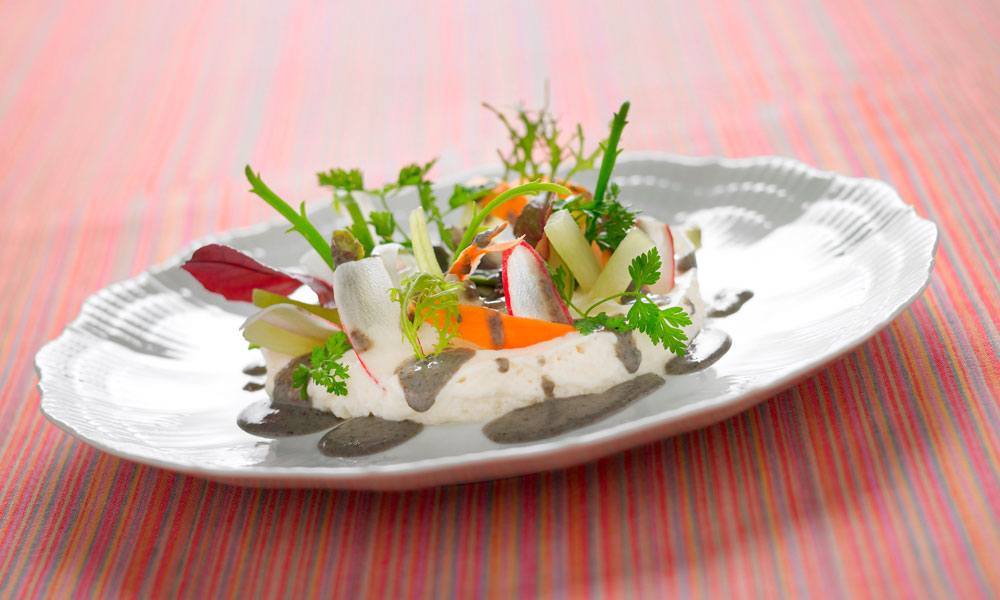
Image context: the lead image uses an official Les Prés d'Eugénie dish photograph rather than a portrait or dining-room interior. That choice matches the article's argument. Guérard's real innovation was not branding wellness around fine dining from the outside. It was rebuilding the plate itself so elegance could come from restraint, freshness, and exact seasoning rather than the old theater of butter, flour, and starch-heavy abundance.[2]
From Le Pot-au-Feu to the spa table
Guérard did not arrive in Eugénie as a health evangelist from nowhere. The 1975 New Yorker profile by Joseph Wechsberg shows him already established as an ambitious and technically formidable chef whose modest bistro, Le Pot-au-Feu in Asnières, had become a destination; the piece even reports that Michelin had unofficially indicated the restaurant could have become the guide's first three-star bistro had it not closed.[3] In other words, Guérard had classical credibility before he began talking about lightness. That matters, because cuisine minceur carried authority precisely because it came from a chef who had already proved he could cook in the old language.
The move to Eugénie changed the setting and therefore the problem. Les Prés d'Eugénie's history page says that in 1974 Guérard left his Michelin-starred bistro for the spa property, renamed it, and started inventing Grande Cuisine Minceur while observing slimming clients.[1] That sentence is the hinge in the whole story. A spa guest does not approach dinner like a diner entering a Paris temple of excess. Appetite, recovery, vanity, health, and ritual all arrive at the table together. Guérard seems to have understood that this was not a restriction to work around but a new audience condition to write for. He could compose meals for people who still wanted ceremony and pleasure, yet could no longer accept heaviness as the unquestioned sign of seriousness.
The speed of the recognition tells you how radical the synthesis looked at the time. The same official history says Michelin gave Guérard one star in 1974, two in 1975, and three in 1977 at Eugénie.[1] The ascent was fast because the idea was new: spa discipline and grand restaurant ambition had been brought under one roof without either one dissolving into parody.
Lightness became technique, not apology
What made cuisine minceur durable was that Guérard refused to write it as punishment. The official page does not speak the language of guilt, denial, or corrective austerity.[2] It speaks instead about high-quality produce from local growers, balanced proteins, complex carbohydrates, intact fatty acids, fiber, vitamins, and trace elements, then insists on "the delight of an outstanding meal" with dessert still present.[2] Read carefully, that list amounts to a different theory of fine dining. Pleasure is still required. It just has to be delivered through concentration rather than bulk, through precision rather than saturation.
The New Yorker saw that change in real time. Wechsberg described cuisine minceur as an assault on calories and cholesterol, but the article's broader point is that Guérard was not stripping classic cuisine down to hospital rations.[3] He was reinventing classic dishes so they stayed delicate, exact, and elegant while shedding the overburdened richness that had come to define prestige dining for an earlier era.[3] That is why the phrase "diet cuisine" misses the point. A true diet menu asks the diner to suspend desire for the sake of compliance. Guérard was after something much more difficult: keeping desire alive while changing the terms on which it was satisfied.
This is where the lineage becomes visible. A great deal of contemporary fine dining still sells lightness, but often as mood or marketing: wellness teas, vegetable language, broth clarity, anti-bloat menus, "clean" luxury. Guérard's version was harder because it demanded that the cooking itself do the translation. Sauces had to become more exact. Garnishes had to earn their place. Texture had to carry satisfaction once the old weight of cream and flour retreated. The plate had to look fully composed, not medically compromised.[2][3]
Why the legacy still feels modern
The most revealing part of Guérard's afterlife is that the house still reads like his argument. Michelin's current page for Les Prés d'Eugénie - Michel Guérard describes the cooking as marked by a "naturalist" DNA, an omnipresent lightness of touch, and a precise ability to marry diverse flavors like an orchestra under direction.[4] Gault&Millau's 2024 obituary puts the point in a more social register, saying that at Prés d'Eugénie he deployed a genius for "luxurious yet popular cuisine."[5] Those two descriptions belong together. Michelin names the formal result on the plate; Gault&Millau names the cultural trick. Guérard made refinement feel airy and welcoming at the same time.
That helps explain why he matters beyond his own generation of nouvelle cuisine. Plenty of chefs made food more modern. Guérard did something narrower and, in the long run, stranger. He showed that health pressure did not have to arrive in a grand restaurant as shame, medical jargon, or flavorless virtue. It could arrive as sequencing, proportion, broth, herbs, vegetables, and room-temperature confidence.[2][3][4] That is a template the restaurant world still uses whenever it wants to promise pleasure with a lighter footprint, whether the menu is framed through longevity, seasonality, recovery, or simply the contemporary diner's fear of post-meal exhaustion.
In that sense, cuisine minceur belongs in fine-dining history not as a side branch for spa guests but as a change in the main line. Guérard kept the choreography of occasion, the beauty of the plate, and the seriousness of the craft. He simply reassigned where luxury lived. Less in the visible weight of the dish, more in the intelligence of composition.[1][2][4][5]
What Guérard really passed down
The easiest way to honor Michel Guérard is to call him a pioneer of healthy haute cuisine, but that phrase is still too blunt for what he actually changed. He gave fine dining a way to talk to diners who wanted both delight and limits. He accepted the spa as part of the dining room's reality, then refused to let that reality flatten the meal into duty.[1][2] The result was a form of hospitality that could count, calibrate, and still seduce.
That is why the lineage keeps extending. Every time a serious restaurant tries to feel lucid rather than punishing, every time it treats a light sauce or a vegetable-led course as something luxurious rather than compensatory, it is moving through a door Guérard helped open.[2][3][4] His great lesson was not that fine dining should become thin. It was that lightness, handled properly, could be as opulent as any grand tradition it replaced.
Sources
- Les Prés d'Eugénie, "The History" - Guérard's 1974 move to Eugénie, the invention of Grande Cuisine Minceur, and the 1974-1977 Michelin ascent.
- Les Prés d'Eugénie, "Healthy & Slimming Cuisine" - 1975 origin, product principles, 1,400-1,500 daily calories, and the insistence that dessert still belongs inside the system.
- Joseph Wechsberg, "La Nature Des Choses." The New Yorker, July 21, 1975 - period account of Le Pot-au-Feu, cuisine minceur, and Guérard's effort to make lightness gastronomically serious.
- MICHELIN Guide, "Les Prés d'Eugénie - Michel Guérard - Eugénie-les-Bains - a MICHELIN Guide Restaurant" - current Michelin framing of the house's naturalist cuisine, lightness, and precision.
- Gault&Millau, "Chef Michel Guérard, five toques, has died" - obituary framing of Guérard as a pioneer of nouvelle cuisine and the author of a luxurious yet popular style at Prés d'Eugénie.