The easiest way to flatten Restaurant SAN is to call it Seoul's Benu effect. The résumé invites that shortcut. Chef Jo Seung-hyun trained at The French Laundry and La Maison Troisgros, then spent eight years as chef de cuisine at Benu in San Francisco before returning to Korea to open SAN in 2024.[1][2][4] But SAN gets more interesting when you stop treating those years as imported prestige and start reading them as structure. The lineage that matters here is not a copy-and-paste of someone else's menu. It is a return route: French rigor, Benu discipline, Korean memory.
As of May 13, 2026, SAN's own site presents that return in unusually plain operational terms. The restaurant offers one fixed tasting menu at KRW 350,000, asks guests to plan three hours, runs dinner Tuesday through Saturday and lunch Friday through Saturday, and opens reservations at 10 AM KST on the 15th of each month through Catchtable.[1] Those details may sound administrative, but they tell you what kind of house SAN wants to be. This is not a loose chef's-counter experiment trading on biography. It is a deliberately built restaurant.
That institutional reading is reinforced by two outside signals. In February 2026, 50 Best framed SAN as one of Asia's hottest new restaurants and centered Jo's move back to Seoul after running Benu's kitchen for eight years.[2] The MICHELIN Guide's current listing describes SAN as creative modern cuisine in which seasonal ingredients are sharpened by sauces and balance, then points to dishes such as lobster jeotgal with chamoe dongchimi, milmyeon, and dweji-gukbap as examples of how the chef interprets Korean flavors through a more rarefied fine-dining structure.[3] That is the key. SAN is not trying to hide where it came from, but it is no longer cooking in San Francisco's accent.
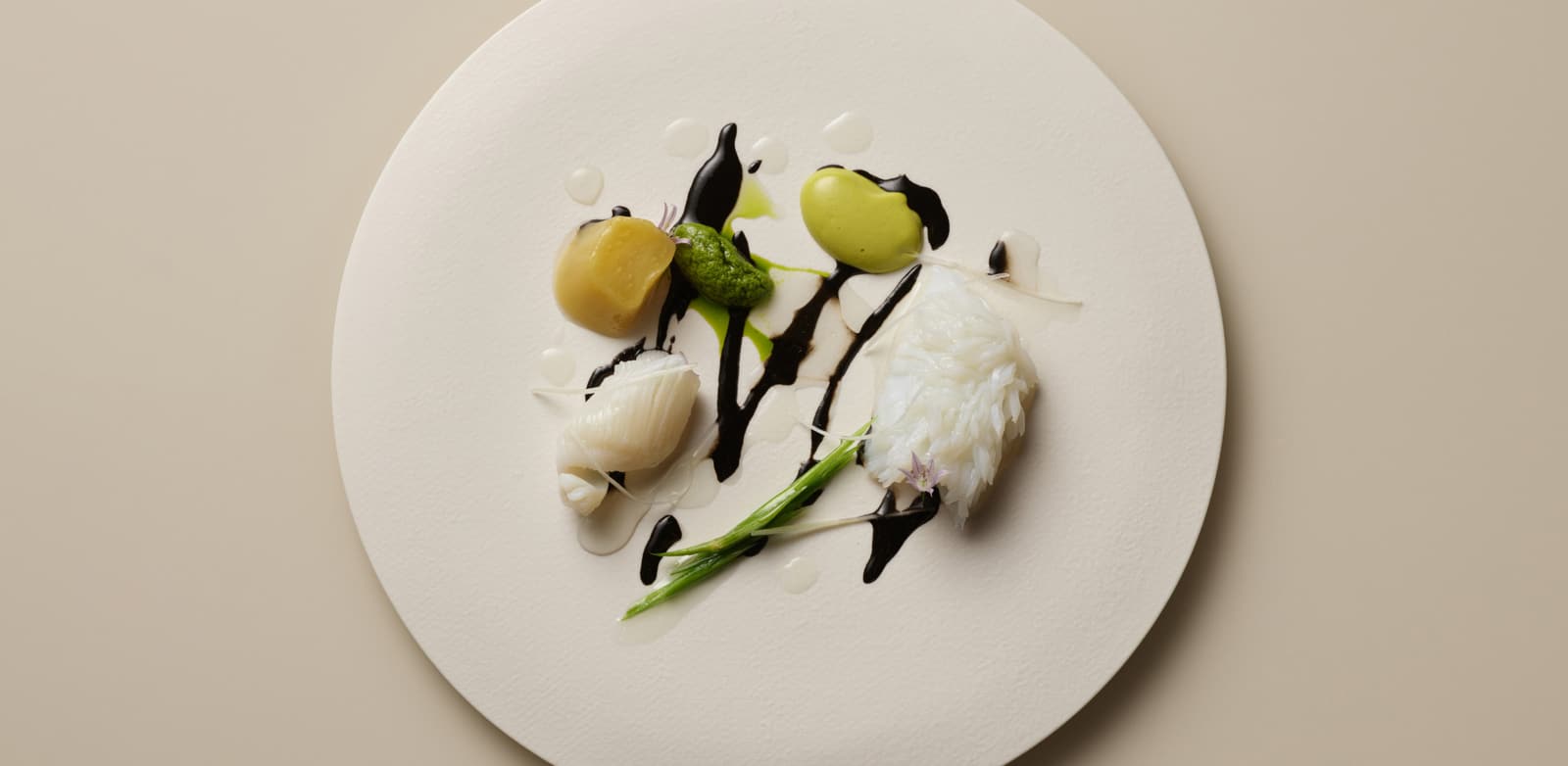
Image context: the lead photograph is not an exterior portrait or a dining-room mood shot. It is an official SAN dish image, and that matters because this article is about a lineage becoming visible on the plate. You can see the house style immediately: clean spacing, disciplined sauce work, and luxury that prefers controlled emphasis over theatrical excess.[6]
1. Benu gave SAN discipline, not identity
Benu matters in this story because it supplied Jo with a serious systems education. SAN's official team page says he led the kitchen brigade there for eight years.[1] Benu's own site still describes the restaurant as a San Francisco destination, notes that it opened in 2010, and states that it became the first San Francisco restaurant to receive three Michelin stars in 2014.[4] In other words, Jo did not pass through an obscure apprenticeship. He spent nearly a decade inside one of the most exacting service-and-execution environments in American fine dining.
Still, SAN's significance begins where straightforward inheritance ends. If Jo had simply reproduced Benu's prestige codes in Seoul, the result might have been technically impressive and culturally thinner. The more useful reading is that Benu trained his sense of compression: how to stage a menu, how to keep a kitchen precise, how to make luxury feel intentional rather than swollen. Those are transferable skills.[1][2][4] Identity had to come from somewhere else.
That is why SAN's official wording matters. The site does not present the restaurant as a Korean branch office of a San Francisco success story. It says Jo returned to Korea and opened a restaurant that blends his classical French training with modern Korean influences.[1] The phrasing is modest, but it clarifies the direction of travel. The movement is back toward Korea, not outward from it.
2. The real lineage is a return route through French and Korean time
50 Best's feature sharpens this point. It places SAN inside the recent ascent of New Korean gastronomy, but it also notes that Jo spent time not only at Benu, but at The French Laundry, Piazza Duomo, and Geranium before returning home.[2] SAN's own biography names The French Laundry and La Maison Troisgros.[1] Put together, the route is less about one mentor than about a chain of environments where exactness, pacing, and ingredient hierarchy are treated as fundamentals.
That helps explain why SAN does not read as a restaurant obsessed with announcing innovation at every turn. In the 50 Best profile, Jo emphasizes basics: hot food served hot, service that genuinely satisfies guests, and consistency.[2] That sounds almost conservative until you place it beside the restaurant's public menu framing. SAN offers a fixed seasonal tasting menu rather than a sprawling menu designed to maximize choice.[1] The three-hour time horizon, the single price point, the reservation rhythm, and the quiet dining contract all suggest a restaurant that wants control before it wants surprise.[1]
Control is where lineage becomes visible. French training here does not function mainly as luxury theater. It acts as a stabilizing frame that lets Korean references arrive with more clarity. Jo's career path taught him how to edit. Returning to Seoul gave him something worth editing toward.
3. Michelin's dish examples show where the route turns home
The strongest evidence that SAN is doing more than polished cosmopolitanism sits in the MICHELIN listing's dish language.[3] Lobster jeotgal and chamoe dongchimi already tell you the restaurant is not content to leave Korean ingredients as garnish around an international chassis. But the more revealing examples are milmyeon and dweji-gukbap.[3]
Those are not generic luxury signifiers. They belong to a warmer register of Korean eating memory: broth, noodles, pork, fermentation, comfort, repetition. When a fine-dining restaurant chooses to elevate that vocabulary, the lineage question changes. The point is no longer whether a chef can present luxury ingredients with enough polish. The point becomes whether he can move a comfort language into a tasting-menu grammar without stripping away its force.
This is where the Benu years start to matter in a more precise way. Benu's influence, at least from the outside, is not a list of dishes SAN should imitate. It is a lesson in how to keep cross-cultural cooking from collapsing into noise. Benu's official description still emphasizes a fixed menu, warm service, and a structure built around seafood, vegetables, a few meat courses, and sweets.[4] SAN appears to inherit that respect for sequence and concentration, then redirect it toward Korean seasonal ingredients and Korean dish-memory.[1][3]
If the restaurant has momentum now, it is because this redirection feels deliberate. Even LetSeoul's summary, written for travelers rather than chefs, identifies SAN's hook in similar terms: French technique joined to personal Korean ingredient stories, with the added note that the restaurant won Asia's 50 Best Restaurants' One To Watch Award 2026 just over a year after opening.[5] That kind of phrasing is useful because it captures what sophisticated diners often want from a new restaurant: not novelty in the abstract, but a sense that the chef has found a specific way to bring biography, technique, and place into alignment.
4. SAN's room and operations protect the cooking from overstatement
The MICHELIN listing also points to SAN's atmosphere: subtle lighting, quiet service, and a thoughtful wine pairing.[3] The official site expands the operational side of that calm. There is one tasting menu, one corkage policy, a small private-dining structure, and a reservation system that keeps the flow legible.[1] None of this is glamorous on its own. Together, it does something important. It prevents the restaurant's identity story from becoming louder than the meal.
That restraint matters because SAN's culinary proposition could easily be oversold. "Chef returns from elite Western kitchens to reinterpret Korean cuisine" is a narrative the global dining world already knows how to market. What separates SAN from a thinner version of that story is the sense that the restaurant is trying to become durable, not merely hot. Jo says as much in the 50 Best piece, where he describes SAN as still young and still developing rather than as a finished doctrine.[2]
The restaurant's official materials support that reading. They are strikingly light on manifesto language.[1] Instead of announcing an abstract philosophy in grand terms, they describe a fixed menu, Korean seasonality, and the practical conditions of the guest experience.[1] For a lineage piece, that restraint is evidence. It suggests that SAN wants to earn identity through repetition and refinement, not through one spectacular declaration of self.
What SAN's lineage actually buys
Restaurant SAN matters in 2026 because it clarifies a question that hangs over a lot of internationally trained chefs who return home: what comes back with them besides status? In SAN's case, the answer looks stronger than status alone. Jo brought back a disciplined service grammar, a respect for fixed-menu sequencing, and the habits of a kitchen shaped by elite French and Korean-American fine dining.[1][2][4] He then turned that discipline toward Korean seasonality and toward dishes whose emotional center sits closer to comfort than to imported prestige.[3][5]
That is why SAN should not be read as Benu transplanted to Seoul. The Benu years are real and important, but they function here as a deep technical layer, not as the headline identity.[1][2][4] The headline identity is the return itself: a chef coming home with a sharpened method, then using it to make Korean references feel more exact, more composed, and more durable inside the tasting-menu form.[1][2][3] In lineage terms, SAN's achievement is not imitation. It is translation under pressure, with just enough quiet around the plate for that translation to stay audible.
Sources
- Restaurant SAN - official site with chef biography, fixed-menu details, hours, pricing, and reservation policy.
- 50 Best Stories, "Meet San: Asia's hottest new restaurant" - feature on Jo Seung-hyun's return to Seoul, SAN's development, and the restaurant's One To Watch Award 2026 context.
- MICHELIN Guide, "SAN - Seoul - a MICHELIN Guide Restaurant" - current listing describing SAN's cuisine, atmosphere, and representative dishes such as lobster jeotgal, milmyeon, and dweji-gukbap.
- Benu - official site describing the restaurant's opening in 2010 and its first three Michelin stars in San Francisco in 2014.
- LetSeoul, "Restaurant SAN - Asia's 50 Best Fine Dining" - current travel-facing summary on the restaurant's address, positioning, and One To Watch Award framing.
- Restaurant SAN, official hero image used for this article's cover.