There are easier ways to sell Pelegrini than the one the restaurant actually offers. You can start with the old-town location in Šibenik, on one of the city's oldest streets and right next to St. James Cathedral. You can mention the Michelin star. You can lean on the stone, the Adriatic light, and the usual romance of dining in a historic Dalmatian core.[1][4] None of that is false. It is also not the most interesting thing about the place.
What matters more is that Rudolf Štefan does not treat Dalmatia as a postcard cuisine. He treats it as a layered border cuisine. On the official site, Pelegrini describes itself as a modern interpretation of traditional Dalmatian flavors, with a menu that shifts seasonally according to what is available nearby.[1] The 50 Best Discovery profile makes the same idea more explicit by naming the forces inside that supposedly local cuisine: Turkish and Austro-Hungarian influences, plus the fish, shellfish, meat, and produce of the present-day coast and hinterland.[2] Read together, those two sources describe a restaurant with a sharper ambition than generic regional pride. Pelegrini wants to turn Dalmatia's long traffic of empires, trade routes, and household recipes into something modern without sanding away the old edges.
That is why the restaurant feels worth profiling now. Croatia's fine-dining scene has become easier for outsiders to notice, but it is still often summarized too quickly, as if the whole country were reducible to sea views and polished seafood towers. The broader Dalmatian frame from 50 Best's regional feature argues otherwise. Dalmatia is a tale of land and sea, shaped over time by Venetians, Austrians, French, Russians, Turks, and other passing powers, with local cooks safeguarding inherited dishes even as a younger generation rewrites them.[3] Pelegrini is one of the clearest rooms in Croatia where that history stops being background texture and starts becoming the grammar of dinner.
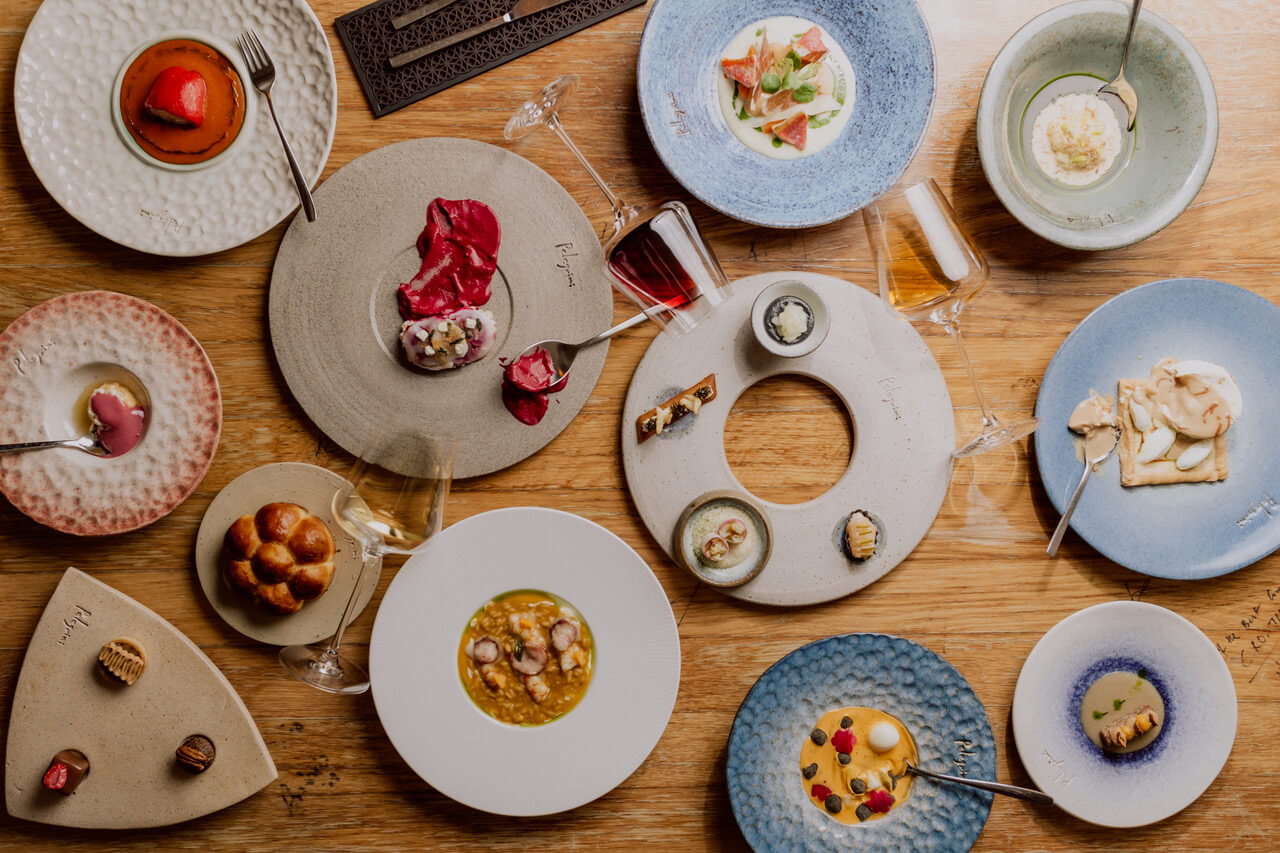
Image context: the lead image uses an official Pelegrini dining photograph rather than a cathedral exterior or a chef portrait. That choice fits this article because the restaurant's argument is cumulative. The point is not one photogenic course by itself, but the way plates, bread, wine, and pacing together make Dalmatian memory feel composed rather than rustic.[5]
1. Rudolf Štefan's house style is not nostalgia. It is old Dalmatian cooking under pressure
Štefan says this directly in his JRE interview. He describes the kitchen as being based on old Dalmatian recipes prepared in a newer and more modern way, and says he draws ideas from the centuries of gastronomic forces that left their traces, recipes, and customs in everyday local cooking.[4] That is a useful correction because it keeps Pelegrini away from two tired traps at once.
The first trap is heritage theater, where a restaurant borrows the authority of grandmothers and village kitchens but delivers only softened luxury cliches. The second is rootless cosmopolitanism, where the room looks contemporary and the plating is precise, yet the local story has been reduced to decorative name-checking. Pelegrini's language suggests a stricter balance. The official site does not promise untouched authenticity; it promises reinterpretation.[1] The JRE interview does not frame the cuisine as invention from nowhere; it frames it as a reworking of an old domestic archive.[4]
That distinction is the core of the restaurant's profile. Pelegrini matters less as a "fine dining restaurant in Croatia" than as a restaurant asking what modern Dalmatian cuisine can sound like when it accepts mixture rather than purity. The word "modern" here is doing real work. It is not merely about plating, or about moving peasant food into a white-tablecloth room. It is about deciding which parts of the old repertoire can survive translation into a contemporary meal without losing their local accent.
2. The restaurant's most interesting ingredient may be Dalmatia's mixed historical palate
The 50 Best Discovery entry gives the cleanest summary of why Pelegrini feels broader than a straightforward seafood address. It says the menu explores the influences that collectively form Dalmatian cuisine, specifically naming Turkish and Austro-Hungarian currents, while grounding the food in local products such as sea snails, scallops, veal, and beef from small producers.[2] That sentence alone expands the field. It reminds you that Dalmatia is not just "Mediterranean" in the soft-focus resort sense. It is Adriatic, Balkan, imperial, pastoral, and mercantile at once.
The regional 50 Best feature helps make that plausible instead of abstract. Its Dalmatia overview describes a coastline shaped by multiple occupiers and travelers, with recipes and produce marked by long contact rather than single-origin purity.[3] Once you read that context back into Pelegrini, the restaurant's project looks less like local-branding duty and more like editing. A chef in Šibenik does not need to invent complexity. The complexity is already there in the region's pantry and memory. The hard part is deciding how much of that history can be made legible on the plate without turning the meal into a lecture.
This is also why Pelegrini's location matters in more than a scenic way. A 14th-century palazzo opposite a cathedral can easily push a restaurant toward dead historicism.[2][4] At Pelegrini, the room seems to do something else. It places a contemporary meal inside a material setting that keeps the city's layers physically present. The old stone is not the subject, but it keeps the food from floating free of place.
3. The local pantry is coastal, but the restaurant refuses to reduce Dalmatia to fish alone
One of the better clues comes from Štefan's answer about his favorite ingredient. He picks mussels, tying them directly to Šibenik's waters and to the Krka river feeding the bay.[4] That answer is revealing because mussels are ordinary in the best sense: abundant, regional, and full of flavor without requiring luxury mythology. They capture the restaurant's strongest instinct, which is to begin with things that belong here rather than with globally portable prestige.
But Pelegrini is not a narrow shellfish shrine. The 50 Best Discovery page makes a point of listing both sea products and inland proteins: sea snails and scallops alongside veal and beef from local producers.[2] The official site reinforces that the menu changes with seasonal availability in the surrounding area, which means the cooking is governed by the actual nearby market rather than by a fixed idealized version of Dalmatia.[1] That is important because it shifts the restaurant away from one-note coastal romance. Dalmatia here is land and sea together, not fish with a nice view.
In practical terms, that produces a more serious kind of regional cooking. Many so-called destination restaurants use local sourcing as an atmosphere layer while still chasing the same international luxury ingredients and the same expected sequence. Pelegrini's language suggests a tougher discipline. If the menu changes with the surrounding season, and if the restaurant truly treats local meat, shellfish, and small producers with respect, then the meal has to respond to what the region can offer rather than to what the category "fine dining" supposedly requires.[1][2]
That pressure is exactly what makes a restaurant profile interesting. Constraint is where authorship becomes visible. Pelegrini seems strongest not when it tries to represent all of Croatia, but when it narrows down to Šibenik Bay shellfish, Dalmatian memory, and the local producers around it, then builds outward from there.
4. Wine and service keep the place from feeling folkloric
The official site includes one detail that matters more than it first appears to: Pelegrini says its love of wine has produced special wine editions created together with winemaker friends, and that service is meant to carry the restaurant's love of gastronomy along with a distinct Dalmatian philosophy of life.[1] That can sound airy if you leave it alone. Read beside the rest of the evidence, it becomes structural.
Restaurants that work from strong regional memory often stumble at one of two points. Either they become museum pieces, treating tradition so reverently that the room stiffens, or they become chef-driven reinterpretation labs that forget hospitality on the way to concept. Pelegrini appears to be aiming for a middle route. The wine emphasis suggests the restaurant understands Dalmatian dining as a table culture, not only a kitchen culture.[1] The 50 Best Discovery profile's note about warm, knowledgeable service points in the same direction.[2] Modern regional cuisine only feels alive if the room can carry it without solemnity.
This may be the quiet reason Pelegrini holds attention. The site keeps returning to sincerity, uniqueness, and taste as king.[1] The dining room may be historically dramatic, but the restaurant's self-description does not read like aristocratic grandeur. It reads like a place trying to keep appetite, conversation, and local memory inside the same frame.
Why Pelegrini matters
The simplest way to describe Pelegrini is that it modernizes Dalmatian cooking. The better way is narrower and more exact. Pelegrini matters because it shows that Dalmatia is already a composite cuisine, and that a contemporary chef does not need to choose between heritage and precision, or between locality and intelligence.[1][2][3][4] He can take the old recipes, the bay's mussels, the inland meats, the cathedral-side stone, the wine friendships, and the region's Ottoman and Habsburg aftertastes, then arrange them into a meal that feels edited rather than embalmed.
That is a stronger achievement than simple scenic dining. Plenty of rooms can give you history as atmosphere. Fewer can make history taste active. Pelegrini's profile, at least from the sources available now, suggests a restaurant doing exactly that: letting Dalmatia arrive not as a postcard, but as a crossroads with appetite.[1][2][3][4]
Sources
- Pelegrini official website - house philosophy, seasonal-menu framing, modern interpretation of Dalmatian flavors, Dalmatian life philosophy, and wine collaborations.
- 50 Best Discovery, "Pelegrini" - profile covering the 14th-century palazzo setting, Turkish and Austro-Hungarian influences in Dalmatian cuisine, local producer sourcing, and service emphasis.
- The World's 50 Best Restaurants, "Taste Croatia: discover 24 of Dalmatia's best restaurants" - regional context on Dalmatia's layered food history and produce system.
- JRE, "Interview with Rudolf Štefan" - chef interview covering Pelegrini's modern Dalmatian style, historical influences, and Šibenik mussels.
- Official Pelegrini image asset used for the lead photograph.