There is a version of top-end French dining that still thinks gravity is the same thing as seriousness. The room is hushed, the gestures are polished, the ingredients are expensive, and by the end of dinner the main memory is weight: heavy curtains, heavy sauces, heavy symbolism, heavy expense. Odette keeps choosing a different route. The useful way to read it in 2026 is not simply as a decorated Singapore institution, but as a restaurant that has made lightness into discipline. Its core claim is that the most luxurious table in the room does not need to feel crowded, monumental, or imperial. It needs to feel exact.[1][2][3][4][5]
That reading starts with the official language around the restaurant itself. Odette's current site describes it as a timeless fine-dining destination inside the National Gallery Singapore, helmed by Julien Royer and inspired by his grandmother, Odette.[1] The Gallery's own live page sharpens the working philosophy: this is a modern French restaurant built on respect for seasonality, terroir, and artisanal produce, with Royer using classic French technique to present ingredients in what the venue calls their purest form and flavour.[4] Michelin's current listing then supplies the outside view. It calls Odette a "priceless jewel" of the Singapore dining scene and praises Royer's use of luxury ingredients, impeccable technique, elegant plating, and a graceful room carried by highly polished service.[5] Put together, those sources suggest a house that is not trying to win by noise. It is trying to win by edit.
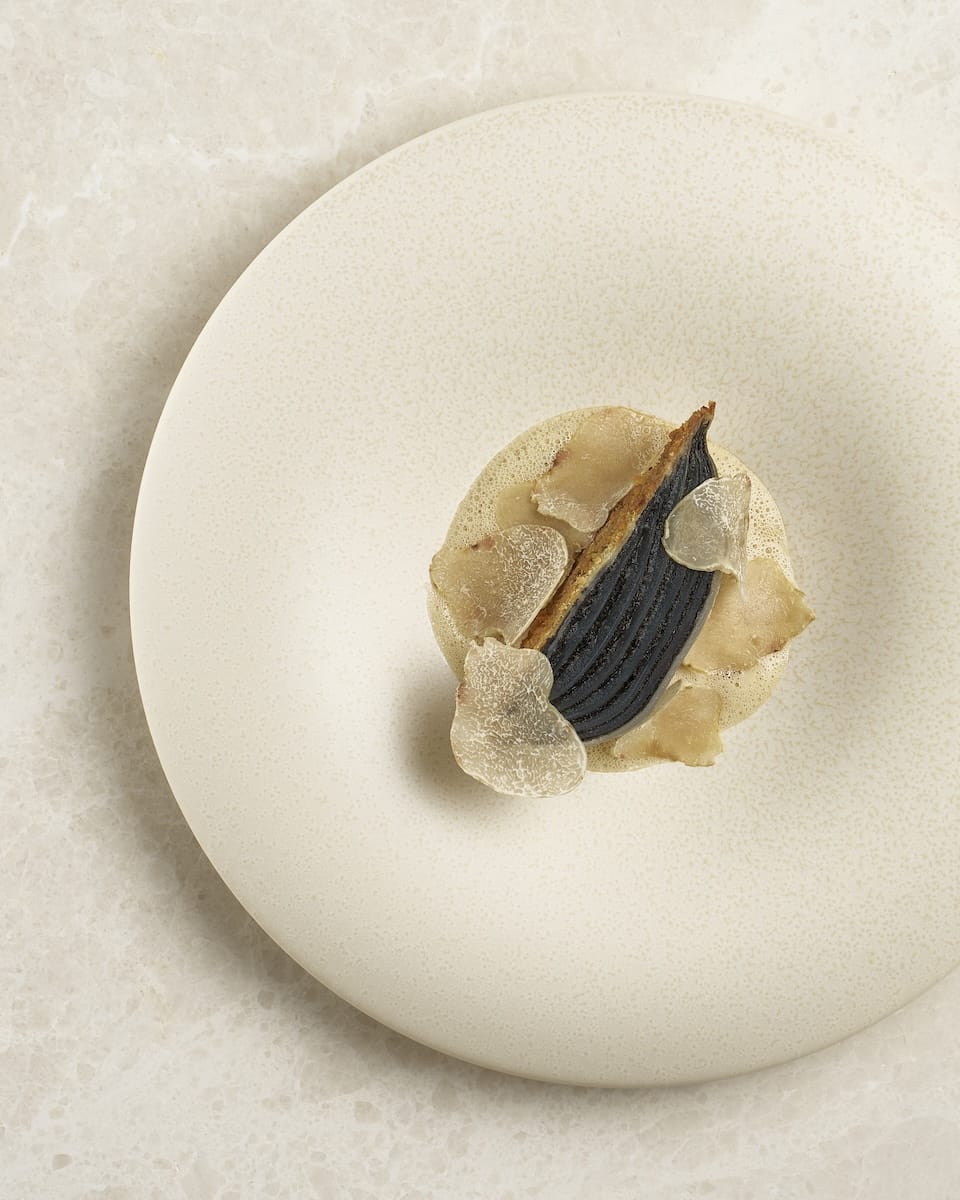
Image context: the lead image uses an official Odette plate photograph rather than the dining room. That choice fits the article because Odette's real signature is not spectacle in the abstract. It is compression. A small central composition on a wide pale field makes the restaurant's argument visible: ingredient intensity is pushed inward, while the surrounding visual space stays calm.[6]
1. The grandmother story matters because it sets the moral scale of the food
Many restaurants mention family as mood music. Odette makes it structural. The current Approach page says Royer owes everything to his family, especially his grandmother, and credits her with showing him "the potential of the purest ingredients."[2] That statement could have stayed sentimental. It does not, because the same page immediately extends the idea into an operating principle: ingredients should be treated with care, their natural character should shine, and every ingredient should have "its place and purpose."[2] That is not nostalgia. It is an editorial rule.
Once you read the restaurant this way, the grandmother tribute stops looking like branding softness and starts looking like a constraint. Odette does not chase luxury by stacking signals. It chases luxury by thinning away anything that interrupts ingredient legibility. Michelin's review of the food helps here. The inspectors do not praise the restaurant for maximalism. They praise the combination of unimpeachable-quality ingredients, creative pairings, careful technique, and exquisite plating.[5] The emphasis falls on control. You can feel the same logic in the image language on the official site, where the food is presented with unusually wide visual breathing room.[1][6]
That restraint is part of why Odette still feels current. In the upper tier of fine dining, "refined" can become code for emotionally cold or conceptually generic. Odette lands elsewhere. Its refinement is not the refusal of feeling. It is the refusal of clutter.
2. Julien Royer's biography explains why the restaurant feels French without feeling sealed off
The second key to Odette is Royer himself. His current chef page is unusually useful because it maps both origin and translation in one movement. Royer is described there as the son of fourth-generation farmers in Cantal, France, a child who grew up foraging and harvesting, and a chef whose years in Asia have infused his French foundation with "a sense of place."[3] That phrase does a lot of work. It explains why Odette does not read like a transplanted Paris room dropped intact into Singapore. It is French in grammar, but not in territorial self-enclosure.
This matters because Singapore has long been one of the places where global luxury dining gets stress-tested hardest. A restaurant cannot rely on imported prestige alone; the city has too much velocity, too much comparison, and too much dining literacy for that. Odette seems to understand that. The Gallery page describes the cuisine through seasonality, terroir, and artisanal sourcing.[4] Royer's page adds the biographical bridge: a French technical base, but with years in Asia shaping how that base is expressed.[3] The result is a restaurant that can remain formally French while still feeling geographically awake.
That is also why the room's quiet works. Silence in fine dining can either feel authoritative or dead. At Odette it works more like concentration. Michelin calls the room understated and graceful.[5] The National Gallery location sharpens that effect further, because the restaurant is not sitting in an anonymous luxury tower. It is placed inside one of Singapore's major civic-art spaces.[1][4][5] The setting does not make Odette into an "art restaurant." It does something more useful. It gives the meal a background of scale and stillness, so the food can stay delicate without disappearing.
3. The National Gallery setting is not backdrop; it is part of the restaurant's grammar
Odette's address matters more than many restaurant addresses do. Michelin specifies the entrance through the former Supreme Court wing's foyer at the National Gallery.[5] The Gallery page repeats the address, confirms the live public-facing service windows, and anchors the restaurant directly inside that institution's circulation.[4] This is more than a pin on a map. It changes how the restaurant's luxury reads.
A hotel restaurant often asks diners to detach from the city and enter a closed world. Odette does nearly the opposite. It places French fine dining inside a civic building devoted to looking, pacing, and attention. That architecture supports the food's clarity. You move into a space already tuned for focus, then sit down to a cuisine built on placement, proportion, and ingredient precision.[2][4] In that sense, the Gallery is not external decoration. It is a silent collaborator.
The official pages make another point quietly visible: Odette's luxury remains artisanal, not merely logistical. The restaurant foregrounds producers, harvest, and ingredient care.[2][4] Royer's biography foregrounds the farming childhood that made those values concrete rather than abstract.[3] Michelin foregrounds execution and service.[5] Each source is describing a different layer, but they lock together cleanly. Odette works because moral vocabulary, technical vocabulary, and spatial vocabulary all point in the same direction.
4. Why Odette still matters in 2026
Odette's continuing relevance therefore has less to do with award accumulation than with its refusal of inflation. It does not need louder theatre to prove distinction. It does not need heavier visual codes to prove seriousness. It does not need to abandon French technique in order to feel contemporary, and it does not need to embalm French technique in order to feel authoritative. Instead, it keeps tightening the same proposition: pure ingredients, exact placement, a room that knows how to stay quiet, and a chef whose French inheritance has been sharpened rather than diluted by Asia.[1][2][3][4][5]
That is a harder achievement than it sounds. Plenty of restaurants can buy luxury ingredients. Far fewer can make them feel inevitable. Odette still can. That is why the restaurant continues to matter. It has turned lightness from an aesthetic preference into a governing method.[2][3][4][5]
Sources
- Odette Restaurant homepage - official framing of the restaurant as a timeless fine-dining destination in National Gallery Singapore, led by Julien Royer and inspired by his grandmother, Odette.
- Odette, "Approach" - official philosophy page on grandmother influence, the purest ingredients, and the idea that every ingredient has its place and purpose.
- Odette, "Chef Julien Royer" - official biography covering Royer's Cantal farming background, years in Asia, and the restaurant's French foundation with a sense of place.
- National Gallery Singapore, "Odette" - current venue page covering cuisine style, seasonality and terroir framing, address, and live public service hours.
- MICHELIN Guide, "Odette - Singapore - a MICHELIN Guide Restaurant" - current listing with the inspectors' description of the National Gallery setting, luxury ingredients, elegant plating, and polished service.
- Odette official image asset used for this article's lead photograph.