Before Hobart's serious dinners begin, part of its food culture is already available over a counter. At 32 Argyle Street, Pigeon Whole Bakers sells sourdough and pastries from a mostly takeaway shop with only a few window seats. In June 2025, Cool Hunting reported that the bakery also supplied bread to acclaimed local restaurants including Fico.[1][4] That report does not establish what Fico serves now, or when a loaf moves between the businesses. It does place a public bakery inside the same dining story as the city's tasting menus.
Fico makes a very different offer. The restaurant publishes the price and length of dinner—nine courses, in a Classic version at A$200 per person or a Gourmand version at A$260—but no sample sequence. At Sonny, certainty shifts again: there are roughly 20 stools, no bookings and no conventional kitchen. A guest can stop for a snack or order most of the short menu, but the venue cannot promise when a seat will clear.[2][3]
These addresses should not be forced into a morning-to-night crawl. They are more revealing as three bargains over choice. At the bakery, the day's work is visible and sold directly. At Fico, the diner chooses a tier and gives the kitchen control of the sequence. At Sonny, arrival is uncertain but ordering and wine service remain conversational. Public selection, booked surrender and queued improvisation coexist in one compact scene.
This is a document-led portrait, not a claim to have visited these rooms or tasted their current food. It draws on venue pages accessed August 22, 2026, recent independent reporting and one older account of the city's supplier constraints. Menus, prices and producer relationships can change. The narrower question is what each venue tells the guest in advance—and who gets to choose when availability changes.
The bakery keeps craft in public
Pigeon Whole has fed Tasmanians since 2011. Discover Tasmania now describes an independent business with 65 employees, a seven-day CBD shop and a seasonal approach to loaves, pastries, sandwiches and coffee.[1] Those numbers complicate the romantic picture of one baker in a tiny room. The retail face is compact; the production and staffing behind it are not.
That difference matters because fine-dining coverage usually begins after a reservation has been made. Pigeon Whole keeps serious craft available without an evening booking or a compulsory sequence. A customer sees what is in the case, buys one item or several and carries the decision away. The shop offers only a few places to sit, but it gives the public direct access to the product rather than asking for faith in an unseen menu.[1]
The reported wholesale relationship with Fico adds a second kind of access, but it needs a date label. Cool Hunting said in 2025 that Pigeon Whole supplied Fico and Templo; neither that article nor the current venue pages document today's contract, the particular bread or its place in service.[4] The useful conclusion is modest: Hobart's bakery culture and its prestige dining rooms were not separate worlds in that reporting. The same bakery sold to the street and into restaurants.
Pigeon Whole also resists a lazy use of the word “small.” A mostly takeaway counter can be physically narrow while belonging to a 65-person operation.[1] The bakery belongs in this fine-dining scene not because it imitates restaurant ceremony, but because it shows how much organized work can remain approachable at the point of sale.
At Fico, buy the form before the food
At 151A Macquarie Street, Fico takes the network's variable inputs and puts them inside a highly legible contract. The official page is unusually blunt: the menu changes every week according to the season, there is no fixed sample menu, and nine courses are the only format. The restaurant calls its style “fun-dining”—casual fine dining in an intimate, convivial room—and lists small producers ranging from Kettering Quail and Weston Farm to Tasmanian Sea Urchin, Felds Farm and Pittwater Oysters.[2][6]
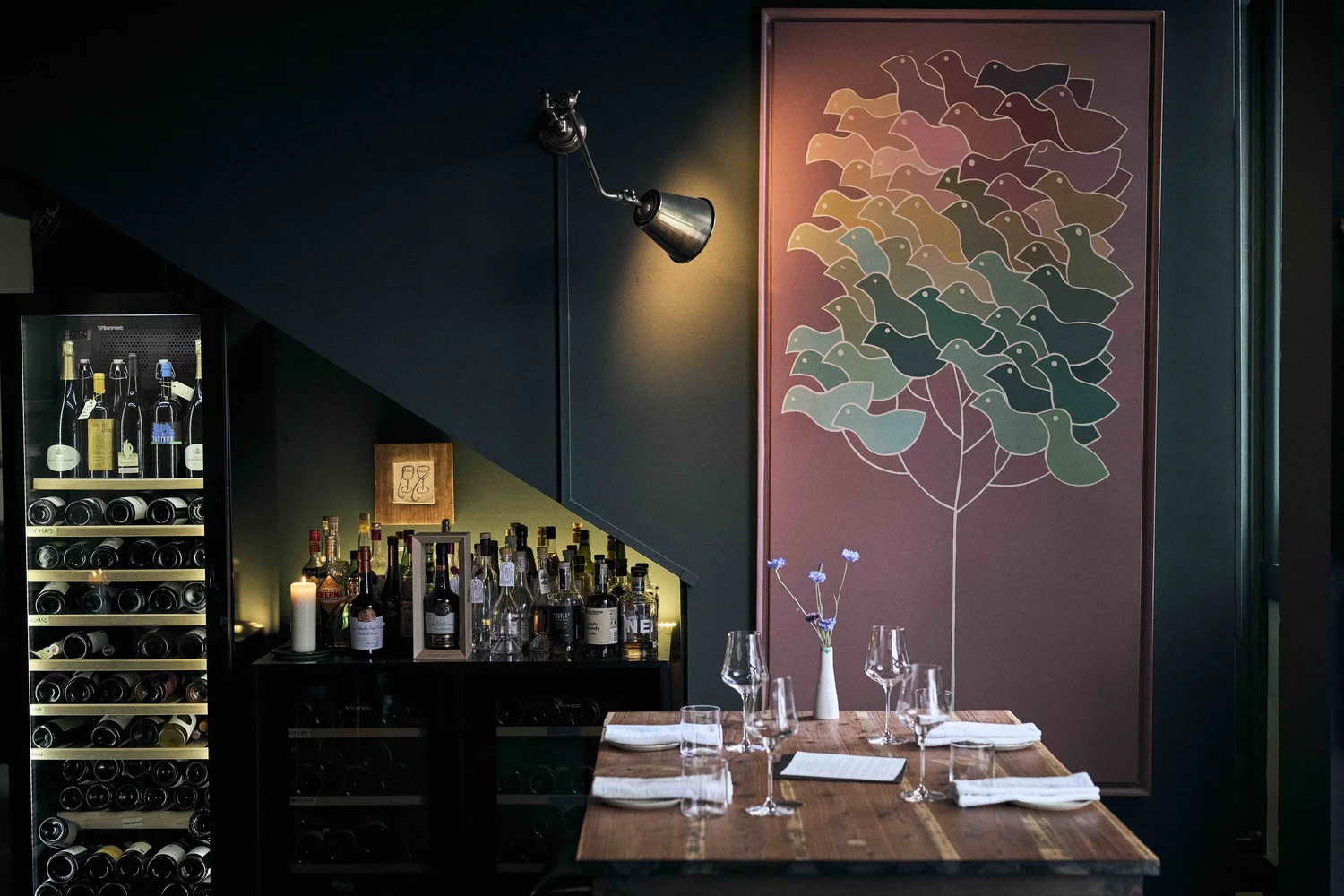
The dining-room photograph on that page makes the social ambition visible. Dark walls and bottle racks could read as solemn, but the timber table, mismatched glassware and enormous flock-like artwork loosen the room. This is not minimalism used to make scarcity look expensive. It is a room trying to make a long meal feel like an invitation.[2]
The fixed menu is more than a culinary statement. It shifts choice from the evening to the moment of booking. Once seated, the guest is not assembling dinner course by course; the kitchen is managing the sequence. Fico can then rewrite that sequence as supply changes. A current restaurant page does not reveal purchasing volumes, waste or margins, so it cannot prove exactly how much operational protection the format provides. What it does establish is simpler: the number of courses stays stable while their contents move.[2]
Classic and Gourmand add one further boundary. They are not two unrelated restaurants hiding under one roof. Fico describes the Gourmand option as adding oysters, caviar, truffle when available and cheese; a 2025 Gourmet Traveller review likewise calls the two versions different “speeds” of the same nine-course idea, with luxury additions on the higher tier.[2][6] The restaurant can therefore vary the degree of extravagance without surrendering the basic choreography.
Fico does not promise the freedom of a broad à la carte list. It asks the diner to buy an authored form rather than known dishes. The website chooses not to publish a sample menu because the food changes weekly; the guest can know the duration, price tiers and luxury additions without knowing the exact sequence.[2] The uncertainty belongs inside a rigid frame.
At Sonny, let the room choose back
Sonny, at 120a Elizabeth Street, makes nearly the reverse bargain. Its official FAQ says the room has about 20 stools—ten at the bar and ten around a few small tables—and operates on walk-ins only because of its size and the limits of its food offering. It has no conventional kitchen. A typical menu may hold oysters, toast, pasta and cheese, changing with producer availability and with the cook working that shift.[3]
Here, limited equipment does not lead to a fixed experience. It leaves room to stop at one snack or to order almost everything and call it dinner. Time Out's October 2025 review describes a queue, a communal central table and staff passing food and wine across it; the venue itself warns that waits are hard to predict.[3][7] Fico secures the time and largely hands the order to the kitchen. Sonny keeps the order and duration more flexible, but makes the start time uncertain.
Once inside, the staff keep interpreting. Sonny's “mystery wine” is chosen from cues supplied by the guest, the food and even the weather; the price is checked if the glass will exceed A$20. The music is vinyl only, complete with pauses to turn or change a record.[3] Neither detail is necessary to feed somebody. Together they reveal a service style built from attention rather than comprehensiveness. The wine list becomes a conversation; the soundtrack admits a human hand.
Those practices make staff judgment visible. A mystery glass depends on listening; a record has to be turned; a wait estimate changes as the room changes. The food range remains narrow, but agency becomes social rather than solitary. A guest chooses partly by asking another person to choose back.
Seasonality changes who gets to choose
In 2017, Gourmet Traveller described Hobart's then-emerging restaurant scene as a product of repurposed small spaces, returning talent and a Tasmanian supply chain rich in variety but constrained by strict seasonality and producers smaller than those on the mainland.[5] That article is a historical snapshot, not a current procurement audit. Its operating question, however, is still visible in the businesses' own current language.
The three current venue accounts give “seasonal” different consequences. Pigeon Whole describes a considered response to changing seasons across bread, pastries, sandwiches and coffee. Fico changes a nine-course menu weekly according to what local growers and distributors can provide. Sonny says its typical oysters-toast-pasta-cheese outline changes when local producers are fruitful or available, and with the skills of the cook working.[1][2][3]
At the bakery, the customer chooses from what has been made. At Fico, the kitchen turns available ingredients into a sequence the guest has agreed not to direct. At Sonny, the night's food and the staff's recommendations are negotiated at close range. The venues do not defeat seasonal variation; they assign the resulting decisions to different people.
The documented links should not be stretched further. Pigeon Whole was reported as a Fico supplier in 2025.[4] Fico and Sonny each publish acknowledgements to small producers, but their pages do not show that the venues are affiliated, buy through one channel or receive the same ingredients at the same time.[2][3] What is visible is not one integrated supply chain. It is a scene unusually willing to name suppliers and explain why a menu cannot remain fixed.
Small formats make their exclusions visible
Smallness is not a moral virtue, and none of these systems is frictionless. Pigeon Whole's few window seats mean that a shop celebrated as communal is mostly a place to carry food away; its 65-person workforce also shows why “small local bakery” can obscure the scale of labor required.[1]
At Fico, certainty has a high admission price. The only route through dinner is nine courses at A$200 or A$260 per person, and the official page says the Gourmand version can accommodate only limited dietary requirements.[2] A fixed sequence gives the kitchen control, but it excludes diners who want a shorter, cheaper or more self-directed meal.
Sonny removes the reservation barrier and creates a waiting barrier. A queue rewards flexibility, but time is not equally disposable. The venue acknowledges unpredictable waits, a limited food range and constraints on some dietary needs; its licence also excludes people under 18.[3] What feels spontaneous to one guest can be inaccessible to a parent, a shift worker or anyone who needs a guaranteed table.
These tradeoffs do not invalidate the venues. They prevent “intimate” from becoming empty praise. Each format asks the guest to absorb a different limit: almost no place to linger, little control over a costly dinner, or no guaranteed start time. The strongest hospitality claim the documents support is not that these limits disappear. It is that the venues state most of them plainly before purchase or arrival.
A neighborhood is not a package deal
Recent criticism shows what these formats have produced without freezing any dish into a current promise. Gourmet Traveller's August 2025 Fico review noted buffalo milk and wild-shot venison in a menu shaped by European skill and Japanese influence.[6] Time Out recorded Sonny serving pasta, toast and crudo around a communal table that October.[7] Those are dated snapshots, not an order list for tonight. They show two different social forms: a long sequence authored in advance, and short plates passed across a bar.
Nor do the three venues add up to a packaged itinerary. Nothing in the sources says a diner should visit them in order, or that they coordinate an experience. Their value as a scene lens lies in the contrast among access models. Pigeon Whole lets the public choose directly from the day's production. Fico asks for confidence in the kitchen's unpublished sequence. Sonny leaves food and wine choice conversational while putting the seat itself in doubt.
Hobart's reliability, in this portrait, does not mean serving the same thing every week. It means being unusually explicit about who chooses when things change. The bakery counter, the nine-course booking and the 20-stool queue each draw that boundary somewhere different. None is universally more generous. Together they make the city's dining ambition legible before the first bite.
Sources
- Discover Tasmania, “Pigeon Whole Bakers” (accessed August 22, 2026) — founding year, workforce, seasonal focus, CBD address, seven-day operation and mostly takeaway format.
- Fico, “Dining at Fico” (accessed August 22, 2026) — nine-course formats and prices, weekly menu changes, sourcing, producer list, “fun-dining” philosophy and source page for the official dining-room photograph.
- Sonny, official FAQ (accessed August 22, 2026) — seat count, walk-in policy, kitchen limits, typical menu, producer availability, mystery-wine service, vinyl policy and access constraints.
- Katie Olsen, “Word of Mouth: Eating and Drinking in Hobart, Tasmania,” Cool Hunting (June 3, 2025) — Pigeon Whole's reported restaurant supply relationship and a recent account of Sonny's queue, menu and wine service.
- Michael Harden, “Hobart's hottest restaurants now,” Gourmet Traveller (December 27, 2017) — historical reporting on repurposed spaces, returning talent, strict seasonality and small-producer supply constraints.
- Gourmet Traveller, “Fico” (August 25, 2025) — dated independent snapshot of the two nine-course tiers, menu influences, ingredients and dining-room character.
- Josie Rozenberg-Clarke, “Sonny,” Time Out (October 7, 2025) — independent review of the 20-seat communal room, walk-in queue, food and mystery-wine service.