The first sound should be a dry tap. Then a fault line runs across the white dome, a server slips a spoon beneath one loosened plate, and the dining room gets a small weather event: hot, herbal vapor rising from something that looked, seconds earlier, like plaster.
Salt-baked whole fish is often sold through that reveal. It deserves the theater. But the trick is not that a kitchen has seasoned one fish with an absurd quantity of salt. The trick is that salt has stopped behaving mainly as seasoning and started behaving as temporary cookware.
Dampen coarse salt, pack it around a whole fish, and heat turns the loose crystals into a rigid shell. Inside, moisture leaving the fish and its aromatics cannot escape as easily as it would from an uncovered roasting tray. The chamber stays humid; the flesh cooks gently; the skin becomes a sacrificial boundary. At the table, the shell must then be opened without undoing everything it protected.[1][2][3]
That chain—build, seal, measure, crack, clear—is the craft. Miss any link and the grand white dome becomes either an expensive way to overcook dinner or a rubble pile that salts the flesh after it leaves the oven.
The crust is a vessel, not a recipe ratio
There is no single sacred formula for the shell. Galton Blackiston's professional salt-baked salmon uses 500 grams of salt and two egg whites around a 2.5-kilogram fish. The whites are whipped and the salt is worked into a stiff, foam-like mass before it is spread down to the foil to make a seal.[1] The Kitchn version takes almost the opposite route: a 2-to-2½-pound fish, three pounds of coarse kosher salt, and only half a cup of water or egg white, mixed until the salt can be packed like wet sand.[2]
Those quantities are not remotely interchangeable, and that is useful. Blackiston is effectively making a light salt meringue over a very large salmon. The second method is building a heavy mineral dome around a smaller round fish. Epicurious records another established pattern—three pounds of salt bound with four whites around a two-to-three-pound snapper or sea bass.[3] The shared principle is not a universal salt-to-fish equation. It is a shell cohesive enough to cover the body without gaps and sturdy enough to come away in controlled pieces.
Water is the minimalist binder: cheap, neutral, and sufficient when the salt's crystal shape packs well. Egg white gives finer salt a stronger network and makes sculpting easier. Neither binder is there to flavor the flesh. Its job is architectural.[2]
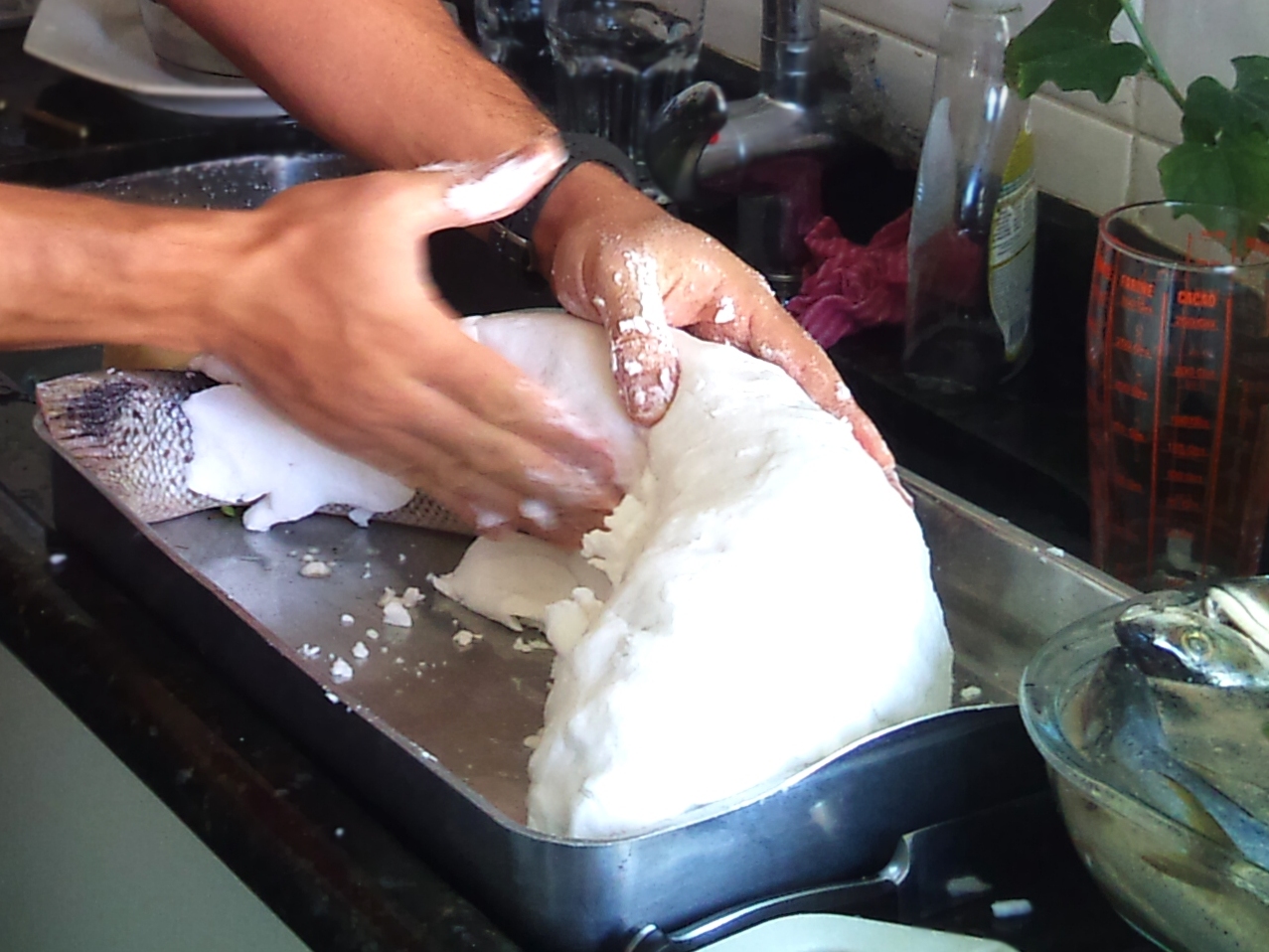
The same is true of thickness. A thin patch is a future vent. A mountain of excess salt adds mass but not necessarily control. The cook wants an even envelope following the fish's shape, with no exposed shoulder or split seam.[1][2] In the cover photograph, hands are pressing that envelope into place before the tray enters the oven. It looks less like seasoning than masonry because, at this stage, masonry is exactly the right mental model.[6]
Salt-baking is not fast curing
The quantity of salt creates an obvious fear: how can the fish emerge tasting of anything else?
The answer begins with time and boundaries. In true dry-salting, salt sits against fish long enough to draw out water; that water dissolves salt into brine, and salt moves into the tissue. The IARC's reference account of salted fish defines the process by substantial salt uptake and explains that the result changes with contact time, temperature, fish thickness, fat content, and other variables.[4] That is preservation or curing. A salt bake is a comparatively short cooking process, and the edible flesh sits behind skin—and, in some versions, scales—while the crust hardens outside.
That does not make the barrier magical. The skin touching the shell can become aggressively salty, which is why the established serving sequence removes it. The Kitchn method deliberately leaves the scales on and discards skin and scales together after baking.[2] The Epicurious version starts with a scaled fish but still removes the skin before service.[3] Those two credible methods disagree about scaling and agree about the important boundary: the salt-contact surface is not the prize.
The distinction also argues for minimizing the interval between packing and baking. Salt plus moisture plus time is the mechanism that moves fish toward curing; there is no magic minute at which a salt crust crosses that line, but building it only when the oven and the rest of service are ready is the prudent inference.[4]
A whole fish supplies its own humid room
Salt crust rewards a whole fish because the body brings its own protective structure. Skin contains the flesh; bones help the fish hold its shape; the cavity creates a sheltered place for lemon, bay, parsley, ginger, lemongrass, or whatever aromatic language the kitchen chooses. As the fish heats, those moist surfaces perfume the enclosed space.[2][3]
What the method does not provide is crisp skin. A humid shell and a crackling exterior are opposing ambitions. If the point of the fish is lacquered scales or brittle, browned skin, choose a pan, grill, or open oven. Salt-baking spends the exterior to protect the flesh. Its ideal texture is succulent and cleanly lifting from the bone, not a compromise that pretends the discarded skin should also crunch.
Nor does the shell rescue indifferent fish. The chamber concentrates what is already inside it. Stale aromatics remain stale; poor cleaning becomes more obvious; a muddy-tasting fish does not acquire nobility because a server arrives with a silver spoon. The spectacle works because the ingredient is simple enough to be exposed once the crust comes off.
Doneness has to be designed before the dome closes
An uncovered fish gives the cook visual information. A salt dome takes it away. There is no browning flesh to inspect and no easy place to press. That makes temperature planning part of construction rather than an afterthought.
The professional methods expose the choice. Blackiston sends a metal skewer through the thickest part after twenty minutes and judges the heat by touch.[1] The Kitchn method pushes a thermometer through the shell and cooks its smaller fish to 135°F, then rests it for five minutes.[2] Epicurious gives a time guide of about 15 minutes per pound and also describes the skewer test.[3] These are working culinary references, not a promise that fish of different shapes, starting temperatures, and species will finish on the same clock.
For home food safety, the UK's Food Standards Agency says fish should be cooked thoroughly: the flesh should turn opaque and separate easily with a fork, and sufficient time at the right temperature is what kills harmful bacteria.[5] A salt shell hides both visual cues until it is removed. That official safety boundary matters more than reproducing a restaurant's softer target without its sourcing and process controls. The useful craft lesson is broader: establish a path into the thickest flesh, avoid bone, follow the safety guidance where you cook, and pack salt snugly around the entry point. The cited methods use an instant-read thermometer or metal skewer; a cook choosing an oven-safe leave-in probe can avoid repeatedly puncturing the shell.[1][2][3]
Both the Kitchn and Epicurious methods prescribe a five-minute rest.[2][3] That pause belongs on the service clock. Neither source supplies an open-ended extra holding window, so a prudent dining room treats additional delay as a doneness risk rather than as free ceremony. Kitchen and server should agree on the reveal before baking begins; a server still finding a trolley after the scheduled rest is not creating suspense but gambling with texture.
The opening is the final cooking technique
A good opening is controlled demolition. Tap until one broad fracture forms. Lift large slabs outward rather than pulverizing the roof. Use a dry brush to clear loose crystals. Peel away the top skin, lift the upper fillet from the frame, remove the spine, then release the lower fillet without dragging it through the salt bed. Both the Kitchn and Epicurious methods make crust removal, brushing or clearing, and skin removal distinct steps for a reason.[2][3]
The cited methods call the opening a centrepiece, invite guests to watch, or bring the fish to the table family-style.[1][2][3] A fine-dining room's most useful translation is controlled spectacle: the server keeps a cooked fish intact while removing an inedible vessel in public. Every movement has a consequence. A hard blow scatters salt; a timid one delays service; a knife angled too deeply tears the fillet. Those are practical service recommendations, not proof that one piece of trolley choreography is universal.
The cleanest service also keeps the sauce quiet. Good olive oil, lemon, or a light herb dressing can sharpen the moist flesh, but a heavy sauce makes the enclosing technique feel redundant. The dome has already supplied concentration and aroma. The finish should reveal that work, not bury it a second time.
The waste has to buy something real
There is no honest way to call a multi-pound crust efficient. The finished shell—whether water- or egg-bound—is service waste, not reusable pantry salt; Blackiston explicitly directs cooks to discard it.[1] A water-bound crust reduces the ingredient list, but not the mineral mass. This is a luxurious technique partly because it converts a cheap staple into single-use equipment.
That cost is defensible only when the salt does jobs worth paying for: it protects a beautiful whole fish, creates a humid aromatic chamber, widens the margin between moist and dry flesh, and gives service a reveal that belongs to the method rather than being pasted onto it. For a Tuesday fillet eaten alone, parchment may achieve much of the moisture control with less mess. For a whole fish shared by a table, the salt shell can turn carving into the meal's central act.[1][3]
The best version therefore ends where it began, with sound. Not a shower of crystals and not applause on command: one tap, one clean crack, then the soft release of steam. The disposable oven has done its work. What remains should taste unmistakably of fish.
Sources
- Great British Chefs, Galton Blackiston, "Salt-baked salmon" (first published 2015) — professional method using a whipped egg-white salt shell, a complete seal, a skewer check, and one-piece crust removal.
- The Kitchn, Amelia Rampe, "How to Salt-Bake a Whole Fish" — tested method covering salt texture, water-versus-egg-white binders, intact scales, full enclosure, probe placement, resting, brushing, and service.
- Epicurious, "Salt-Baked Fish" (January 26, 2012; adapted from Martha Stewart's Cooking School) — an established salt-and-egg-white method, aromatic layering, time and skewer guidance, and skin-removal sequence.
- International Agency for Research on Cancer, "Salted Fish," in Some Naturally Occurring Substances — reference account distinguishing brining, dry-salting, and pickle curing, including water loss, brine formation, salt uptake, and process variables.
- UK Food Standards Agency, "Cooking your food" (updated June 12, 2024) — official home-safety guidance on sufficient cooking time and temperature, plus doneness cues for fish and seafood.
- Wikimedia Commons, "File:Fish in salt crust-01.jpg" — Alberto's real 2010 photograph of a whole fish being covered with its salt mantle, licensed CC BY 2.0 and used as the article image.