The first sip snaps like green apple, then turns stranger: lemon peel, old wood, hay, a little cellar, a prickle of bubbles and a finish so dry it seems to pull the tablecloth tight. Gueuze does not behave like the beer most tasting menus occasionally wheel in as a cheerful change of pace. It behaves like an acid course.
That distinction changes where the glass belongs. Do not park it beside a token bar snack and announce a “beer moment.” Bring it in when the menu needs its edges back—after fried batter, before a brown-butter sauce becomes tiring, alongside an oyster, or at the point where cultured cream and aged cheese threaten to make the evening feel upholstered. Gueuze can cut, echo and reset in one pour. Its value is structural, not whimsical.
The category needs a boundary before the pairing begins. Lambic is the spontaneously fermented base beer; gueuze is made by blending lambics of different ages and allowing the blend to ferment again in the bottle. The official specification for Oude Geuze is exacting: the blended lambics must average at least one year in age, the oldest component must have spent at least three years in wooden barrels, and the finished beer undergoes secondary fermentation on its sediment.[1] This is closer to blending a non-vintage sparkling wine than choosing a fashionable sour ale—though the flavor belongs wholly to the Zenne Valley and Pajottenland tradition.
The bubbles are carrying acid, not bitterness
Most beer pairings lean on one of three familiar tools: hop bitterness against fat, malt sweetness beside roast, or carbonation as a scrub brush. Gueuze rearranges that kit. The protected specification caps bitterness at 20 BU and pH at 3.8; a scientific review describes gueuze as highly carbonated from bottle fermentation, dominated on the palate by sourness, acidity and sometimes astringency, with little to no bitterness because aged hops are used.[1][2]
The sourness is not a flavoring dropped into finished beer. It develops through a long microbial succession. Lactic-acid bacteria help build the characteristic sour profile; Brettanomyces later contributes esters and aromas that can read as fruit, smoke, leather, mineral or barnyard, depending on the beer and the drinker.[2] The same review reports lactic acid around 2–3.5 grams per liter and acetic acid around 0.4–1.6 grams per liter in lambic and gueuze.[2] Those numbers do not tell a sommelier whether a bottle is delicious, but they explain why the glass can perform jobs normally assigned to sharp white wine or sparkling wine.
This is the pairing mechanism: bubbles lift; acid narrows richness; low bitterness avoids making delicate seafood metallic or aggressively bitter; fermentation aromas can meet food with its own smoke, age or funk. Gueuze is not neutral between bites. It is an active seasoning that happens to arrive in a glass.
Start with the oyster, but do not stop there
Oysters make the cleanest demonstration because there is nowhere for a bad match to hide. Oud Beersel has built recurring public events around its own Geuze-and-oysters pairing; its 2026 Lambic Days program offers oysters in portions of six with a lambic-based sauce and a guest's choice of gueuze.[3] The logic is almost architectural: salinity gives the beer a straight line, carbonation clears the oyster's creamy weight, and acidity can occupy the place a squeeze of lemon otherwise would.
But “gueuze equals oysters” is too small an idea for a tasting menu. The better question is what comes immediately after the raw, saline opening. A crisp croquette filled with grey shrimp; smoked eel under cultured cream; a leek blackened at the edge; a mushroom tart with hazelnut; pork belly with fermented cabbage—each offers some combination of fat, browning, earth, smoke or fermentation for the beer to push against.
There is real menu evidence for that wider range. The archived Amuse Gueuze dinners paired lambic beers across six-course menus rather than isolating them at the aperitif. Recorded combinations included Hanssens Oude Geuze with mushrooms, porcini cream, grilled polenta and hazelnuts; a 3 Fonteinen gueuze with pork belly, smoked pumpkin and red cabbage; and other lambics with smoked eel, mussels, sole, stuffed pasta, aged cheese and fruit-led desserts.[4] These menus are historical examples, not universal laws, but together they reveal a grammar: gueuze likes a plate with resistance.
Give the sourness something soft to cut
The most common mistake is to match acidity only by resemblance. Pickled radish, verjus, citrus gel and gueuze can sound coherent on paper and taste like three people interrupting one another. A sharply dressed raw fish may become harder, not brighter. A delicate consommé may disappear behind the beer's fermentation character.
Instead, give the acid a soft landing. Fat, starch, gelatin, dairy and slow sweetness let the beer create contrast without turning punitive. Think fried artichoke with an anchovy cream rather than raw artichoke with lemon; roast chicken skin and bread sauce rather than poached breast in clear broth; caramelized onion and washed-rind cheese rather than a plate assembled entirely from pickles. Salt helps the next sip feel vivid, while browning gives the wood-and-fermentation aromas somewhere to go.
The brewery's own guidance points in the same broad direction. Lindemans recommends traditional sour lambics with oysters and seafood, pâté, aged cheese and rich meat, specifically framing acidity as a counterweight to fat.[5] Producer advice naturally favors the producer's bottles, so it should not be mistaken for independent proof. Here it is useful because it converges with the multi-course event record and with the drink's documented sensory structure.[2][3][4]
Fruit lambic is a separate decision. Kriek or raspberry lambic can be brilliant with duck, chocolate or a fruit dessert, but sweetness and fruit intensity vary widely. Substituting one for dry gueuze without tasting it can turn a savory course into a sauce pairing the chef never intended. The bottle must earn its place by structure, not by category romance.
One bottle should make a cameo, not seize the menu
Even a beautiful gueuze can exhaust the palate if the pairing becomes a stunt. Sourness accumulates. Fermentation aromas that look intricate beside one plate can feel insistent by the third. The most convincing placement is usually a single small pour, or two related pours only when the kitchen has a real comparison to make—young versus mature, unfruited versus fruit, one blender versus another.
This is where restaurant service should borrow from wine rather than the taproom. A 750-milliliter bottle can support several tasting pours across the dining room; it does not need to arrive as a full beer serving for every guest. The glass should leave room for aroma, and the introduction should explain the job in one sentence: a blend of differently aged lambics, poured here for acid, bubbles and fermented depth. The guest now knows what to notice without being assigned a brewing lecture.
Temperature matters just as much. Lindemans recommends 50–59°F (10–15°C) for traditional lambics, warmer than refrigerator-cold fruit beer, so complexity and aroma can open. It also advises standing a bottle-conditioned gueuze upright to settle its natural sediment, opening it gently and pouring slowly.[5] That is not decorative ritual. Too cold, the beer becomes a narrow blade; handled roughly, a lively bottle can turn the pairing into foam and sediment before it reaches the table.
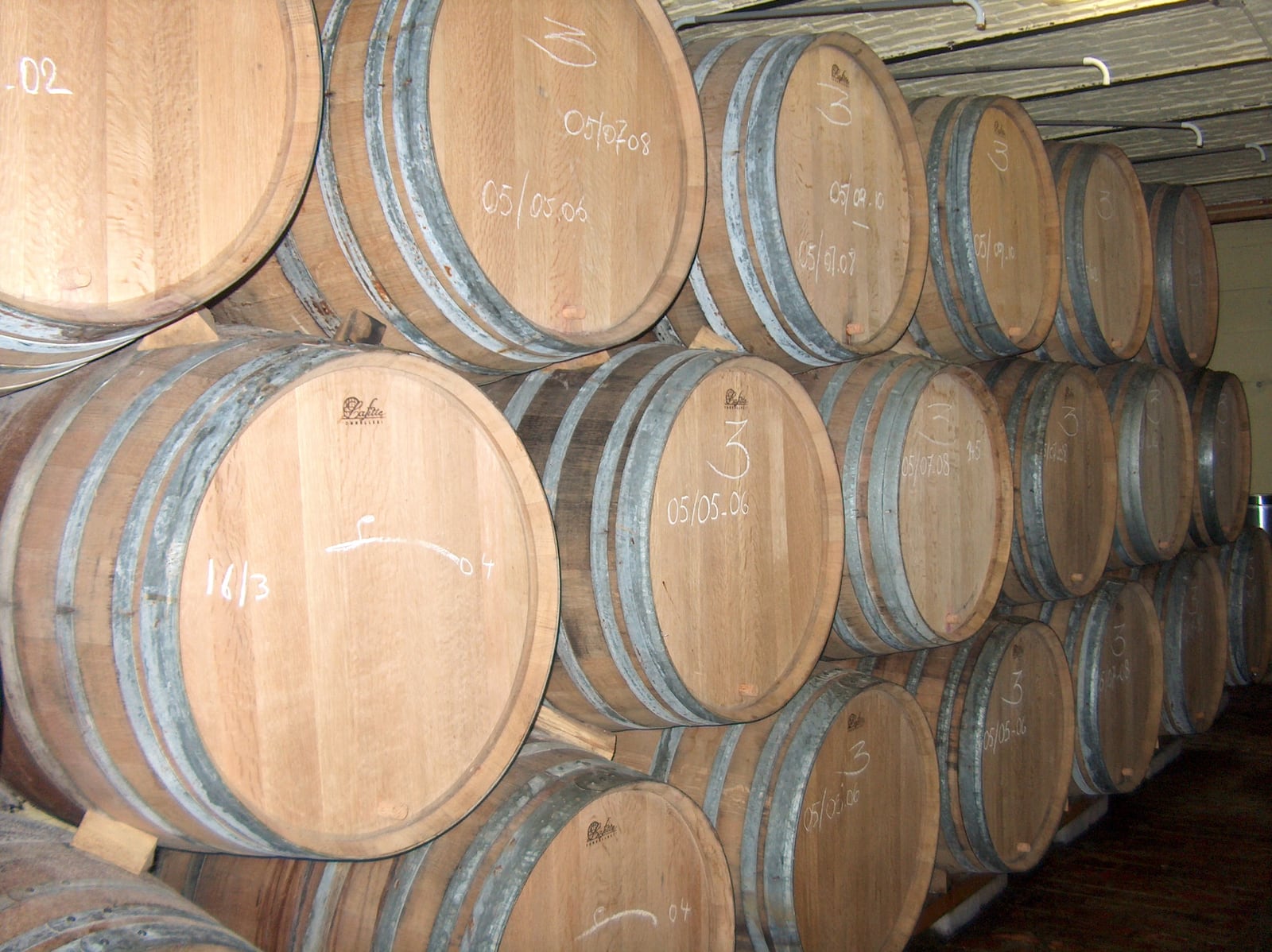
The cellar photograph above gives the service a useful backstory. Those rows of wooden barrels at Hanssens are not a mood board for rusticity.[6] They represent inventory at different ages, each batch carrying its own acidity and aroma, waiting for blending to turn variation into balance. Gueuze reaches the table because someone tasted time and composed it.
The pairing earns its place when the menu feels lighter afterward
The final test is not whether gueuze surprises a wine drinker or impresses a beer collector. It is whether the course on either side becomes clearer. The oyster should taste more marine, not merely more sour. The fried bite should regain its crunch. The mushroom should look earthier, the cheese less heavy, the next course newly possible.
Used that way, gueuze is neither novelty nor palate cleanser—the latter phrase understates how much flavor it brings. It is a hinge. A small, cellar-cool pour can swing a tasting menu from raw to browned, from sea to cellar, or from savory richness toward cheese without asking hops, sugar or alcohol to do all the work.
The beer break is what happens when a restaurant wants applause for changing categories. The acid course is what happens when it knows exactly why the bottle is there.
Sources
- Official Journal of the European Union, “Vieille Gueuze / Oude Geuze” product specification (2016) — protected-name requirements for spontaneous fermentation, pH, bitterness, blending ages, wooden-barrel ageing and bottle conditioning.
- John Carriglio, Drew Budner and Katherine A. Thompson-Witrick, “Comparison Review of the Production, Microbiology, and Sensory Profile of Lambic and American Coolship Ales,” Fermentation 8, no. 11 (2022) — institutional repository record and full paper covering microbial succession, acid concentrations, carbonation and sensory profile.
- Oud Beersel, “Lambic Days 2026” — current brewery program for its recurring geuze-and-oysters service, including portions, lambic-based sauce and guest-selected geuze.
- Lambic.info, “Amuse Gueuze” — archived course-by-course records from Belgian seasonal lambic-pairing dinners hosted by chefs and restaurants.
- Lindemans Brewery, “FAQs” — producer guidance on traditional-lambic food matches, serving temperature, glass choice, sediment and pouring.
- Wikimedia Commons, “File:Barrels.jpg” — Henna's 2005 documentary photograph of wooden lambic barrels at Hanssens Artisanaal, used as the article image.