The most revealing argument about Bistro Lolo is happening over a plate of chips.
Condé Nast Traveler's 2026 review calls the restaurant's triple-cooked fries, made from Kenyan highland potatoes, its standout dish. NairobiEats, publishing its account of a January birthday lunch in February, reaches the opposite verdict: the fries were dry and not worth ordering again. This is more useful than a smooth chorus of praise. Two writers encountered the same emblem of the kitchen—a French bistro staple translated through local produce—and found excellence in one visit, disappointment in another.[3][4]
That disagreement catches Bistro Lolo at precisely the right moment. The restaurant, inside the new Céline & Lolo boutique hotel in Lavington, has already become an international-media darling and an attractive local gathering place. The room photographs beautifully. The terrace invites lunch to blur into drinks. The menu is compact enough to read in a minute. Yet the first independent accounts do not support one easy verdict on the cooking or service.
This is therefore a review of the reviews, not a claim to have eaten there. Read together, the restaurant's current menu, a local meal report, and two international design-and-travel assessments suggest a place whose hospitality concept arrived fully formed while its most basic promise—making simple food land the same way every time—remains the live test.[1][2][3][4][5]
The room does not wait for the food
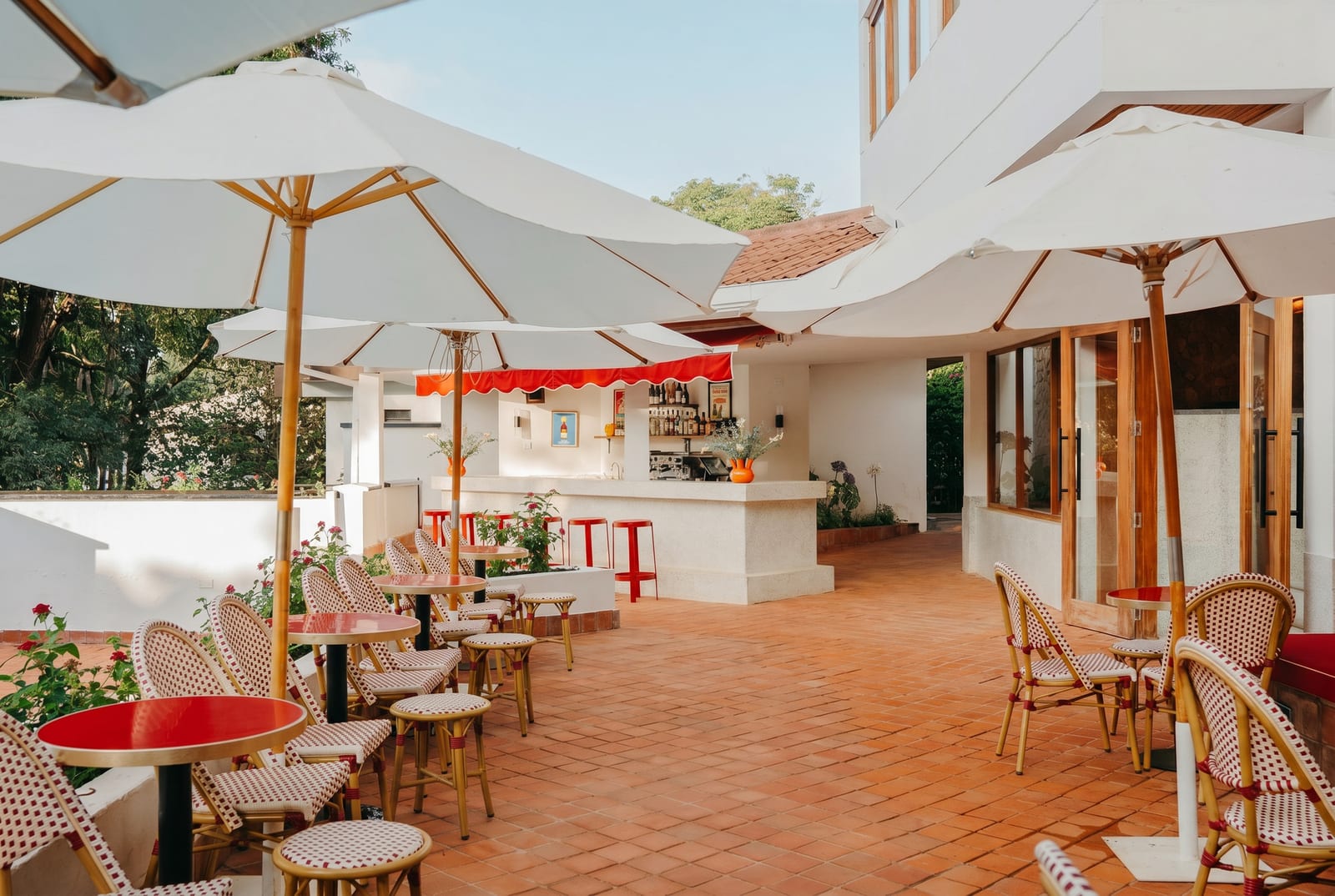
Bistro Lolo begins with a powerful advantage: the restaurant is inseparable from a particularly seductive piece of Nairobi. Powerhouse Company converted a 1970s villa into a 1,200-square-metre hotel complex with guest rooms, indoor and outdoor bars, a terrace, pool deck, restaurant, and professional kitchen. ArchDaily's July 2026 project record credits Amy May Roux for photographs that make the material sequence legible: deep timber, patterned floors, low warm light, garden green, and tables that feel placed for lingering rather than turnover.[6]
Wallpaper describes the bistro as the hotel's social heart. Its pool terrace draws both locals and travellers; terrazzo, bold colour, warm lighting, and an easy passage between inside and garden create the sensation of a private house that happens to take reservations. The original pool remains the centre of the property, edged by terracotta tiles and orange loungers.[5] Nothing about that arrangement is neutral. It tells a guest to loosen the schedule before a menu appears.
The restaurant's own language makes the same promise more explicitly. It presents Bistro Lolo as a neighbourhood room that can carry a day from coffee through dinner, supplied by local growers and small producers but French in its culinary centre of gravity.[1] That is promotional copy, not independent proof. Still, it accurately names the product visible across the external coverage: not ceremony, innovation, or a chef's grand narrative, but ease with enough polish to feel special.
The early consensus is strongest here. Condé Nast Traveler finds a dining room poised between refinement and relaxation. Wallpaper sees a mixed crowd giving the hotel life beyond its bedrooms. Even NairobiEats, the least convinced by the meal, gives the ambience its highest rating and says the setting is what sells the place.[3][4][5] Bistro Lolo has not merely decorated a restaurant attractively. It has built a reason to arrive.
A short menu leaves the kitchen exposed
The current dinner card is almost defiantly familiar. Oeuf mayonnaise costs KES 250; bread and butter KES 400; steak frites KES 1,800; roast chicken and red snapper KES 1,700 each. There are four bistro classics, four salads, four desserts, and a few looser "originals," including a lamb or vegetable curry with mango chutney, raita, and naan. The menu warns that dishes and prices can change with the seasons.[2]
This is not a list designed to conceal itself behind novelty. Mayonnaise, butter, jus, roast chicken, fries, and clafoutis make execution unusually visible. A diner can tell whether the fish has a good crust, the potato has a dry centre, or the bread has justified its wait. The restraint is appealing, but it removes alibis.
The red snapper is the clearest plate-level success in the local account. Condé Nast Traveler notes seafood from the Kenyan coast as one of the menu's local anchors, without naming the snapper specifically. NairobiEats praises the fish's seasoned crust and flaky interior, even while recording that its plate needed a separately ordered starch to feel complete. On that visit, it cost the same KES 1,700 shown on the current menu.[2][3][4] That continuity matters: the review and current card at least describe a stable dish, even if the evidence still comes from one critic's meal.
Then come the fries. Condé Nast Traveler reads the triple-cooked highland potatoes as the kitchen's star; NairobiEats finds them desiccated.[3][4] The sensible conclusion is not that one writer must be wrong. Reviews are single services, and potatoes, oil temperature, holding time, and the gap between kitchen and table all vary. The clash identifies repeatability as the issue. A bistro can survive one ambitious plate missing its mark. It cannot build trust if its most elemental side dish oscillates between destination-worthy and disposable.
Local produce is a beginning, not an identity
There is an appealing clarity in using a French grammar without pretending Nairobi is Paris. Chef Richard Loeff's menu, as Condé Nast Traveler describes it, puts Kenyan highland potatoes and coastal seafood inside a repertoire of steak frites, croque-monsieur, and oeuf mayonnaise. The restaurant says its ingredients come from local growers and small producers.[1][3]
But provenance does not automatically make a restaurant locally authored. A potato grown in Kenya can still be asked to perform only as an imported idea of Frenchness. The more interesting question is whether Bistro Lolo's bistro form bends toward the city around it.
There are early signs that it does. The menu's curry, samosas, squid-and-rice-noodle salad, and tropical fruit dessert loosen the classical frame.[2] More importantly, the restaurant behaves like a Nairobi social room rather than a European period set. Wallpaper's account of a steady local crowd, the official all-day schedule, and NairobiEats' birthday-lunch perspective all describe a place used for swimming, coffee, work, dates, drinks, and dinner—not only for hotel-guest feeding.[1][4][5]
That social use is part of the cuisine's meaning. A neighbourhood bistro is not defined only by sauce technique; it is defined by return. Its food has to be desirable on an ordinary Tuesday, durable across different appetites, and consistent enough that the room does not become a one-photograph experience. Bistro Lolo's prices and familiar dishes position it for repetition more than once-in-a-lifetime spectacle. The reviews have not yet established whether the kitchen can earn that repetition.
Service is where atmosphere becomes hospitality
The design coverage treats time stretching out as a luxury: a drink becomes dinner, a long lunch slips toward evening, and the pool slows the city down.[1][5] NairobiEats describes a less flattering version of stretched time. The reviewer records roughly thirty minutes for bread, slow service through lunch, and a friendly server who could not make the delays disappear.[4]
One lunch cannot diagnose an operation. Nor should a design magazine's mood report be mistaken for a service audit. Together, however, they expose the restaurant's central operational challenge. "Unhurried" works only when the guest feels held. A long interval can be languor if drinks are watched, expectations are set, and the table senses control; the same interval becomes waiting when a KES 400 bread order appears to have fallen out of the sequence.
This distinction matters especially in a hotel restaurant built to serve many clocks at once. Breakfast guests, poolside drinkers, local lunch tables, room-service orders, and dinner reservations can all pull on the same property's hospitality operation. The sources do not show whether production or staffing is divided among those services; the operational strain is an inference from the formats advertised, not a documented account of the kitchen's topology.[1][6] Whatever the back-of-house arrangement, the room has to absorb complexity without passing it to the diner.
The split verdict is the useful verdict
International coverage has already given Bistro Lolo a seductive identity: a restored modernist villa, French comfort food, Kenyan produce, crisp tablecloths, coastal fish, wine, and a pool bright enough to rearrange an afternoon.[3][5][6] The local review supplies the necessary resistance. It agrees that the red snapper and butter can be excellent, then asks whether the food and pacing consistently justify the beauty around them.[4]
Neither account should dominate simply because one is more prestigious or more local. Condé Nast Traveler offers useful culinary and sourcing detail but writes within a celebratory Hot List frame. NairobiEats provides the granular friction of an actual lunch but reflects one table on one day. Wallpaper is persuasive on design and crowd, not a close restaurant review. The official menu establishes what is being sold now, not how well it will be cooked tonight.[1][2][3][4][5]
The honest 2026 verdict is consequently provisional and specific. Bistro Lolo is already a convincing room: visually distinctive, socially flexible, and unusually capable of making a hotel restaurant feel like a neighbourhood address. The local review makes the strongest plate-level case for the red snapper, while the international review supports only the broader promise of coastal seafood. The humble things—fries, bread timing, the conversion of leisure into attentive service—are where the kitchen and floor still need to make the beautiful idea reproducible.
That is not a minor caveat pasted onto an otherwise finished success. For a bistro, reproducibility is the whole plot. The first visit is won by the villa and the pool. The second has to be won by dinner.
Sources
- Bistro Lolo, official restaurant page — the venue's own description of its all-day neighbourhood role, French orientation, local growers, small producers, and Lavington address.
- Bistro Lolo, official breakfast, lunch, and dinner menu (2026 snapshot) — current dishes, structure, Kenyan-shilling prices, and seasonal-change notice.
- Condé Nast Traveler, Sharon Machira, "Bistro Lolo" (Hot List 2026) — review of Richard Loeff's French bistro cooking, Kenyan highland-potato fries, coastal seafood, wine, and dining-room character.
- NairobiEats, "Céline and Lolo" (February 4, 2026) — independent local account of one lunch, including red snapper, fries, bread timing, service, prices, and the reviewer's split food-versus-ambience verdict.
- Wallpaper, Lauren Ho, "Céline & Lolo is a hotel that taps into Nairobi's creative soul" (March 25, 2026) — report on Lavington context, the pool terrace, restaurant crowd, design, and French-leaning menu.
- ArchDaily, "Céline & Lolo Hotel / Powerhouse Company" (July 14, 2026) — project record for the converted 1970s villa, including programme, area, architects, and Amy May Roux's real photographs of the restaurant and hotel.