As of April 25, 2026, the prestige headline around Evvai is easy to state. Michelin's new Brazil selection made Evvai and Tuju the first Three MICHELIN Star restaurants not only in Brazil, but in all of Latin America.[5] That is a real threshold, and it matters. The more useful way to read Evvai, though, is older and more specific than the star count. The restaurant's real subject is Oriundi: the long afterlife of Italian migration in Brazil, rewritten as a contemporary tasting menu rather than preserved as comforting nostalgia.
That distinction matters because Evvai is easy to flatten from both directions. If you read it too quickly, it can sound like a polished fusion room where Italian technique meets Brazilian ingredients and the rest is branding. If you read it too sentimentally, it can sound like a heritage project whose main job is to honor ancestry. The restaurant's own language is more exact than either version. On the official menu page, Evvai defines Oriundi in literal terms as someone natural from, originating in, or proceeding from somewhere else, and notes that in Italy the term is used for Italian immigrants and descendants around the world.[1] The page then makes the restaurant's claim directly: this is an "Italian immigrant cuisine" integrated with local producers and with descendant traditions born from the great migrations from Italy to Brazil.[1]
That is not just a poetic label. It is the key to the whole house. Evvai is not trying to stage Italy inside Brazil, nor to dissolve both into an anonymous cosmopolitan luxury language. It is working on the more difficult seam where forms travel, ingredients change, and identity stays active rather than settled.
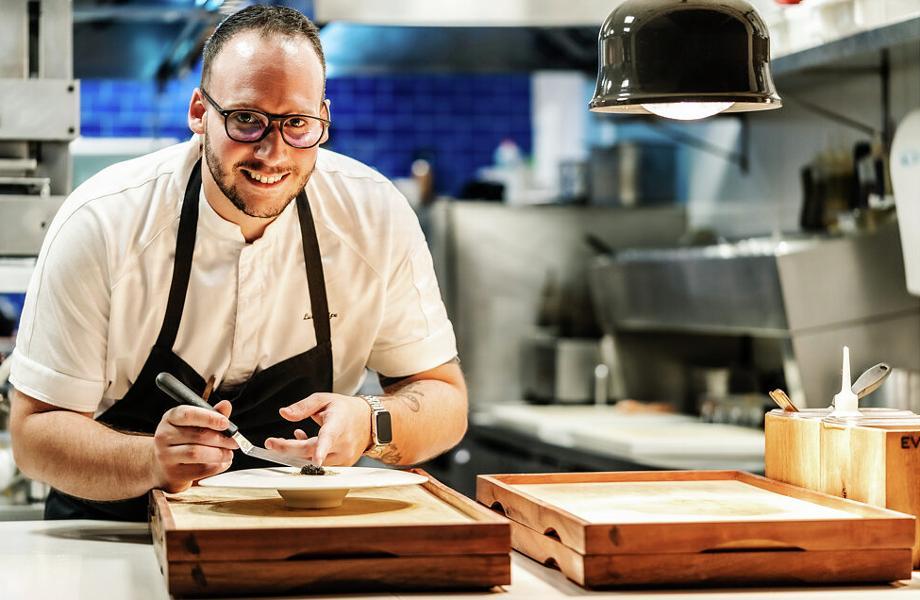
Image context: the lead image uses 50 Best Discovery's photograph of Luiz Filipe Souza plating at the pass rather than a neutral dining-room shot. That choice fits the argument because Oriundi cuisine is being built in real time. The restaurant's lineage does not live only in family memory or menu copy; it lives in the act of deciding, course by course, what part of Italian inheritance still holds shape inside São Paulo now.[4]
1. "Oriundi" changes the lineage question
Many fine-dining lineage stories are built around a single clean line: one national tradition, one master, one archive, one revival. Evvai's story is messier in a productive way. The official About page says Luiz Filipe Souza explores his own origins through the cultural exchange born from Italian migrations to Brazil, then practices what he calls cozinha Oriundi.[2] The menu page sharpens that idea by refusing the simpler language of authenticity.[1] The restaurant does not say it is reproducing a canonical Italian table abroad. It says it is cooking from what migration produced after arrival: descendants, exchange, adaptation, and local integration.[1][2]
That is why "fusion" is too weak a word here. Fusion often suggests two complete cuisines being combined from the outside, as if each one remained sealed before the chef chose to blend them. Evvai's own concept implies something different. Italian and Brazilian foodways are already historically entangled by the time the guest sits down. Oriundi cuisine starts from that entanglement as a lived condition. The menu is not inventing contact between Italy and Brazil; it is assuming that contact already happened and asking what disciplined, ambitious cooking can do with the result.[1][2]
This is also where the three-star news becomes more than a badge. Michelin's 2026 selection did not elevate Evvai as a generic luxury room. It elevated a restaurant whose public self-definition is unusually rooted in migration, descent, and exchange.[5] The stars make the concept newly visible to a wider audience, but the concept itself was already there.
2. São Paulo is not a backdrop here; it is the present tense of the idea
The restaurant's language keeps one foot in Italy, but the room's energy is resolutely São Paulo. Evvai sits on Rua Joaquim Antunes in the Pinheiros/Jardim Paulistano zone, and its current service rhythm is precise rather than sprawling: Tuesday to Thursday from 7:00 PM to 10:00 PM, Friday from 7:00 PM to 10:30 PM, and Saturday at lunch and dinner.[3] Those details seem administrative until you read them alongside the restaurant's lineage claim. Oriundi cuisine needs a contemporary city to land in. Without a living metropolitan frame, migration risks becoming museum narrative.
50 Best Discovery helps make that present tense visible. Its current profile describes a warmly lit dining room, a thirteen-course Oriundi tasting menu, and a series of dishes that move freely across expected borders: sourdough with seven kinds of butter, foie gras lollipops, Grana Padano ravioli, and a dessert centered on Brazilian honey paired with stout.[4] Those examples matter less as luxury bait than as evidence of how the house thinks. Pasta remains a load-bearing form. Dairy, bread, and ravioli carry obvious Italian echoes. But the menu's movement is broader, less obedient to national purity, and more interested in what immigrant cuisine can become under pressure from Brazilian ingredients and contemporary technique.[1][4]
In that sense, São Paulo is not just where Evvai happens to be located. It is the city-scale proof that Oriundi need not mean backward-looking. The restaurant keeps migration memory alive by making it urban, paced, and current.
3. The menu treats inheritance as a grammar, not a shrine
The official menu page is concise, but it says the crucial thing: Evvai's menu reflects inspirations that are at times Italian, at times Brazilian, and at times both, tracing parallels and connections between tradition and contemporaneity, between Brazil and Italy.[1] That sentence is doing real work. It suggests that the chef is not simply choosing symbolic ingredients from each side and arranging them on a plate. He is looking for a grammar strong enough to carry more than one belonging at once.
This is where the restaurant's lineage becomes genuinely interesting. In a lot of heritage-driven restaurants, memory gets reduced to quotation. A grandmother's dish appears as a luxe reference, a regional product becomes a sentimental marker, and the menu asks the diner to admire the emotional honesty of the gesture. Evvai's public language points toward a more demanding model.[1][2] Memory matters, but only if it can survive translation into a rigorous tasting sequence. A migrant lineage that cannot bear reinterpretation is just branding with family names attached.
50 Best Discovery's dish examples support that reading because they are not arranged like a lesson in one pure canon.[4] Bread service, foie gras playfulness, ravioli, Brazilian honey, and a drinks pairing all sit inside one long-form experience. The connective tissue is not strict regional fidelity. It is the chef's ability to make movement between inheritances feel authored rather than random. The tasting menu becomes the proof that Oriundi is a method, not just a theme.
4. Why the three-star frame clarifies rather than distorts the restaurant
Luxury accolades often flatten restaurants by encouraging diners to chase status before structure. Evvai now faces that risk more than before because the Michelin headline is so large.[5] But the current public information actually makes the restaurant easier to read, not harder.
The official site still describes Luiz Filipe Souza as modern, creative, and rooted in Italian heritage, while also foregrounding the cultural exchange produced by migration to Brazil.[1][2] 50 Best Discovery still frames the room around inventive Italian dishes and migrant food culture rather than around generic spectacle.[4] Michelin's 2026 announcement adds the global signal without changing the deeper story.[5] Put together, those sources suggest a restaurant that reached the top tier not by imitating Europe's most settled luxury codes, but by sharpening a specifically Brazilian-Italian line of thought until it felt complete enough to stand there on its own.
That is why Evvai feels more substantial than a restaurant simply surfing the current appetite for identity-forward fine dining. Its identity claim is narrow, operational, and risky in the right way. It has to make migration taste coherent. It has to turn descendant memory into sequence. It has to let Italian inheritance remain visible without letting Brazil become decorative. Those are harder tasks than calling a menu "contemporary Italian" or "Brazilian with European technique."
Why Evvai matters now
The simplest reading of Evvai in 2026 is that it is one of Latin America's first three-star restaurants. That is true, and it belongs in the lead.[5] The better reading is that the restaurant gives high-end dining a more exact way to talk about inherited cuisine in the Americas. Not origin as purity. Not fusion as novelty. Migration as a working grammar.
That is the force of Oriundi. Italian migration to Brazil is not treated as a backstory the chef occasionally cites to dignify a dish.[1][2] It is treated as the restaurant's operating condition. The menu can be Italian, Brazilian, or both because the restaurant begins from the idea that cultural inheritance after migration is already mixed, already local, and still capable of discipline.[1][4]
So the three stars do not simply make Evvai bigger. They make its central claim harder to ignore. This restaurant is arguing that the most persuasive lineage is sometimes the one that moved, adapted, and kept cooking anyway. In São Paulo, under the name Oriundi, that argument now has the highest level of public recognition a dining room can receive.[1][2][4][5]
Sources
- Evvai official menu page, defining "Oriundi," describing the restaurant as an Italian immigrant cuisine integrated with local producers and descendant traditions, and explaining the menu's Italian/Brazilian parallel structure.
- Evvai official About page, describing Luiz Filipe Souza's roots, the cultural exchange born from Italian migration to Brazil, and the restaurant's self-description as cozinha Oriundi.
- Evvai official contact page, listing the restaurant's current opening hours and address in São Paulo.
- 50 Best Discovery, "Evvai - São Paulo - Restaurant," covering the current thirteen-course Oriundi tasting menu, sample dishes, drinks pairing, dining-room character, contact details, and the chef photograph used here.
- Michelin, "the new MICHELIN Guide Rio de Janeiro & São Paulo 2026 selection," announcing Evvai and Tuju as the first three-star Michelin restaurants in Brazil and Latin America.