Rovinj makes more sense as a fine-dining route than as a single-table brag. The town is small enough that its ambitious rooms can be read almost like topography. One of them is folded into old-town stone below St. Euphemia. Two of them sit in the hotel-and-marina band on the eastern shore, where terraces, promenades, and sea views turn dinner into part of the waterfront walk.[1][2][3][4] That physical closeness is the useful thing. You can feel the city changing registers without ever leaving the same compact piece of coastline.
For a visitor, the best way to use that is to stop asking which restaurant is "the one" and start asking what kind of Rovinj you want the meal to reveal. Monte is the room for family memory, habitat language, and old-town concentration.[1] Agli Amici Rovinj is the polished marina-facing transfer of a Michelin-starred house from Godia, with the city's most decorated current fine-dining status and a terrace directly facing the sea.[2] Cap Aureo Signature Restaurant turns the view itself into part of the tasting structure: Jeffrey Vella's menus are served on a fifth-floor glass terrace looking over the marina and old town, with seasonality and locality framed as the central discipline.[3]
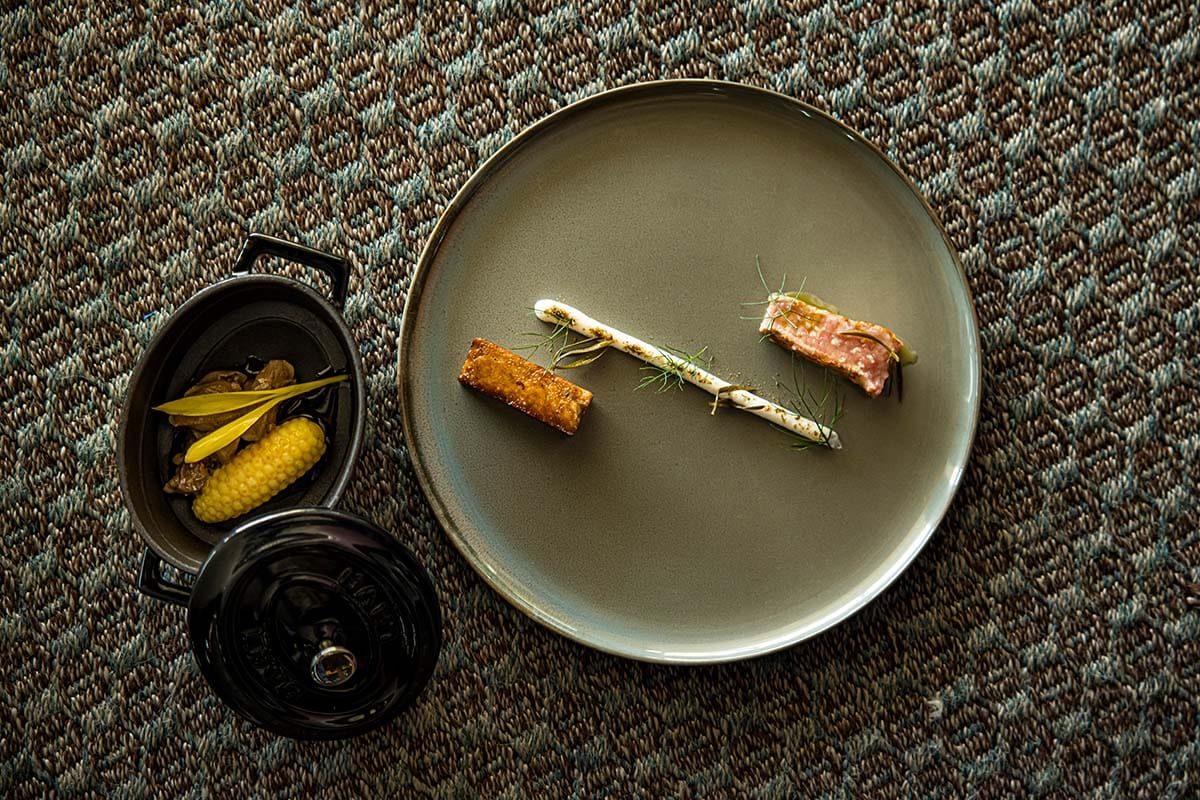
Image context: the lead photo is Agli Amici Rovinj's official dish image. It suits this article because the point is not to rank plates in isolation. The real story is how three nearby rooms translate the same Istrian setting into three different dining grammars.[2]
The useful split
- Choose Monte if you want Rovinj to feel oldest, closest, and most rooted in family-house memory.
- Choose Agli Amici if you want the city's most ceremonial waterfront dinner, with the strongest sense of contemporary destination polish.
- Choose Cap Aureo if you want a hotel aerie, a broad tasting-menu argument, and the clearest panoramic sweep across marina and old town.
If you have time for more than one serious meal, the city reads best in that order of widening view: stone first, then waterfront, then height.
1) Monte: old-town stone, family memory, and habitat as menu logic
Monte remains the most intimate way to enter Rovinj's serious dining culture because the house still presents itself as a family story before it presents itself as an accolade machine. The restaurant describes itself as hidden in the stone-walled courtyard of chef Danijel Đekić's birth house, at the foot of St. Euphemia, and explicitly frames the room as a place of gathering, recollection, and memory.[1] That is already a different proposition from a grand-hotel destination table. You climb into the old town, narrow the scale, and let the city's texture do part of the work before the meal begins.
The stronger reason to book Monte, though, is that its current language about food is unusually coherent. The restaurant says its cuisine is "cultivated" rather than merely composed, and the Flora and Fauna menus are described as rooted in Rovinj and its surroundings: Adriatic depth, Mediterranean vegetation, forests, cultivated land, and wild terrain all enter the menu through daily collaboration with fishermen, farmers, winemakers, and artisans.[1] That makes Monte the sharpest choice if you want dinner to feel inseparable from place, not merely supplied by it.
Its history matters here too. Monte states plainly that it became Croatia's first Michelin-starred restaurant in 2017, while also stressing that the restaurant began in 1985 as a traditional Istrian tavern run by the chef's parents.[1] In travel terms, that gives the room a useful double charge. It is both a local inheritance and a high-end institution. You do not go there for skyline drama. You go there because Rovinj's older emotional core is still legible at table level.
2) Agli Amici Rovinj: the marina terrace and the city's most decorated current dining room
Agli Amici Rovinj is where Rovinj stops feeling like a hidden old-town enclave and starts feeling like a full contemporary luxury destination. The restaurant's own page calls it the Istrian home of the Scarello family and says chef Emanuele Scarello brought the Michelin-starred cuisine of Agli Amici from Godia to Rovinj.[2] The location description is even more important than the lineage: the restaurant sits between Grand Park Hotel Rovinj and the marina, with a terrace directly overlooking the sea.[2] On foot, that means the dinner belongs to the promenade as much as to the dining room.
Agli Amici also carries the clearest current prestige signal. The restaurant says it opened on June 22, 2021, won its first Michelin star in less than three months, and received a second Michelin star in June 2024, which it describes as currently the only two-star distinction in Croatia.[2] Whether or not you care about awards for their own sake, that public framing tells you what kind of night this is supposed to be. Agli Amici wants to function as Rovinj's headline room.
What keeps it useful within an itinerary is that the menu logic still stays tied to the territory. The restaurant says its Rovinj kitchen follows the same philosophy as the original house while working with small-scale cultivators, artisans, farmers, and fishermen, prioritizing both local production and environmental and economic sustainability.[2] It also spells out two tasting-menu tracks: one dedicated to Rovinj / Sea and another to Istria / vegetables and meat.[2] That split is exactly why Agli Amici works best as the city's waterfront statement piece. It lets the coast and hinterland arrive in a more polished, more obviously destination-oriented register than Monte.
3) Cap Aureo: the fifth-floor glass terrace and the broadest panoramic argument
Cap Aureo belongs to the same Grand Park Hotel ecosystem as Agli Amici, but the feeling it sells is different. If Agli Amici reads as a sea-facing terrace restaurant, Cap Aureo reads as a lifted platform above the whole band of waterfront movement. Maistra's official page describes it as a menu by Michelin-starred chef Jeffrey Vella built on seasonality, locality, and affection for the region, while the restaurant's glass terrace on the fifth floor is said to open onto a spectacular vista of the marina and Rovinj's old town.[3] That difference in elevation matters. Cap Aureo does not pull you closer to the city. It lets you survey it.
The menu framing is also broader and more openly programmatic. Maistra says guests choose among three tasting paths: My Istria, a seasonal menu driven by local produce within 50 km; A Journey Since 2019, a retrospective of the restaurant's most celebrated dishes since opening; and Towards a Greener Thought, a vegetarian route shaped by the season.[3] All guests at the same table share the same menu, which reinforces the sense that Cap Aureo wants dinner to function as one collective argument rather than a series of individual edits.[3]
Within a trip, Cap Aureo is strongest when you want Rovinj to appear as a composed panorama. Grand Park Hotel's own page describes the property as harmoniously placed on the town's eastern shore with remarkable views of the old town, and explicitly names Cap Aureo and Agli Amici as its Michelin-starred restaurants.[4] That means the hotel zone is not a compromise or overflow district. It is one of the places where the town now stages its most ambitious dining identity.
How to sequence the city
The cleanest short-trip order is Monte first, Agli Amici second, Cap Aureo third if you are lucky enough to have that much time. That progression moves from enclosed stone to open waterfront to elevated overview. Even if you only have two meals, the principle still helps:
- Monte + Agli Amici if you want the strongest contrast between old-town intimacy and contemporary marina polish.[1][2]
- Monte + Cap Aureo if you want the clearest shift from family-house memory to panoramic hotel modernity.[1][3][4]
- Agli Amici + Cap Aureo if you are staying around Grand Park and want to compare two different kinds of luxury waterfront staging without leaving the hotel-marina corridor.[2][3][4]
Rovinj is unusually good at this because the distances are short and the restaurant identities are not blurred together. The old town still has enough stone, slope, and inherited texture to make Monte feel earned. The eastern shore has enough promenade glamour and view-driven architecture to make Agli Amici and Cap Aureo feel like distinct forms of arrival rather than copies of one another.[1][2][3][4]
Bottom line
The mistake in Rovinj is searching for one definitive dinner when the town is small enough to be read as a dining sequence. Monte gives you habitat, lineage, and the pressure of old-town stone.[1] Agli Amici gives you the marina, the terrace, and the clearest current prestige signal.[2] Cap Aureo gives you a fifth-floor vantage point and a more panoramic tasting-menu frame.[3][4] Taken together, they show why Rovinj's fine dining is stronger as a route than as a trophy.
Sources
- Monte official site, on the courtyard setting below St. Euphemia, the restaurant's family history, Croatia's first Michelin star for Monte in 2017, and the Flora/Fauna habitat framing.
- Agli Amici Rovinj official page, on the Scarello family, the June 22, 2021 opening, Michelin recognition, the marina-and-sea terrace location, and the two tasting-menu tracks.
- Cap Aureo Signature Restaurant official Maistra page, on Jeffrey Vella's menu concept, the fifth-floor glass terrace, and the three tasting-menu paths.
- Grand Park Hotel Rovinj official page, on the eastern-shore setting, old-town views, and the hotel's Michelin-starred restaurant lineup.