The easiest way to misread Botrini's is to treat it as one more Mediterranean special-occasion room with a famous chef's name over the door. The stronger reading starts with the building. The restaurant's own page says it occupies a two-story former elementary school in Chalandri, with a red-tile roof and a green garden for the long Athenian summer.[1] Michelin keeps the same core image but sharpens the hospitality logic: a former school on the outskirts of Athens, an elegant dining room with an open-view kitchen, the option of a chef's table, and an outdoor setting when the weather turns friendly.[4] That combination matters because Botrini's is not trying to overwhelm guests with metropolitan swagger. It is trying to make intimacy feel structured.
That is why this place reads so well as a restaurant profile in 2026. Chef Ettore Botrini's cooking has prestige, but the house is built around something softer and harder at once: memory under discipline. The official menu page says each course arrives with a story card, part childhood diary, part family archive, part miniature cultural footnote.[2] The meal therefore does not move like a parade of luxury ingredients. It moves like a conversation that has been edited until only the necessary details remain.
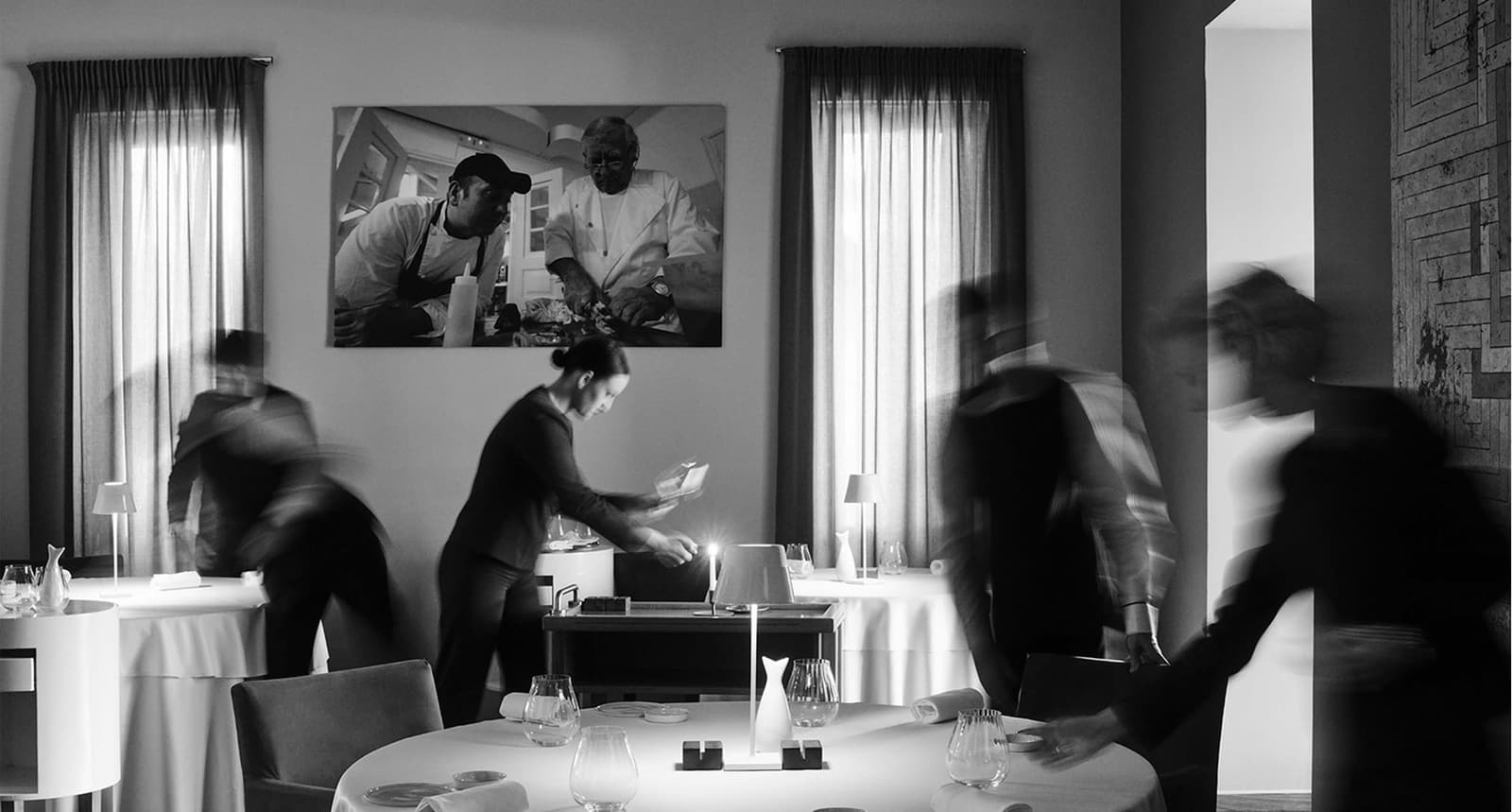
Image context: the lead image uses Botrini's official interior photograph because this profile is about how the room frames memory. The white tablecloths, bright walls, and sightline toward the kitchen make the house feel lucid and current, not sentimental.[1][4]
1. The schoolhouse gives the meal its first lesson
Former-schoolhouse restaurants can easily collapse into gimmick. Botrini's avoids that trap because the building is doing practical work. On the official site, the house is described with plain affection rather than theatrical branding: two stories, red roof, garden, summer service.[1] Michelin adds the open-view kitchen and the choice between the main room and chef's table.[4] Those details create a very particular rhythm. The guest is never far from action, but the action is filtered through a calm shell.
The effect is more important than the romance of the address. A fine-dining room needs some way to pace attention. Botrini's gets that pacing from contrasts: suburban quiet against the intensity of the pass, greenery against polished white surfaces, the old school envelope against a very contemporary service grammar. Even 50 Best Discovery, which is usually brisk in tone, describes the place as a comfortable, contemporary restaurant in a converted school and stresses that the food references Botrini's personal memories rather than anonymous luxury codes.[5]
That last point is crucial. Plenty of restaurants want to feel personal. Fewer build an architecture that can carry personality without becoming cluttered. Botrini's uses the schoolhouse to do exactly that. The former classrooms do not ask for nostalgia; they provide containment. Inside that containment, stories can be delivered course by course without the evening drifting into over-explanation.
2. The menu is written as a sequence of remembered scenes
The current menu page is unusually revealing because it explains how Botrini wants the guest to read dinner. The page presents the tasting experience through the paired names Varkada and Peripatos, then says that behind each dish lies a story the chef shares with the table.[2] Those stories, written on cards presented before each course, form what the restaurant calls a diary of tasteful memories: childhood recollections, elements of the house philosophy, Botrini family history, and small lived customs such as Tuscan fishermen marinating in seawater.[2]
This is a much smarter device than the usual chef's-table monologue. A card gives the story a boundary. It turns biography into dosage. One plate can point to Corfu, another to Tuscany, another to a family habit or a remembered smell, and the guest receives each reference as an accent rather than a burden. The menu page also notes access to more than 900 wines and presents the cellar as part of the same gastronomic proposal.[2] That matters because the restaurant is not only pairing flavors. It is building a narrative environment in which wine, service, and anecdote all share the job of transition.
This is where Botrini's becomes more interesting than a generic Greek-Italian fusion label. Fusion can be lazy when it means little more than juxtaposition. Botrini's uses story structure to keep the crossing legible. The stories tell you why the bridge exists before the flavors arrive.
3. Greece and Italy meet here as biography, not branding
Michelin's summary of the restaurant remains the cleanest short description of the house thesis: the meal unfolds between Greece, especially Corfu and Thessaly, and romantic Tuscany.[4] On Botrini's own team page, Ettore is described as a Greek-Italian chef born and raised in Corfu, shaped both by his father's cooking and by training in Lausanne plus time in three-star kitchens in France and Spain.[3] Meanwhile, 50 Best Discovery emphasizes that he later became head chef at the family restaurant Etrusco in Corfu before beginning the Athens chapter.[5]
Taken together, those sources explain why the food at Botrini's does not read as diplomacy between two national cuisines. It reads as one chef's internal geography. Corfu has always been a place where Venetian, wider Italian, and Greek histories brush against each other; Botrini's does not need to fake that overlap because it already lives in the chef's own formation.[3][5] Michelin's mention of dishes rooted in natural ingredients and traditional cues supports the same impression: the kitchen is not chasing novelty by shock. It is trying to make inheritance feel precise.[4]
That precision also helps the room avoid heaviness. Personal memory in restaurants often turns sticky. It arrives with too much reverence and too little editing. Botrini's seems to understand that memory has to move. One course points back to family history, another to daily practice, another to regional product, and the evening keeps walking.
4. Why Botrini's feels current instead of commemorative
The strongest argument for Botrini's right now is that the restaurant is not frozen around Ettore's reputation. The team page says he now works alongside Ilias Ntoukas as executive R&D chef, bringing experience from The Fat Duck, Quintonil, Noma, Alchemist, and Hiša Franko, with locality and sustainability as central parts of his approach.[3] Michelin likewise points to Ntoukas as the chef's right-hand man, responsible for dishes rooted in natural ingredients and tradition.[4]
That matters more than résumé worship. A restaurant built on personal memory can go stale if it becomes self-quotation. A younger technical partner changes the pressure inside the system. The chef-patron provides the archive; the R&D kitchen keeps asking how that archive should taste now. Botrini's own pages reinforce the sense of flexibility by offering the chef's table directly at the pass, preserving the garden as a second seasonal mood, and treating wine as an active part of the proposal rather than a bolt-on luxury list.[1][2]
So the reason to care about Botrini's in 2026 is not simply that it remains one of Greece's decorated dining rooms. It is that the house still knows how to convert biography into hospitality. The schoolhouse setting gives the evening shape, the story cards meter the emotional register, and the Greek-Italian crossing lands as lived memory rather than marketable fusion. In a category crowded with louder restaurants, Botrini's makes a quieter and more durable argument: fine dining can feel cultivated without feeling embalmed.
Sources
- Botrini's Restaurant, "Our Restaurant" page, covering the two-story former elementary school in Chalandri, the red-tile roof, the green garden, the restaurant's 2011 opening, and its first Michelin star in 2014.
- Botrini's Restaurant, "The Menus" page, covering the Varkada and Peripatos tasting structure, the story cards presented before each course, the diary-of-memories concept, the chef's table at the pass, and access to more than 900 wines.
- Botrini's Restaurant, "Our Team" page, covering Ettore Botrini's Greek-Italian background, his training path, and Ilias Ntoukas's experience at The Fat Duck, Quintonil, Noma, Alchemist, and Hiša Franko.
- The MICHELIN Guide, "Botrini's" listing, covering the Greece-Tuscany throughline, the former-school dining room with open-view kitchen, the chef's table and outdoor space, and the kitchen's emphasis on natural ingredients rooted in tradition.
- 50 Best Discovery, "Botrini's Restaurant" profile, covering the converted-school setting, Ettore Botrini's route from Etrusco in Corfu to Athens, and the way the menu references his personal memories and wider Italian culture.