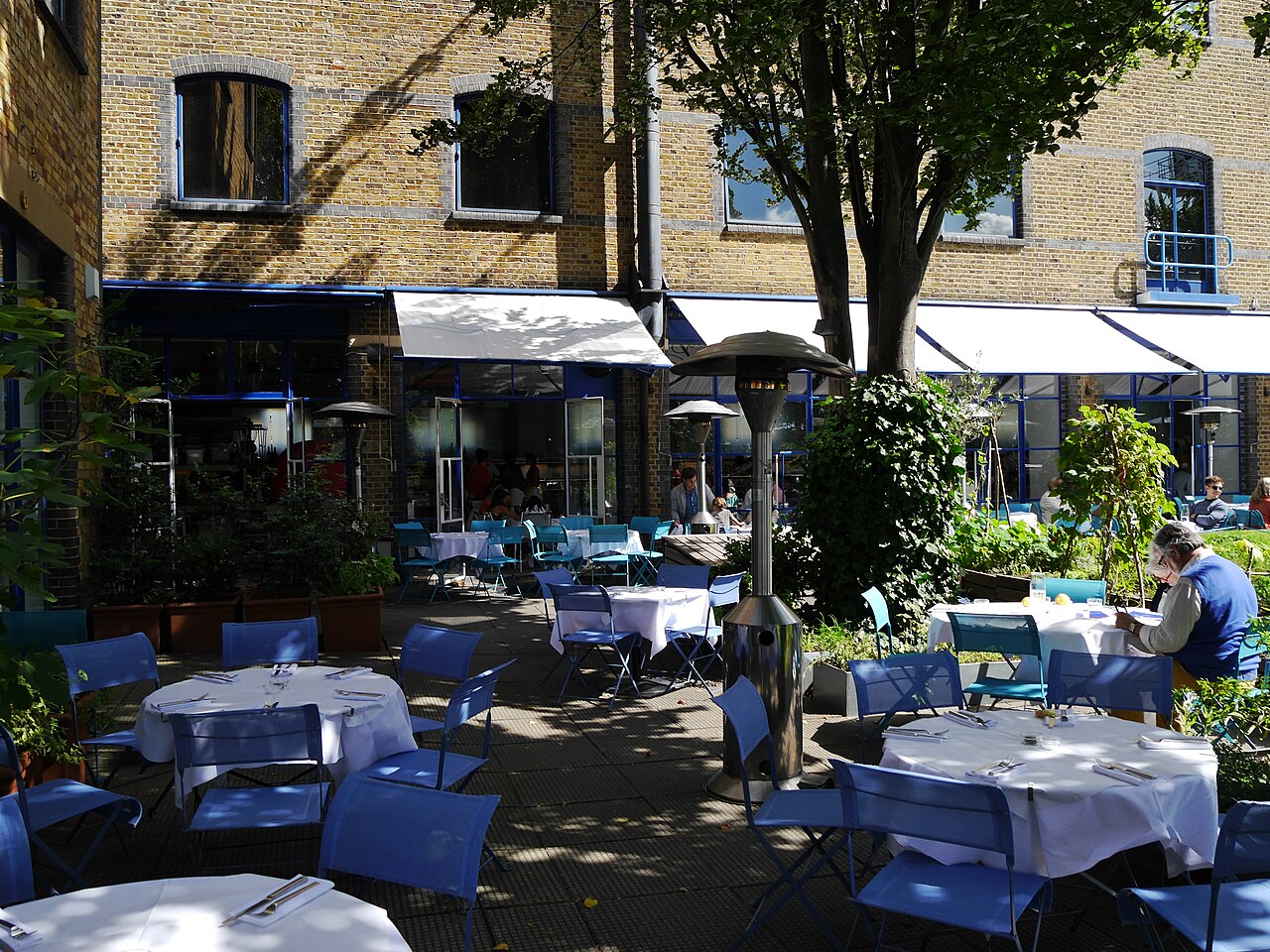
The River Cafe's most durable technique is the one that looks least like technique. A plate of grilled fish with herbs, a bowl of pasta, a vegetable dish brightened by oil and salt, a piece of fruit treated as enough: these can sound like anti-fine-dining gestures until the operating discipline underneath comes into view. Ruth Rogers and Rose Gray did not make London Italian by adding more ceremony. They made it Italian by insisting that the right product, at the right moment, could carry the room if the kitchen stopped before cleverness took over.[2][4]
That sounds obvious now because the restaurant helped make it obvious. The River Cafe opened in Hammersmith in 1987, at Thames Wharf, and its official public identity still joins several practical signals into one idea: Italian restaurant, riverside garden terrace, Richard Rogers design, open kitchen, and a location that is neither old clubland nor hotel dining room.[1] It began as something humbler than the mythology later suggests. The Guardian's Rose Gray obituary describes the early River Cafe as a modest restaurant in the old Duckhams oil storage facility before it became one of Britain's most influential rooms.[5]
The craft lesson is this: simplicity only works when the restaurant has already solved the harder problems off the plate. What should be bought today? What should not be bought? Which ingredient deserves heat, which deserves rawness, which deserves only oil, lemon, salt, or a little anchovy? How much wine knowledge is needed to make Italian directness feel expansive rather than plain? The River Cafe's answer is not a single recipe. It is a way of editing.
Restraint starts at the market
The most revealing River Cafe sentence is Rogers's account of wanting to cook the way Italians shopped: not arriving at the market with a fixed recipe, but letting seasonality decide what dinner can become.[4] That is the technical core. A daily-changing, ingredient-led kitchen does not reduce labor. It moves labor upstream into selection, rejection, timing, and menu writing.
This matters because "simple Italian" is easy to fake. A restaurant can serve pasta and olive oil while still cooking from habit rather than attention. The River Cafe's version asks more of the kitchen because the plate has fewer hiding places. If the crab is weak, if the tomatoes are early, if the asparagus has lost snap, if the pasta is overworked, there is no elaborate architecture to distract the diner. Michelin's current guide language points to the same structure: the River Cafe's honest, rustic Italian simplicity depends on ingredient quality, with the open kitchen and wood-fired oven dominating a lively riverside room.[2]
That is why the restraint feels active. The kitchen is not refusing technique. It is choosing techniques whose visibility does not overwhelm the product: grill, roast, boil, dress, fold, season, serve. The work is in proportion. A heavy sauce can rescue a mediocre ingredient; a light hand exposes it. The River Cafe became influential because it made that exposure look generous rather than austere.
The open kitchen makes the promise public
An open kitchen changes the ethics of simplicity. It removes the curtain that might otherwise protect a dish from scrutiny. At The River Cafe, Michelin identifies the on-view kitchen and wood-fired oven as part of the room's character, not background decor.[2] The official site also presents the restaurant as a designed riverside space with an open-kitchen identity rather than as a purely nostalgic Italian fantasy.[1]
That openness matters because the restaurant's food depends on trust. A diner has to believe that a short menu is not laziness, that a plain plate is not underproduction, and that the price of the meal is buying judgment as much as visible complication. The room helps make that believable. Stainless steel, glass, terrace light, fire, and service pace all tell the same story: the restaurant is not hiding a grand French machine in the back. It is letting the guest watch a different machine, one built around heat, hands, and sequence.
This is where The River Cafe differs from casual rusticity. A rustic restaurant can lean on charm when precision slips. The River Cafe's room is too exposed for that. If the food is supposed to rely on the quality of clams, crab, wild sea bass, vegetables, pasta, herbs, and oil, then the kitchen's confidence must show in tiny margins: how long the ingredient waits, how hot the oven is, how much salt the dish can take, how little garnish is enough.[2][3]
Italian food became a London training language
The River Cafe's influence also travels through people. Gray and Rogers trained or employed chefs who later became public names, including Jamie Oliver and Hugh Fearnley-Whittingstall, and the Guardian obituary frames Gray as someone whose influence passed through a generation of contemporary British cooks.[5] A later Guardian profile describes Rogers and Gray as self-taught in a formal professional sense, but drawn deeply to the simplicity of domestic Italian cooking: grilled fish, fresh herbs, polenta, bread, and olive oil.[4]
That combination is important. The River Cafe did not teach London only a cuisine. It taught a posture toward food. Stop treating Italian cooking as heaviness. Stop treating luxury as distance from ordinary ingredients. Stop mistaking abundance for seriousness. A kitchen could be modern by becoming more direct.
OAD's capsule is useful here because it names the method without overcomplicating it: seasonal Italian ingredients, short handwritten menus, and pride in doing less rather than more.[6] That phrase could be mistaken for anti-technique, but the opposite is closer to true. Doing less demands a stricter hierarchy. The cook has to know when less is clarity and when less is neglect. The River Cafe's best lesson is that restraint is not an aesthetic by itself. It is a test of whether the restaurant knows what it is looking at.
Wine and room turn plainness into amplitude
The food's directness would feel thinner without the wine program and the room. Michelin calls out what it regards as one of London's strongest Italian wine lists, while 50 Best Discovery notes an all-Italian list with regional breadth.[2][3] That is not a luxury add-on. It expands the grammar of the meal. If the plate is disciplined, the wine can add geography, acidity, age, fruit, bitterness, and texture without forcing the kitchen to decorate the food.
The terrace and river setting do related work. 50 Best Discovery describes The River Cafe as an elegant waterfront restaurant and terrace that remains a favorite decades after it emerged, while emphasizing that Rogers and Gray pursued seasonality and provenance before those ideas became fashionable restaurant language.[3] The physical place helps keep the food from reading as a cookbook exercise. It is London, not Tuscany cosplay: Thames Wharf, glass, industrial edges, garden terrace, open kitchen, Italian appetite.
That setting explains why the restaurant's simplicity has aged better than many louder dining-room inventions. It is not built around a single trick. It is built around a repeatable set of relationships: London diners and Italian regional memory, British ingredients and Italian treatment, designed space and informal warmth, fixed craft and changing seasons.[1][3][4]
The hard part is knowing when to stop
The River Cafe's relevance in 2026 is not that every ambitious restaurant should imitate its menu. Many have tried, and imitation often turns the method soft: a few seasonal nouns, some olive oil, a high price, and a claim to effortlessness. The real inheritance is sharper. Buy as if the ingredient will be visible. Cook as if the guest can see the decision. Season as if one extra flourish might weaken the point. Let wine and room provide range instead of forcing the plate to perform every kind of drama at once.
That is why the restaurant still matters as a craft model rather than only as a London institution. Its food is not simple because the kitchen has nothing else to say. It is simple because the kitchen has decided what not to say. In fine dining, that can be the hardest technique of all: letting the ingredient remain legible after the restaurant has done enough work to deserve restraint.
Sources
- The River Cafe, official website - current restaurant identity, Thames Wharf address, booking durations, terrace/open-kitchen framing, contact details, books, and Rose Gray memorial note.
- MICHELIN Guide, "River Cafe - London" - current guide listing covering the one-star status, terrace, open kitchen, wood-fired oven, ingredient-led Italian cooking, wine list, and service hours.
- The World's 50 Best Discovery, "The River Cafe" - profile covering the waterfront terrace, Ruth Rogers and Rose Gray, seasonality, provenance, daily-changing menus, British ingredients, and Italian wine list.
- Rachel Cooke, "The River Cafe's Ruth Rogers: 'Do I wish we served cheaper food? I've thought about that a lot'," The Guardian, 2017 - interview context on the restaurant's 30-year influence, Italian simplicity, shopping by season, and London food culture.
- Amy Fallon, "Rose Gray, chef and co-founder of River Cafe, dies aged 71," The Guardian, 2010 - obituary covering the 1987 opening, early site, Michelin-star history, Gray and Rogers's influence, and alumni.
- Opinionated About Dining, "River Cafe" - capsule profile of the restaurant's 1987 opening, seasonal Italian ingredients, short menus, and "doing less" influence on London dining.
- Wikimedia Commons, "File:River Cafe, London 04.JPG" - Edwardx's 2014 real photograph of The River Cafe in London, used as the article image.