La Pyramide is easiest to flatten into a grand old name: Fernand Point, three stars, nouvelle cuisine before the phrase hardened, Bocuse and the Troisgros brothers passing through Vienne, and a dining room that became a pilgrimage stop for serious cooks. All of that is true enough to matter. It is also incomplete. The more interesting reason La Pyramide still holds attention is that the restaurant never became only a shrine. It kept behaving like a house on a road.
That road matters. The official history places the inn's origins in 1822 on the Nationale 7, the route that carried travelers between Paris, Lyon, the Rhône valley, and the south.[1] The property celebrated its 200th anniversary in 2022, and its own story is deliberately domestic: four families over two centuries, a family-run establishment, an inn near Vienne's ancient stone pyramid, and a present-day Maison Henriroux that asks guests to sleep, eat, drink, meet, and linger rather than merely bow before a famous dining room.[1]
This is the right way to profile La Pyramide now. Not as "the place where Point once cooked," and not as a nostalgia engine selling a vanished French hierarchy, but as a hospitality system that keeps Point's pressure alive by giving it rooms, wine, garden, bistro, hotel keys, and contemporary stewardship.[1][2]
The legend began as a working address
Fernand Point's importance is not in doubt. La Pyramide's own spirit page says that in 1933 he became the first chef to receive three Michelin stars, and it describes the Vienne restaurant as the place where he worked alongside and trained names who would shape French gastronomy: Paul Bocuse, Jean and Pierre Troisgros, and Alain Chapel.[3] Britannica gives the wider reputation in compressed form: Restaurant de la Pyramide was regarded by many as the world's finest restaurant, and after Point's death in 1955, his widow Marie-Louise, known as Mado, maintained its standing.[4]
Those facts are often used to make Point look like a remote founder. The more useful reading is practical. La Pyramide became influential because it converted a provincial address into a school of judgment. A chef could come through Vienne and learn that modernity did not have to mean rejecting French cooking. It could mean lightening it, sharpening it, insisting on freshness, and refusing the dead weight of prestige for its own sake.
That is why Ma Gastronomie still matters. Kitchen Arts & Letters describes the book as compiled by Mado Point from Point's notebooks, sketches, recipes, and tributes, and notes that the cooks Point trained would later be associated with nouvelle cuisine.[5] The Los Angeles Times account of the book's English-language revival makes the house feel more tactile: the Kullas interviewed Mado Point and Point's disciples in 1974, and Mado's care for the recipes shaped how the book was preserved.[6] La Pyramide's legacy is therefore not only a list of dishes. It is a transmission method: notebooks, memory, disciples, kitchen standards, and a widow who treated continuity as work.[5][6]
Henriroux keeps the house from becoming a museum
The present-day restaurant could easily have hidden behind that inheritance. Instead, Patrick Henriroux's current La Pyramide reads like a careful negotiation between archive and update. The official site says Henriroux and his family have run the house since 1989, and that his two Michelin stars, awarded in 1992, have never left the fine-dining restaurant.[1] That continuity is not the same as preserving Point's room under glass. It is a second long stewardship layered onto the first.
The fine-dining page makes the balance explicit. La Pyramide still offers, on request, historic dishes associated with the house: turbot in Champagne, Bresse chicken poached in a cow's bladder with truffles, and the layered chocolate, meringue, and praline marjoram cake.[2] But the page frames those dishes as Henriroux's way of perpetuating history while adding modern flair, not as a fixed reenactment.[2]
That distinction is the whole profile. A restaurant with this much history can fail in two opposite ways. It can become a costume drama, serving famous dishes as proof that nothing has changed. Or it can modernize so aggressively that the old name becomes a logo attached to unrelated luxury. La Pyramide's current strength is that it tries to keep the historical dishes available without making them the entire guest contract. The archive remains edible, but the house is not trapped inside it.
The cellar and bistro widen the story
The wine cellar is the clearest sign that La Pyramide is still a house system rather than a single tasting-menu monument. The official fine-dining page describes a 300-square-metre cellar with more than 1,500 wine references, including a strong Rhône Valley emphasis because the restaurant sits in the Condrieu orbit, plus Burgundy and other French regions because Vienne is geographically central.[2] It also notes three sommeliers working closely with the kitchen.[2]
That matters because wine makes continuity less theoretical. The old Point story belongs to French culinary history; the cellar brings it back to the local slope, the Rhône, Condrieu, Côte-Rôtie, and the traveler's sense of being south of Lyon rather than inside a generic luxury room.[1][2] The restaurant does not only remember a chef. It remembers where the address stands.
The same is true of the bistro and bar. The homepage presents La Pyramide as a two-star fine-dining restaurant, Espace PH3 bistro, and Blue Pearl Lounge Bar, all folded into a four-star hotel and family establishment.[1] In many grand houses, secondary spaces can feel like brand extensions. Here they make editorial sense. If La Pyramide began as an inn along a road, then a bistro open through the day and a bar upstairs are not distractions from the legend. They are ways of letting the address behave like hospitality again.
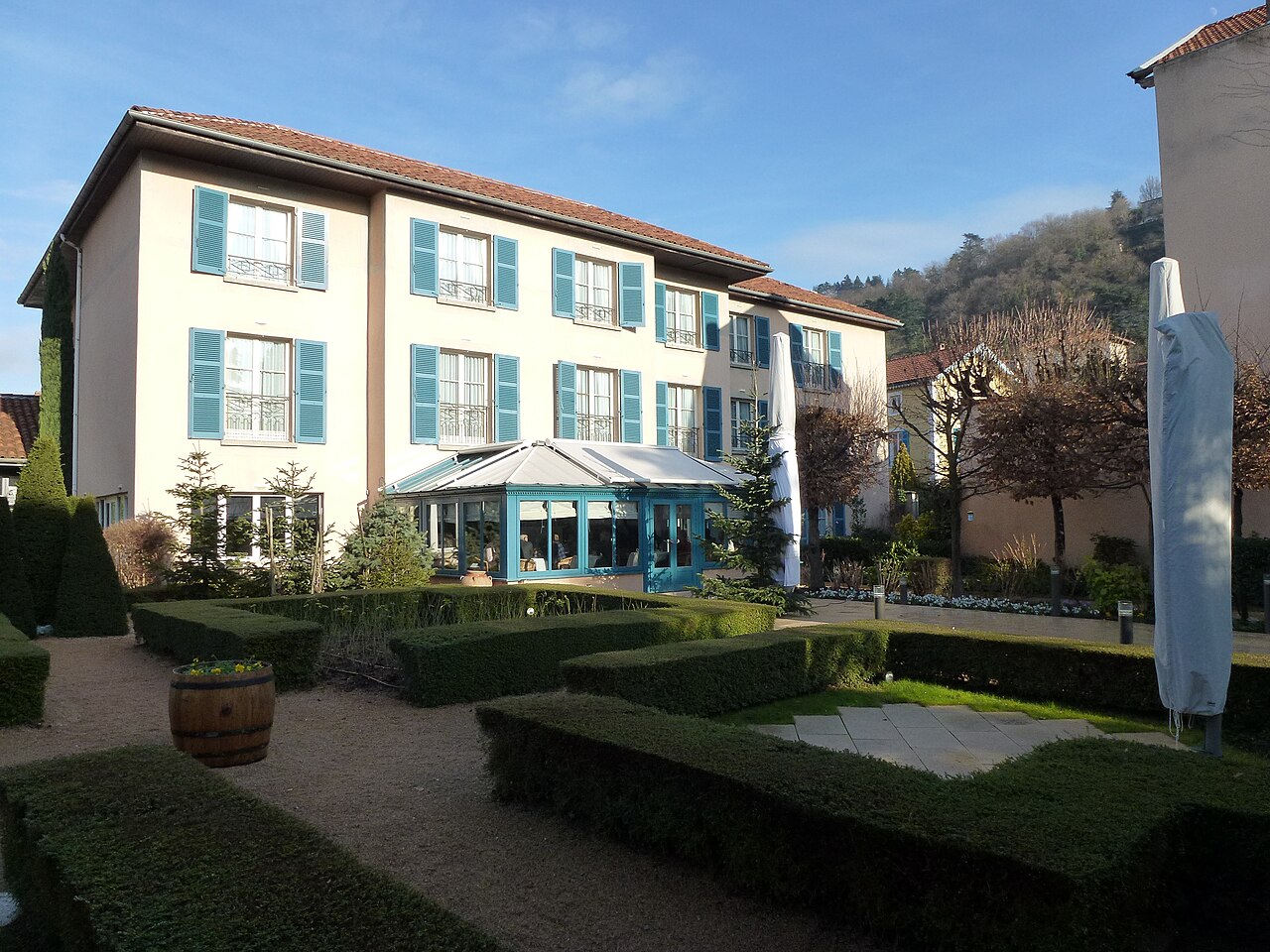
That is why the exterior photograph is the right image for this piece. A plated dish would make the story too narrow. The building, garden edge, and street frontage show the more durable point: La Pyramide's mythology has always needed an approachable physical container.[7] Fine dining history can float into abstraction, but a roadside house has to answer the door.
Why it still matters
La Pyramide matters in 2026 because many famous restaurants are now managing the same tension at higher speed: how to keep a historic name useful without turning dinner into heritage theater. The Vienne answer is unusually legible. Keep the old dishes available, but do not let them freeze the kitchen. Keep the hotel and garden in the story, because the guest is not only eating a plate but entering a house. Keep the cellar regional enough that the address remains in the Rhône rather than in the vague country called luxury. Keep the family language, but make it operational rather than sentimental.[1][2]
Point's influence still runs through French cooking because he taught later chefs to treat freshness, lightness, imagination, and mastery as serious virtues rather than casual ones.[3][5] Mado Point's continuity matters because she kept the work from dissolving into anecdote after 1955.[4][6] Henriroux's stewardship matters because he has had to make the legend hospitable to people who arrive by reservation rather than by apprenticeship.[1][2]
That is the La Pyramide lesson. A great restaurant does not survive by being famous. It survives when fame is converted back into systems that guests can feel: the welcome, the road, the cellar, the garden, the remembered dish, the updated plate, the room that refuses to become a museum. The roadside inn never disappeared. It became the structure that lets the legend keep working.
Sources
- La Pyramide, official homepage - current house history, 1822 origin, Nationale 7 setting, four-family continuity, 2022 bicentenary, Maison Henriroux stewardship, hotel, bistro, bar, and family-home framing.
- La Pyramide, "Fine Dining Restaurant" - official page on Patrick Henriroux's two-star restaurant, historic dishes available on request, 300-square-metre cellar, 1,500 wine references, Rhône Valley emphasis, and sommelier team.
- La Pyramide, "The Spirit of the Establishment" - official historical framing of Fernand Point, the 1933 three-star milestone, his pupils, and the "cauldron of French cuisine" reputation.
- Encyclopaedia Britannica, "Restaurant de la Pyramide" - concise reference on Fernand Point founding the Vienne restaurant, its reputation, Point's 1955 death, and Mado Point's continued stewardship.
- Kitchen Arts & Letters, "Ma Gastronomie" - bookseller reference on Mado Point compiling Fernand Point's notebooks, recipes, sketches, and tributes, and on La Pyramide's place in freshness, imagination, and nouvelle-cuisine lineage.
- Betty Hallock, "New life for a chefs' cult classic," Los Angeles Times, 2008 - archival article on the English edition of Ma Gastronomie, the 1974 interviews with Mado Point and disciples, and Mado's preservation of Point's recipes and credos.
- Wikimedia Commons, "File:Restaurant La Pyramide 1.JPG" - PHILDIC's real 2012 exterior photograph of Restaurant La Pyramide in Vienne, used as the article image.