At Lyla in Edinburgh, the seafood tasting menu can now end upstairs. Lyla began offering four bedrooms in April 2026, designed by the same Glasgow studio that shaped the restaurant below.[1]
The extension might have been a neat piece of branding and nothing more. Then morning arrives. Breakfast is brought to the room: pastries, gravlax, cheese, berries, juice and coffee. The restaurant's interest in the Scottish coast survives sleep and returns on the tray.[1]
That small continuity is the interesting part of a recent British restaurant-with-rooms cluster. At Lyla, four bedrooms have appeared above a Michelin-starred city restaurant. At Osip in Somerset, another four complete a farm-led restaurant in a former country inn. At JÖRO, seven apartments sit over a restaurant that moved from a shipping container into a nineteenth-century paper mill near Sheffield.[1][2][5][6]
Three businesses do not establish a national boom, and beds beside ambitious kitchens are hardly a new British invention. “Restaurants with rooms” is already a familiar travel category, stretching from pubs and farmhouses to grander destination properties.[8] What these three recent projects reveal is narrower and more useful: tiny room inventories are being authored as part of the meal. The restaurant is the gravitational center; sleep, breakfast, transport and retail are being pulled into its orbit.
Four rooms can hold the mood
Lyla's expansion is the cleanest urban version. The Georgian building on Royal Terrace already supplied height, symmetry and calm; Scarinish designed both floors, so the transition upstairs does not require a change of visual language. At publication, Lyla offered room-only stays as well as a dinner-and-room package, with breakfast included in both.[1] A guest can therefore buy the full sequence without the rooms becoming available only as an expensive menu supplement.
The practical luxury is a missing journey. After a long tasting menu, there is no taxi search, wet pavement or bright hotel lobby to break the spell. That advantage is an inference from the layout, not a promise the restaurant makes. But Wallpaper's account of climbing upstairs, sleeping and receiving breakfast in the room shows how completely four keys can alter the end of dinner.[1]
They also change the restaurant's obligation. A dining room can control light, music and temperature for several hours. A bedroom has to hold them through the night, when a rattling radiator or a poor mattress outweighs the elegance of the last sauce. The extension works only if hospitality remains convincing after the chefs have gone home.
At Osip, breakfast is another harvest
Osip makes the room-to-menu connection more literal. Its current home outside Bruton is a former country inn, and its daily-changing menu uses produce grown by the team on a nearby farm. The four bedrooms sit directly above the restaurant; Osip describes them not as an add-on but as the completion of a destination joining food, drink, art and design.[2]
Morning is folded into that proposition. Breakfast, included with a room, is served in the restaurant and changes with the seasons. A concierge can arrange complimentary transfers from nearby transport hubs, subject to availability—useful in a rural area where the restaurant itself warns that taxis are limited and Uber is unavailable.[3] The transfer is not peripheral service here. It is part of making a remote, three-and-a-half-hour dinner realistically inhabitable.[3]
Osip also makes the commercial contract unusually visible. Overnight guests must dine in the restaurant on at least one night of their stay. Check-in begins at 4 p.m., breakfast runs from 8 to 9.30 a.m., and checkout is at 11.[4] For a one-night stay, dinner becomes the middle movement of a 19-hour house rhythm.
The cancellation clocks expose the added complexity. A standard restaurant booking for fewer than six can be cancelled without charge more than 24 hours ahead, while a room requires 14 days for a full refund; group bookings of three or four rooms require two months.[3][4] That gap is not a diner trap hidden in small print. It is evidence that a bed commits the business to a different inventory problem than a table does.
JÖRO turned one booking into a small campus
JÖRO's move is the most expansive. The restaurant left its shipping-container home in Kelham Island for a renovated paper mill on the edge of the Peak District. The new site combines the flagship dining room with two bars, a terrace, an outdoor barbecue kitchen, a deli shop and seven rooms—five studios and two one-bedroom apartments.[6]
Upstairs, the rooms have kitchens and look toward Wharncliffe Woods and the Oughtibridge Valley. Guests can book them with a dining package or on a room-only basis. House-made continental breakfast is delivered to the apartment, while produce from the downstairs SHÖP gives the guest the option to carry part of the pantry upstairs.[5]
This is more than making the late journey home easier. The old restaurant concentrated its identity inside a compact industrial box. The mill distributes it across several tempos: tasting menu, terrace, live fire, bar, shop, sleep and breakfast.[5][6] A diner can experience the building as a tightly scored night; a room-only guest can treat it as a base near the Peak District. The restaurant remains the author, but it no longer insists that every visitor read the same chapter.
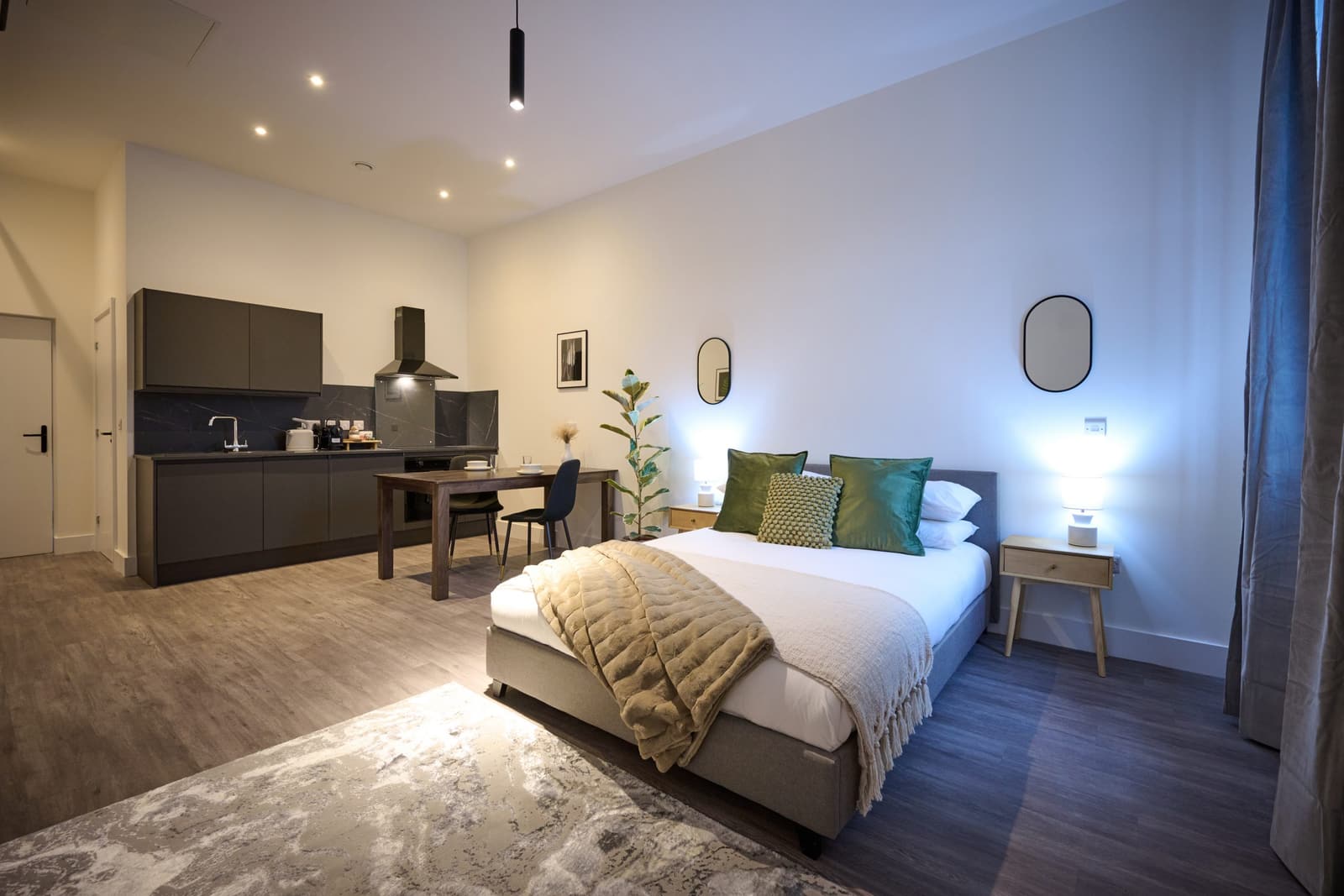
JÖRO's photograph of a studio apartment catches that change in scope. A made bed and a compact black kitchen share one open room; the breakfast tray and downstairs shop have somewhere to land. This is not dining-room decoration carried upstairs. It is a small piece of domestic infrastructure inside the restaurant's orbit.[5]
Hotel work arrives with the key
The seductive account of this movement is that a bedroom lets dinner continue. The truer account is that it makes a restaurant learn the least glamorous habits of a small hotel: luggage, housekeeping, hot water, nighttime noise, breakfast timing, transport, deposits and access.
Access is the sharpest test. Osip's restaurant is accessible, but its upstairs accommodation is not.[3] JÖRO likewise states that the Oughtibridge rooms can be reached only by stairs and cannot accommodate wheelchair users or people who struggle with steps.[7] The physical intimacy that makes four or seven upstairs rooms feel special can also make the full experience unavailable. Design coherence is not a substitute for inclusive circulation.
Breakfast creates a gentler but still demanding test. It cannot feel like the exhausted remainder of dinner. Lyla sends a compact picnic of seafood, baking and fruit to the room; Osip returns guests to the restaurant for a seasonal farmhouse breakfast; JÖRO delivers a continental breakfast to apartments equipped with their own kitchens.[1][3][5] Each answer fits the house. None lets the kitchen pretend its job ended with dessert.
That is why room count matters. Four, four and seven are not miniature hotels in any conventional sense. They are small enough for a chef-led identity to reach the bedside table, yet large enough to introduce hotel-grade failure points. The room earns its place when the mundane systems are as considered as the menu—not when a branded robe merely extends the merchandise shelf.
The inn returns with a tasting-menu clock
There is no single formula here. Lyla is an urban seafood restaurant whose rooms can be booked without dinner. Osip requires an overnight guest to dine and uses transfers, farm rhythm and breakfast to make a rural destination cohere. JÖRO has apartment kitchens and a shop, allowing the stay to loosen beyond the tasting menu.[1][3][4][5]
Together, they invert a familiar hotel-restaurant hierarchy. The bedroom is not the main product with a prestigious dining room downstairs; the meal sets the tone, and the rest of the building has to answer it. That inversion is the movement worth watching—not a claim that every ambitious restaurant now needs sheets and keys.
A tasting menu once had an easy final boundary: the last sweet, the bill, the door. A restaurant with rooms moves that boundary into the morning. The plate can be exquisite, but the whole idea now has to survive the mattress, the shower and the first coffee.
Sources
- Hugo Macdonald, “A Michelin-starred Edinburgh favourite adds rooms to its restaurant.” Wallpaper, August 11, 2026 — Lyla's four-room expansion, shared design language, breakfast and stay formats.
- Osip, “A farm-to-table restaurant and rooms in the heart of Somerset” — official overview of the daily-changing farm menu, country-inn setting and four bedrooms above the restaurant.
- Osip, “Rooms” — official breakfast, concierge, transfer, dining-duration, accessibility and cancellation details.
- Osip, “The Rooms: Terms & Conditions” — official check-in, breakfast, checkout, dining requirement and group-cancellation terms.
- JÖRO, “Oughtibridge Mill Rooms” — official room count, apartment features, breakfast service, room-only option, mill location and Tim Green photograph used for this article.
- Welcome to Sheffield, “JÖRO 2.Ö now open at Oughtibridge Mill” — account of the move from Krynkl, the paper-mill conversion and the expanded bars, terrace, barbecue, shop and room mix.
- JÖRO, “Frequently Asked Questions” — official booking, deposit and stair-only accommodation guidance.
- National Geographic Traveller (UK), “Looking for a gourmet meal and a good night's sleep? Try the UK's best ‘restaurants with rooms,’” May 13, 2025 — category context and an independent JÖRO profile.