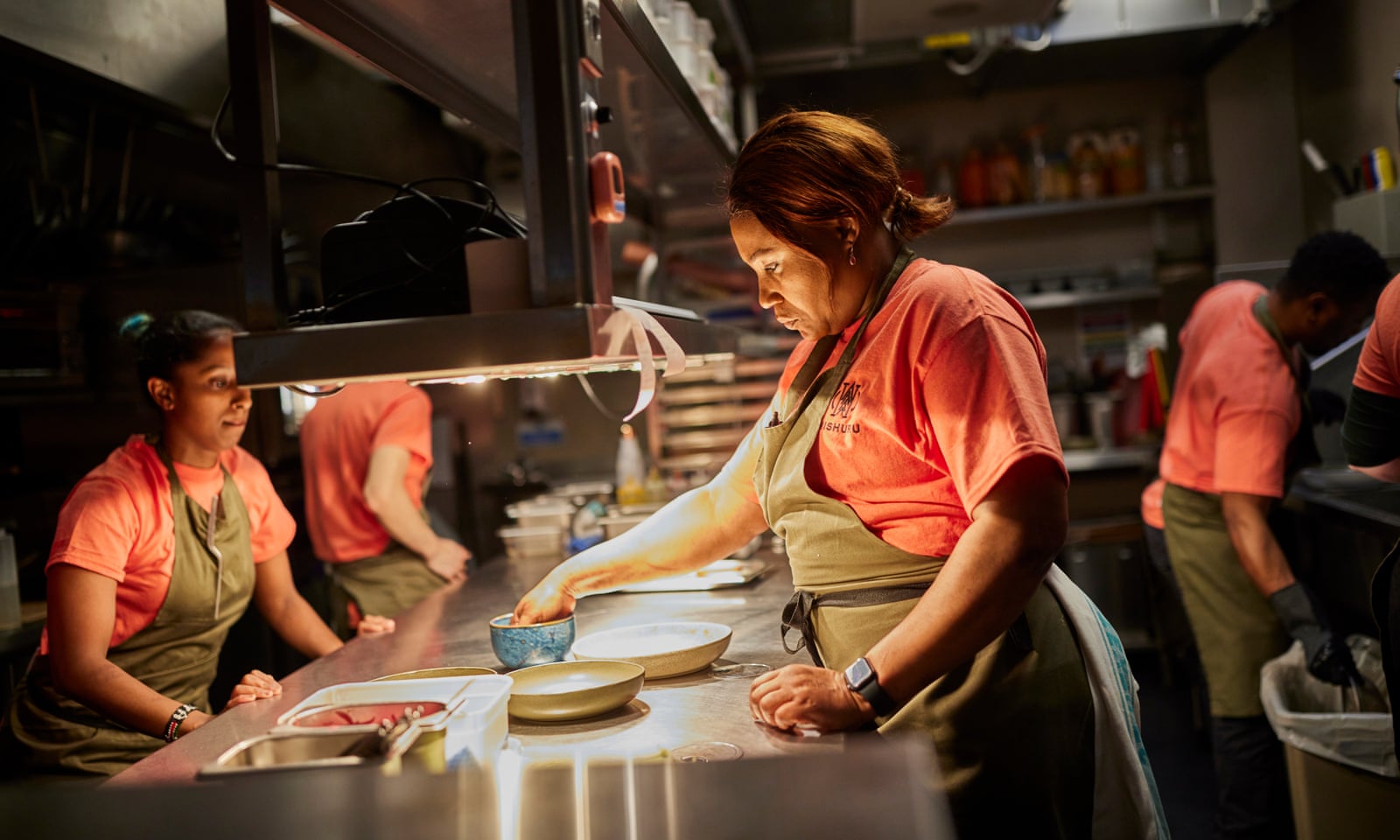

At eight in the morning, Chishuru does not look much like the old fantasy of a Michelin-starred restaurant. There is no silver dome, no murmuring dining room, no server brushing an invisible crumb from white linen. There are cooks in coral shirts, deep pots on the stove, a working pass, and chef-owner Adejoké “Joké” Bakare talking through the day while the kitchen is still becoming ready.
That is the useful tension inside The Staff Canteen's short film. The title leads with Bakare's historic Michelin recognition, but the camera keeps returning to ordinary restaurant time: prep, ingredients, shopping, teaching, and the handoff into service.[1] Chishuru itself resists the stiff vocabulary often attached to the award. Bakare and business partner Matt Paice prefer “set menu” to “tasting menu” and “wine flight” to “pairing”; the point is a relaxed, welcoming room, not a performance of formality.[3]
Watch for where the restaurant places the rigor that it removes from the dining room. It is in the sauce pot, the rice, the market trip, the team's repeated tasting, and the open kitchen. The film cannot transmit bitterness, smoke, fermentation, or chile heat through a screen. It can show the system that makes those sensations coherent for a guest who may be meeting them for the first time.
8:00 a.m.: the sauce station is a school
The film's first clock card appears around 0:13. Bakare is already in the kitchen, framed by metal, steam, and the practical scale of prep.[1] The scene is quiet, but the companion interview supplies its flavor logic: some of Chishuru's sauces and its jollof rice take hours, and Bakare describes sauce-making and rice cookery as the restaurant's core work. She still takes a close role while giving the team room to learn.[2]
That division of attention matters more than a signature flourish. A sauce is both a finished flavor and a record of judgment: when aromatics have cooked far enough, whether bitterness needs rounding or preserving, how chile heat sits against sweetness, and whether the base supports the main ingredient or covers it. Michelin's current listing praises Chishuru's controlled spicing and sauces that deepen ingredients without masking them.[5] The star may be visible on the door; calibration lives in the pot.
Bakare also treats tasting as education for cooks who did not grow up with these flavors.[2] That is a more demanding form of transmission than handing someone a recipe. A formula can name weights and temperatures, but it cannot by itself teach the moment when a sauce tastes integrated rather than merely blended. The team's palate has to acquire a reference point, then reproduce it under changing conditions.
This is why “authenticity” is too blunt a word for the work on screen. Bakare has explained that her food cannot be reduced to one Nigerian tradition: her parents are Yoruba and Igbo, she grew up in Hausa territory, and the culinary histories informing her cooking do not obey modern borders neatly.[7] Chishuru is not preserving a sealed national recipe book. It is making Bakare's particular field of memory teachable without pretending that one chef can stand in for all of West Africa.
10:58 a.m.: ordinary ingredients, accumulated decisions
Around 5:08, the chapter card reads 10:58 a.m. and Bakare lifts a tray of eggs in the working kitchen.[1] The image is almost aggressively unglamorous. That is its value. Fine dining often photographs the last ten seconds of a dish and hides the preceding hours. The film instead keeps catching food before it has acquired a plate, a name, or an explanation from the floor.
Rice makes the same point more forcefully. At Chishuru it can appear as jollof or as sinasir, a fermented rice pancake, among other forms.[3][7] Those are not interchangeable starches placed beneath “the real dish.” Fermentation, grain texture, cooking liquid, crust, and serving temperature determine how a sauce will land. The rice is structure: it absorbs, contrasts, carries, and gives the diner a way through intensity.
The Staff Canteen profile warns against the lazy idea that a layered West African preparation is simply a one-pot mixture in which every flavor arrives at once.[2] Chishuru's photographic spread makes the rebuttal visible. Rice, plantain, grilled or roasted elements, pickles, creams, and sauces remain distinct enough to be combined at the table. Complexity comes from relationships among parts, not from making each plate look complicated.
1:00 p.m.: London belongs in the larder
At about 7:46, the film leaves the restaurant for a shop whose shelves carry the packaged goods and ingredients of an everyday London food network.[1] The detour prevents “West African ingredients” from becoming an exotic pantry list. Bakare describes finding increasingly specific Nigerian produce in London markets, including breadfruit seeds that are fermented, washed, and used for their lactic flavor and dense texture.[2]
An earlier Eater photo essay documented the Brixton version of this route in 2022: plantain from one neighborhood shop, miscellaneous supplies from another, specialty rice and cassava flour ordered in, and yaji still sourced from Nigeria because Bakare did not trust a substitute.[6] That was a different site and an earlier stage of Chishuru, so it should not be mistaken for today's exact supplier sheet. It does reveal the durable method. Sourcing is a map of confidence, not a simplistic rule that “local” is always better.
The current restaurant is therefore London food in a precise sense. London supplies customers, cooks, markets, import routes, and the conditions for a West African set menu to become a neighborhood restaurant in Fitzrovia. Nigeria supplies memories, techniques, spices, and ingredient standards that cannot always be recreated nearby. Bakare's authorship lies partly in deciding which distance is acceptable and which substitution would change the dish's identity.
4:00 p.m.: the brigade makes flavor repeatable
The 4:00 p.m. chapter arrives around 8:26, when more bodies and faster motions fill the kitchen.[1] This is the film's compressed threshold between preparation and service. The chef is still visible, but the restaurant can no longer operate as an extension of one person's hands. Cooks have to recognize the same target; front-of-house staff have to translate the menu; plates have to cross the open pass intact.
Chishuru's open kitchen was a deliberate choice. Bakare wanted to preserve contact with guests, while the largely fixed menu removes the anxiety of navigating unfamiliar starters and leaves a more manageable choice of main.[3] Paice describes the floor team's explanatory work through ingredients and forms such as uda, uziza, grains of paradise, and sinasir.[3] Done badly, that kind of explanation can turn dinner into a lecture. Done well, it gives the guest just enough footing to taste with attention.
The set menu is thus not a prestige script. It is a hospitality tool. The kitchen controls enough of the sequence to introduce its flavor grammar; the guest keeps meaningful boundaries around dietary path and main course; the room stays musical and informal rather than ceremonial.[2][3] Choice is reduced so curiosity can increase.
What an eight-minute workday cannot prove
The Staff Canteen is professional food media, and its film is a polished portrait accompanied by a favorable chef profile.[1][2] Its eight minutes and forty-nine seconds do not audit wages, schedules, supplier economics, waste, or the physical toll of service. They cannot prove that every day runs as smoothly as this edit. The historical headline—the first Black female chef in the UK to earn a Michelin star—is important, but it can also pull attention back toward a lone-chef story if the brigade disappears behind it.[4][7]
The better use of the video is narrower. It lets us see where Bakare spends attention and how often authorship becomes teaching. Sauce is tasted by more than one palate. Rice has to survive more than one pair of hands. Ingredients move through a city before they move through the pass. The open kitchen carries explanation in both directions: cooks see the room, and guests see some of the labor behind the plate.
Near the end, Bakare sits in the dining room rather than posing over a finished dish.[1] The day has moved from pots to shelves to the pass and finally to the place where somebody eats. Chishuru's achievement is not that Michelin ceremony has been smuggled into West African food. It is that the restaurant relocates ceremony into care: long sauce work, practiced rice, selective sourcing, a trained team, and a set menu confident enough to welcome a guest without becoming stiff. The table can relax because the kitchen has not.
Sources
- The Staff Canteen, “A Day With the UK's Only Black Female Michelin Star Chef,” 2026 — the embedded YouTube film following Adejoké Bakare through morning preparation, shopping, and the transition into service at Chishuru.
- The Staff Canteen, “How Joké Bakare took West African cooking to Michelin-star level,” January 20, 2026 — companion profile on sauces, rice, breadfruit seeds, palate training, the set-menu format, and the restaurant photographs.
- The Michelin Guide, “Chishuru's Adejoké Bakare On Her MICHELIN-Star Success” — interview on the relaxed room, open kitchen, set-menu language, guided choice, ingredient explanation, and the move from Brixton to Fitzrovia.
- Chishuru, “About” — official chronology of Bakare's 2019 residency win, the 2020 Brixton opening, the 2023 Fitzrovia move, and the 2024 Michelin star.
- The Michelin Guide, “Chishuru — London” — current star listing and inspector account of the restaurant's spicing, sauces, ingredients, service, and atmosphere.
- Adam Coghlan and Michaël Protin, “Morning, Noon, and Night With Joké Bakare at Chishuru in Brixton,” Eater London, April 11, 2022 — an earlier photo diary of market sourcing, prep, rice, live fire, staff meal, and service.
- Neha Gohil, “UK's first black female Michelin-starred chef: ‘We're at the forefront of west African food,’” The Guardian, February 6, 2024 — Bakare's culinary influences, independence, Michelin milestone, and David Levene's kitchen photograph used as the article image.