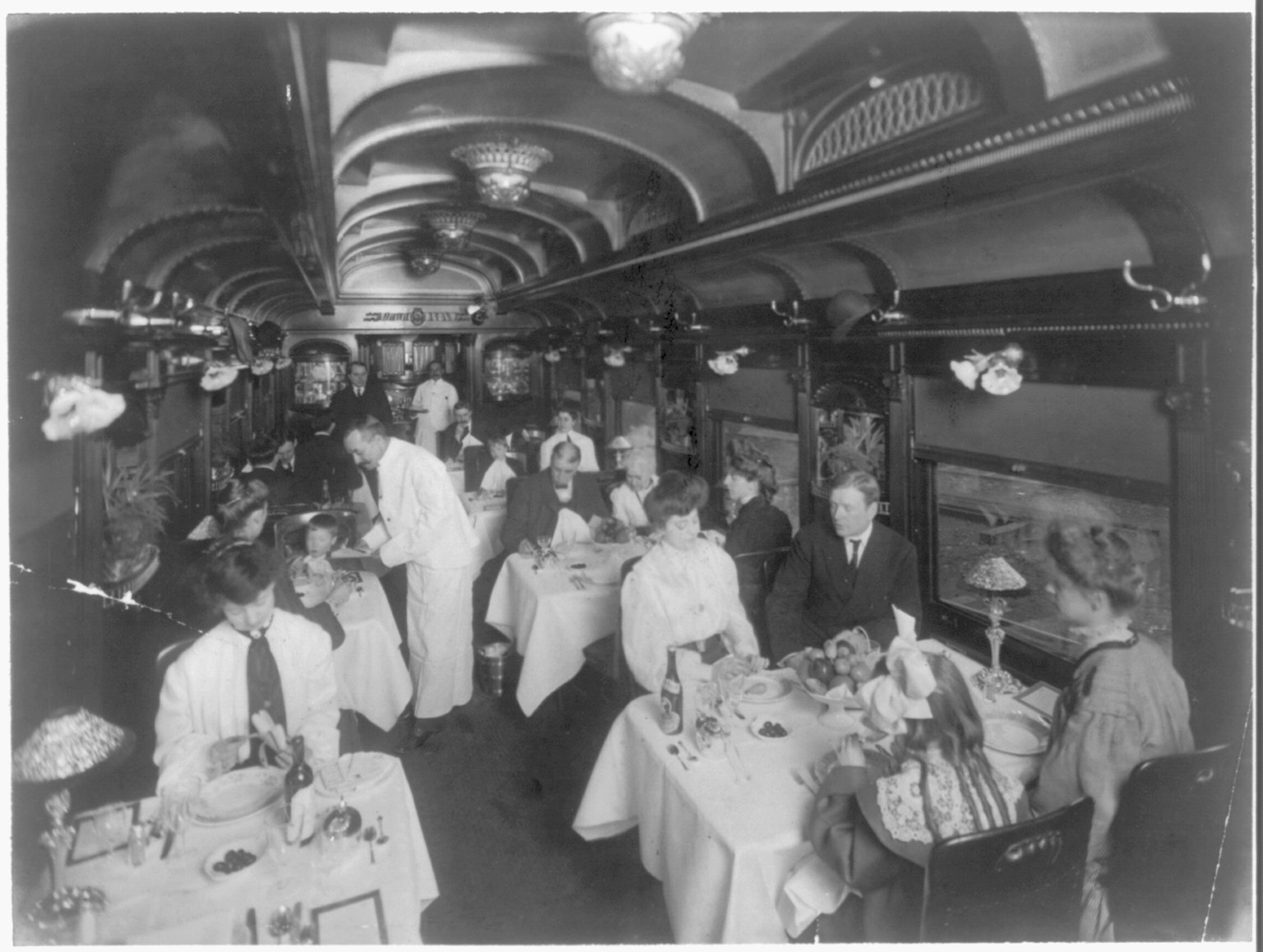
The photograph is wide enough to show both the luxury and the people producing it. Around 1905, a railroad dining car is crowded beneath a procession of curved ceiling ribs. Flowers soften the dark wood. Fruit rises in a bowl. White cloths make each small table look settled. In the narrow aisle, waiters in pale jackets lean between chairs with barely enough space to turn.[7]
The catalog identifies a dining-car interior filled with patrons; it does not say whether the car was underway when the shutter opened.[7] The stillness is useful anyway. It lets us see two histories that railroad publicity often pulled apart. On the table, regional dishes, patterned china and route names made travel feel edible.[1][2][3] In the aisle and galley, a labor-intensive service depended heavily on Black men working as waiters and chefs under racially restricted, low-paid conditions.[4][6]
The menu and carriage could name gumbo, Chesapeake seafood, Santa Fe and Cochiti more readily than they named the people carrying the room. Reading those two lines together—not polishing one and hiding the other—is where the dining car belongs in fine-dining history.
Before lunch could move, the journey had to stop
In the middle of the nineteenth century, eating by rail often meant bringing a basket or gambling on a station stop. The National Park Service describes prepared food going stale during long journeys and passengers trying to buy what they could in the short time before departure. Its history traces an important intermediate step through Civil War hospital trains, which carried kitchen and dining areas so that wounded soldiers could be fed without halting the train.[1]
Civilian experiments followed. The Philadelphia, Wilmington and Baltimore Railroad designated three cars for dining, although their food was prepared in advance rather than cooked during the trip. Pullman then joined cooking, eating and travel more completely. Its hotel car President entered service in 1867 with a menu that included gumbo; in 1868, a dining-only car appeared under the name Delmonico.[1]
The name did editorial work. Delmonico's was already shorthand for a grand New York restaurant, so attaching it to a railcar told passengers what standard they were meant to imagine before a plate arrived. The claim was not merely food is available. It was restaurant ceremony can travel with you.
That distinction begins the lineage. A hamper feeds a passenger. A station restaurant interrupts a journey. A dining car absorbs the meal into the transport system, then turns the route itself into part of what the passenger is buying.
A route brand still required a full brigade
Once meals moved onboard, the architecture began writing the service plan. The galley could not expand for a busy night. Tables could not be pushed into a private room. Supplies left with the train or had to meet it farther down the line. Staff and guests also needed to pass safely between cars; in 1887, Pullman patented the Sessions Vestibule, an enclosed, flexible connection that helped make that movement less hazardous.[1]
A surviving B&O dining car makes the labor scale unusually concrete. The car that became No. 1083 began as a 36-seat heavyweight diner in the mid-1920s. After a major 1954 rebuild, its crew numbered 12: one steward, six waiters, a chef, two cooks, a dishwasher and a pantryman.[2] That is not a universal staffing formula, and the car's assignments changed over time. It is evidence of how many distinct jobs could sit behind one compact room's appearance of ease.
The roster divides the work into a chain: the steward at the dining-room threshold; waiters carrying orders and plates; cooks in the galley; a pantryman between production and service; a dishwasher returning a finite stock of tableware. That description is an inference from the listed jobs rather than an operating manual, but it makes the labor intensity legible.[2]
Capacity therefore became part of the cuisine. Santa Fe's streamlined Cochiti, built for the Super Chief and placed in service in 1937, originally seated 36. Only near the end of its career was that increased to a tighter 46. The California State Railroad Museum estimates that the car served more than a million meals over 31 years.[3] Whatever romance passengers attached to the view, the operation was multiplication: the same small room reset again and again across a continent.
A route could season the menu
Railroad dining was standardized enough to travel and specific enough to sell a place. Pullman's early gumbo suggested a world beyond generic roast meat.[1] The B&O promoted Southern fried chicken and Chesapeake Bay seafood in the car later rebuilt as No. 1083.[2] On the Cochiti's first Super Chief run, the menu ranged from sirloin steak for two at $2.75 to swordfish, poached salmon and boneless chicken pie.[3]
Norfolk & Western menus preserved by Virginia Tech add a more intimate boast: apple or peach pie was described as “baked on car today.” The same collection lists roast sirloin, a “Famous Salad Bowl,” breakfasts, snacks and beverages rather than one ceremonial set meal.[5] These records complicate the sepia fantasy that every rail dinner was a procession of silver-domed courses. A dining car had to cover appetite across a long day, not stage only its glamorous hour.
Regional dishes served two purposes at once. They differentiated one railroad from another, and they made the route seem edible: Chesapeake seafood belonged to the B&O's eastern identity; Santa Fe wrapped the Southwest into the Super Chief's names, interiors and tableware. The Cochiti itself was named for Cochiti Pueblo, while its Mimbreno china drew motifs from ancient pottery of the Mimbres Valley.[3]
That second example needs a boundary. The museum record documents a corporate design program; it does not establish what the named communities approved, supplied or gained. Regional storytelling can connect a meal to terrain, but it can also turn living cultures into luxury atmosphere. A responsible history has to notice both the specificity and the appropriation risk instead of treating themed china as neutral scenery.
The white jacket did not make the work light
The brightest figure in the 1905 photograph is a waiter bending into the aisle. His jacket catches the light because the uniform is part of the room's visual order. Yet the image does not tell us his pay, hours, authority or life beyond the frame.[7]
Museum histories restore part of that missing context. The B&O Railroad Museum's dining-car exhibition describes African American men working as waiters and chefs under systemic racism that restricted their employment choices and concentrated them in low-paid, grueling service jobs.[4] The National Park Service likewise includes dining-car waiters among the railroad occupations taken up by Black workers after the Civil War and identifies Pullman as a major employer of African Americans.[6]
The job titles matter. The National Park Service lists porters and dining-car waiters as distinct railroad occupations.[6] Folding every Black railroad service worker into the familiar Pullman porter label erases the food-service specialists who made the meal possible. It also makes the dining room look more effortless than it was.
There is another danger in correcting the record: hardship should not become the only thing we can see. Carrying plates on a moving floor, reading a table, sequencing orders with a small galley and preserving composure in a racially stratified workplace required skill. The point is not to replace nostalgia with pity. It is to recognize that the celebrated “service” was performed by people whose expertise and constrained choices belong inside the culinary account, not in a footnote after the china pattern.
The 12-person roster on B&O No. 1083 and the labor history in the museum's X-4045 diner describe the same luxury from opposite sides.[2][4] One names the choreography; the other asks who was permitted to perform it, and on what terms.
What the menu remembered—and what it left out
These sources do not prove that dining cars handed an operating model to modern restaurants. They document railroad dining on its own terms, not a causal family tree. Its place in fine-dining lineage is more critical: the car concentrated a familiar luxury mechanism, making geography vivid while making labor recede.
The surviving menus remember place in appetizing detail: gumbo, Chesapeake Bay seafood, a Santa Fe chicken pie, apple or peach pie baked onboard.[1][2][3][5] The rolling stock records preserve 36 seats, patterned china and a 31-year service life.[3] The crew roster and labor exhibitions have to do different archival work. They return cooks, pantry staff, dishwashers and waiters to a story that luxury objects can otherwise tell by themselves.[2][4][6]
There is a contemporary analogy here, but it should remain an analogy rather than a claim of descent. Any restaurant that sells a region through ingredients, names or craft motifs faces a question the dining car makes unusually plain: is place being treated as a set of attractive signals, or as a network of people whose authorship, work and benefit remain visible? The historical sources cannot answer that question for today's dining rooms. They can stop us from mistaking décor for the whole story.
Look again at the archival photograph. The windows give little away. The tables look momentarily complete, but the waiter in the aisle keeps the image from becoming a fantasy of self-setting cloths and self-arriving plates. The room is full of work.[7]
Sources
- National Park Service, “Pullman and the Advent of the Dining Car” — history of onboard food before dining cars, hospital-train kitchens, the President and Delmonico cars, and the Sessions Vestibule.
- National Museum of Railroad History & Innovation, “B&O No. 1083: Pullman Diner” — museum record covering the 36-seat car, 1954 rebuild, regional food and 12-person dining crew.
- California State Railroad Museum, “AT&SF Dining Car No. 1474 Cochiti” — collection history, Super Chief schedule and design, first-run menu, seating capacity and service life.
- National Museum of Railroad History & Innovation, “Dining on the B&O: The China Collection” — exhibition account of railroad tableware and the low-paid, demanding work performed by African American dining-car waiters and chefs.
- Virginia Tech Special Collections and University Archives, “Norfolk & Western Railway Menus, c. late 1940s–1960s?” — archival collection description covering full meals, snacks, prices and food advertised as baked onboard.
- National Park Service, “African American Railroad Workers” — overview of African American railroad occupations, including dining-car waiters, and Pullman's employment role.
- Wikimedia Commons, “Entire dining car interior LCCN99401038.jpg” — 1905 photograph credited in the record as copyrighted by Geo. R. Lawrence Co., with Library of Congress catalog provenance; source of the article image.