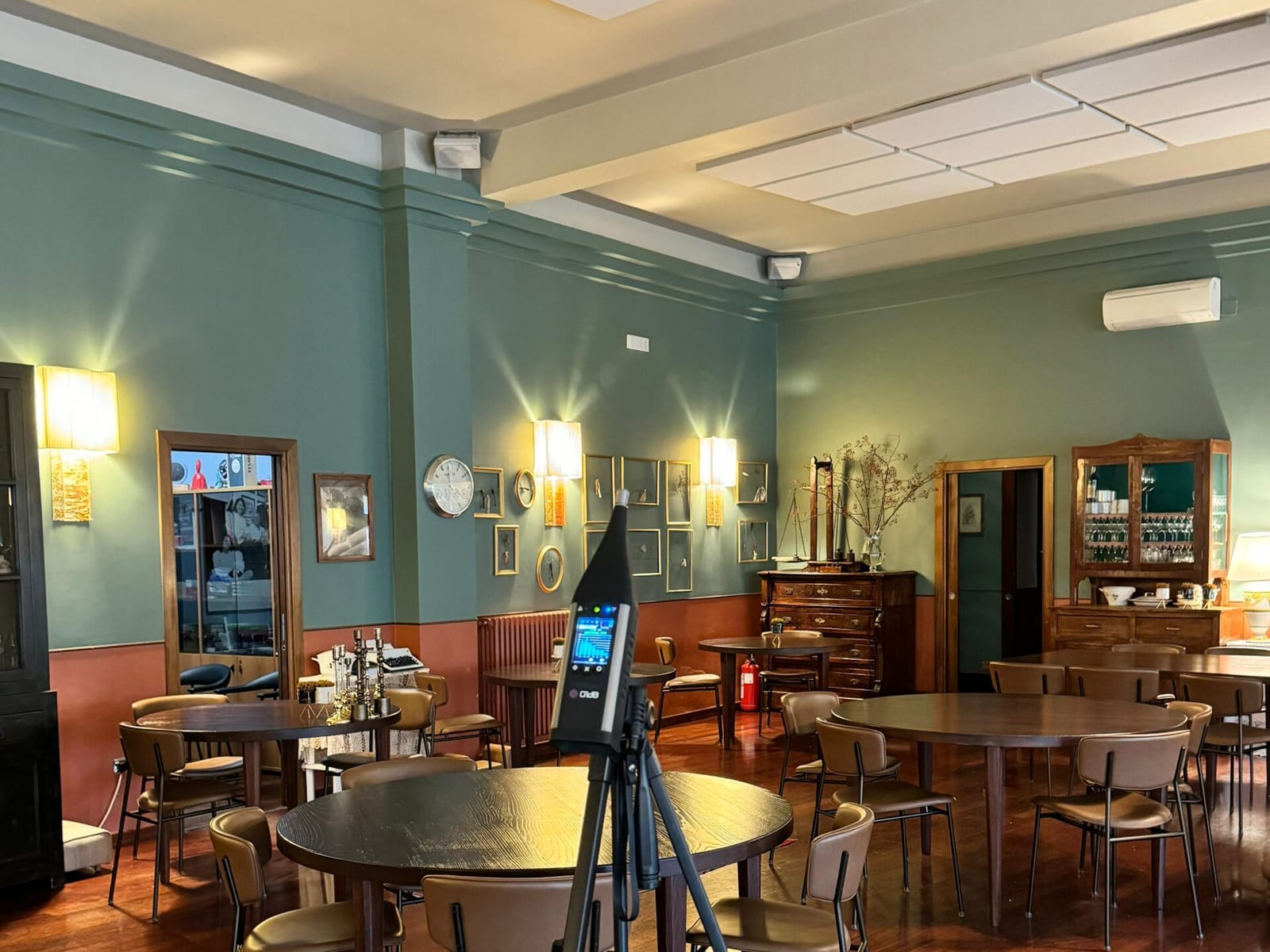
Before dinner at Oasis Sapori Antichi, an engineer fired a blank pistol in the dining room.
The shot was not theater. Microphones stood about 1.2 metres above the floor, clear of the walls, while the impulse travelled across green plaster, polished timber, glass cabinets, tables, chairs, and ceiling. The room's reply revealed what ordinary conversation had been fighting: sound took too long to leave.[1]
Fine dining measures almost everything else that decays. A sauce is reduced to the right density. A rested fish is watched by the degree. A hot plate has a short useful life between pass and table. Yet the room carrying the server's description and the guest's answer is often judged with two vague words—lively or loud—as if acoustics were a matter of temperament.
That dodge has consequences. A reflective room does not merely contain noise; it recruits diners into making more of it. Conversation gets harder, voices rise, neighboring tables rise in response, and the restaurant begins amplifying its own effort. The argument over whether this feels energetic or exhausting is usually treated as taste. The evidence says it is also design, operations, and access.
Oasis offers an unusually legible case because someone measured the room before and after treatment. The numbers do not establish a universal recipe for quiet. They do show that a dining room can be tuned with the same seriousness as the food—and that refusing to measure it is a choice.
A room can serve the previous sentence twice
Acousticlab's pre-intervention survey at the Michelin-starred restaurant in Vallesaccarda, southern Italy, reported an average reverberation time of 1.6 seconds. Reverberation time describes how long sound energy takes to fall away after its source stops. It does not mean that each word remains crisply audible for 1.6 seconds. It means late reflections keep arriving, smearing one syllable into the next and one table into another.[1]
The survey tracked two other measures. C50, which compares useful early sound with later reflected sound, was −1.8 decibels; STI, the Speech Transmission Index, was 0.53 on a scale where higher values indicate better transmission. The project team fixed 40-millimetre glass-wool absorbers across the ceiling, then repeated the measurements. Reverberation time fell to 0.8 seconds, C50 moved to +2.7 decibels, and STI rose to 0.64.[1]
In plain dining-room language: the room stopped finishing so much of every sentence for a second time.
The cover photograph is valuable because it refuses the usual fantasy of restaurant design. There is no perfect plate in a pool of light. A black sound level meter occupies the foreground; white panels interrupt the ceiling; empty tables wait below. The image shows hospitality as verification rather than mood.
The source also needs a boundary. This is a vendor-hosted case study, and it names the manufacturer's panels. It is not an independent randomized trial, nor does it publish a night-by-night guest survey. Its strength is narrower: a named acoustic engineer, a stated ISO measurement method, the actual instrument class, and before-and-after room metrics. Those data support the conclusion that the intervention changed the room. They do not prove that every restaurant should copy its ceiling.
Noise recruits the guests
The most important sound source in a full restaurant is often the restaurant's own customers. When background sound rises, people involuntarily increase vocal effort so they can be heard. This is the Lombard effect, and it turns a room from a passive container into a feedback loop.
A 2021 field study makes that loop visible. Researchers measured sound levels and reverberation while 142 guests evaluated 12 Berlin restaurants during ordinary service. Longer reverberation was associated with higher sound levels, and the relationship grew with the number of guests. Higher sound levels predicted lower soundscape pleasantness and lower overall restaurant-quality ratings; the authors also found that atmosphere mediated part of how diners interpreted the sound.[5]
That last point explains why bad acoustics can survive. People do not experience a decibel number in isolation. They experience candlelight, music, a full bar, the clink of good stemware, and the social proof of a crowded room. Noise can borrow glamour from everything around it. By the time conversation becomes work, the room has already labeled the effort as buzz.
A much larger but less controlled dataset found the same problem from another direction. Gregory Farber and Lily Wang analyzed crowd-sourced readings from 2,376 New York restaurants and bars. Their exploratory study found many reported levels unconducive to conversation, while venue managers' own online descriptions tended to understate loudness.[2] Phone-based crowd data cannot replace calibrated measurement: devices, positions, occupancy, and recording durations vary. It can, however, expose the scale of a blind spot. Operators are not always reliable judges of the rooms in which they spend every service.
This is why “maximum capacity” is the wrong endpoint. A room also has an acoustical capacity: the number and arrangement of people it can hold while preserving the kind of communication the restaurant claims to offer.[4] Fire code determines how many bodies may enter. Hospitality should determine how many conversations can still function.
The target is not silence
A tasting room should not sound like an anechoic chamber. Some sound is useful. It masks private conversation across neighboring tables, gives a room social warmth, and lets laughter feel communal rather than exposed. A perfectly dead room can be as uncomfortable as a reflective one.
The research therefore does not supply one magic reverberation time for every dining room. The Berlin study notes strikingly different published recommendations: for the same example room, one standard suggests 0.85 seconds, while another acoustical model recommends 0.38 seconds. Its authors describe restaurant sound design as a trade-off between comfort and liveliness, shaped by the character of the place.[5]
That trade-off is not permission to stop measuring. It is the reason to measure the intended experience. A six-seat counter, a vaulted dining hall, and a bar-led bistro do not need the same soundscape. They do share a test: can a guest hear a companion and a server without turning every exchange into projection?
New York's Atera provides a second measured example. In a manufacturer-published account of the restaurant's acoustic fit-out, recessed ceiling panels and a textile curtain cut reverberation by more than half and reduced the noise level by about 5 decibels.[6] The point is not that five is the sacred number. It is that visual intimacy—a compact room, dark materials, close counter seats—does not guarantee acoustic intimacy. The surfaces still have to do the work.
Nor is absorption only a construction detail. Music level, loudspeakers, table spacing, open-kitchen exposure, glass and plate handling, chair movement, and the pace at which a room fills all enter the same system. A restaurant that adds panels but turns up the playlist to recover “energy” has treated a feedback loop as a volume knob.
Does noise change the food?
This is where an appealing claim outruns the evidence. It is easy to say that a noisy restaurant makes its dessert less sweet, its seasoning weaker, or its wine flatter. Laboratory work suggests sound can alter some sensory judgments, but the record is mixed.
Charles Spence's review of the research describes experiments in which loud background sound changed ratings of sweetness, saltiness, aroma, or texture. In one study, participants eating under 75–85 decibels of headphone noise rated sweet foods less sweet and salty foods less salty than under 45–55 decibels, yet their liking ratings did not change. Earlier studies found no clear taste effect, and different experiments used different foods, sounds, tasks, and listening conditions.[3]
That is not a basis for claiming that an acoustic panel improves a chef's sauce. Much of the work was conducted with headphones or controlled noise, not a table of friends inside a working restaurant. Real dining adds aroma, expectation, attention, music, conversation, and the sound made by the food itself.
The defensible conclusion is subtler. Excess noise competes for attention and can mask delicate food sounds—the crack of a shell, the snap of a tuile, the quiet fizz of a pour—that contribute to texture and anticipation.[3] Acoustic comfort protects the conditions in which a diner can notice. It does not season the plate.
Quiet is an access feature
The liveliness defense also tends to imagine one frictionless listener. It ignores guests who process speech differently, rely on lip-reading, use hearing aids, tire quickly in competing voices, or simply came to dinner to talk.
A 2022 Scientific Reports study tested 31 adults over 60 with normal hearing, mild hearing loss, or moderate-to-severe hearing loss. Participants encountered prerecorded restaurant noise from 35 to 85 decibels while researchers measured vocal effort, word recognition, communication disturbance, and stated willingness to spend time and money. The authors found that keeping background noise below 50 decibels minimized the impact on intelligibility and vocal effort in their test.[4]
That number should not become another decorative target. The experiment used one laboratory table, a fixed artificial talker, no lip movement, and no hearing aids; the authors state those limitations. Its practical force lies in the direction of the result: as noise rose, understanding fell, disturbance increased, and participants with hearing loss faced a steeper barrier.[4]
There is a separate worker question. The World Health Organization stresses that hearing risk depends on level and duration: its current safe-listening guidance gives 40 hours per week at 80 decibels but only four hours at 90 decibels.[7] A guest's two-hour dinner and a server's repeated shifts are not the same exposure. A room can be merely tiring for one person and an occupational concern for another.
Calling acoustic clarity an amenity therefore undersells it. A quiet table available on request, a server who faces the guest while speaking, a music system that can come down before the room reaches its peak, and a fit-out tested for speech are forms of access. They also happen to be gracious service.
The room needs a real service
The honest acoustic test is not an architect clapping once in an empty shell. It is a mock service with the playlist on, ventilation running, glassware moving, seats occupied, and voices coming from every direction. Measurements should sample the quiet corner and the reflective center, the first seating and the full room. Then the team should repeat them after the intervention instead of trusting a product specification.
Oasis's ceiling is not visually invisible, but it is visually calm. That matters. Acoustic work fails when it is treated as emergency foam applied after the room's “real” design is complete. Absorption, upholstery, curtains, spacing, and speaker placement belong in the material language from the start. So does a plan for re-testing after hard furniture replaces soft prototypes or an open kitchen begins sending metal-on-metal sound into the room.
The controversy is not loud versus quiet. It is whether a restaurant may charge for attention while designing a room that consumes it.
The blank pistol at Oasis supplied a useful answer. The dining room spoke, the instruments recorded how long it kept speaking, and the ceiling changed. No plate looked different afterward. The service became easier to hear.
Sources
- Domenico Russo and Acousticlab, “Evaluation and optimization of acoustic comfort in restaurant environments: the case of Oasis Sapori Antichi.” Acoustic Bulletin, August 18, 2025 — measurement method, before-and-after metrics, ceiling treatment, and the article's real dining-room photographs.
- Gregory S. Farber and Lily M. Wang, “Analyses of Crowd-Sourced Sound Levels of Restaurants and Bars in New York City.” Proceedings of Meetings on Acoustics, 2018 — exploratory analysis of 2,376 venues and manager-versus-reported loudness.
- Charles Spence, “Noise and its impact on the perception of food and drink.” Flavour 3, 9 (2014) — open review of restaurant noise, taste, aroma, texture, and the mixed boundaries of laboratory evidence.
- Pasquale Bottalico, Rachael N. Piper, and Brianna Legner, “Lombard effect, intelligibility, ambient noise, and willingness to spend time and money in a restaurant amongst older adults.” Scientific Reports 12, 6549 (2022) — controlled study, accessibility findings, acoustical-capacity framing, and limitations.
- Jochen Steffens, Tobias Wilczek, and Stefan Weinzierl, “Junk Food or Haute Cuisine to the Ear?” Frontiers in Built Environment 7 (2021) — field measurements and patron responses across 12 Berlin restaurants.
- Kvadrat Acoustics, “Atera restaurant | A+I” — project account reporting the restaurant's integrated acoustic treatment and measured reductions in reverberation and noise.
- World Health Organization, “Deafness and hearing loss: Safe listening” (updated March 6, 2026) — current guidance on sound level, exposure duration, monitoring, and hearing risk.