Rannaghor asks dinner to climb a narrow staircase before it serves a single bite.
Above Sienna Calcutta in a nearly century-old Hindustan Park house, the room contracts to eight seats, an open kitchen, a counter, and the people cooking. Small fish recur on the walls and table pieces. Plates and bowls come from Sienna's pottery practice in Shantiniketan.[2][3] The official terms are unusually concrete: thirteen courses, dinner at 8 p.m. from Friday through Sunday, and ₹4,500 per person including tax and service charge.[1]
That could describe a familiar global chef's-table format. Rannaghor's distinction is what it puts inside the format: not a parade of isolated Bengali references, but the momentum of a Bengali meal. Bitterness opens the appetite. Vegetables and fish keep changing texture and status. Duck and rice restore gravity after the small plates. Milk sweets and a pantry digestif close the arc.[2][3]
This is a reported walkthrough, not a claim to have occupied one of the stools. The named plates reconstruct Rannaghor's August–September 2025 opening menu, documented in published accounts and a diner's photograph of the printed sequence.[2][3][8] A March 2026 local review confirms that the kitchen keeps changing dishes as its research and seasons move.[4] What follows is therefore a map of the menu's grammar, not a promise of precisely what will appear on a future night.
Before course one: make the kitchen the room
The ascent matters because Rannaghor is less a restaurant hidden above Sienna than Sienna reduced to its most concentrated form. The business began with pottery made in Shantiniketan, then grew into clothing, a café, and a broader project about Bengal's food and craft. Rannaghor brings those strands within arm's reach: clay beneath the food, fish worked into the room's visual language, and chefs Avinandan Kundu and Koyel Roy Nandy narrating ingredients from across Bengal as they cook.[1][2][4]
The official description uses epar and opar—this side and the other side—to frame West Bengal and Bangladesh as a connected culinary territory rather than two tidy menu categories. It also makes a large claim for a small room: food can preserve microregional stories that popular accounts leave unheard.[1] The scale helps. At eight seats, provenance does not have to arrive as a paragraph printed under a course name; it can pass directly from cook to diner.
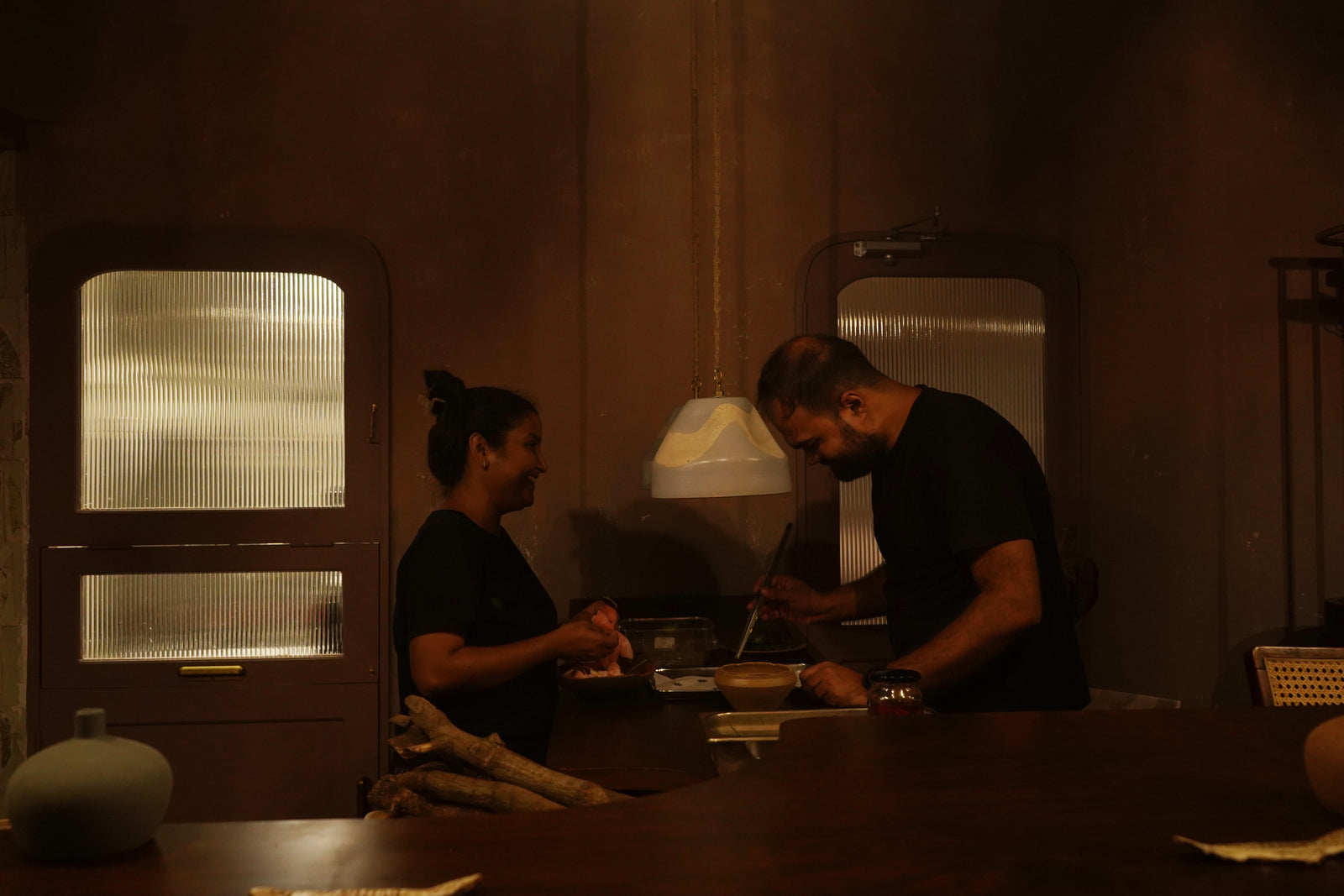
The cover photograph catches that exchange without turning it into spectacle. Two members of the kitchen team bend over the counter under warm, low light. One is plating; the other is smiling. There is no wall separating production from hospitality. The image is atmospheric, but it is also operational evidence: a thirteen-course story here depends on cooks being able to hold a room while they cook for it.[1]
Course one: bitterness gets the first word
The documented opening menu begins with Ucchey-Ol. A piece of bitter gourd sits on elephant-foot-yam foam, finished with mango-pickle oil.[2][3] The plate is small, but its argument is exact. The kitchen has not chosen bitterness for fashionable abrasion. It has kept the position that bitterness often occupies in a Bengali lunch and altered the delivery system.
Food writer Tushita Patel describes teto, the bitter opening, as a recognized first course in a traditional Bengali meal, with uchché among the ingredients that can perform it.[5] Rannaghor preserves that opening cue, then assigns three distinct roles to bitter gourd, yam foam, and mango-pickle oil. The point is not to make the gourd stop being bitter. It is to keep bitterness explicit while letting other components frame it.
There is a useful historical boundary here. No single procession can stand in for all Bengali eating across centuries, communities, classes, and both sides of the border. Sahapedia's historical survey finds different old texts prescribing different sequences—one beginning with sweet, another with rice and ghee before greens and vegetables.[6] Rannaghor is therefore not recovering one eternal order. It is choosing a legible Bengali order and using it as contemporary composition.
That is the first clue to the entire meal. Heritage here is a verb: select, compress, contrast, continue.
The opening act: let fish change its job
The most playful first-act course in the published menu is Snacks-Jam, a charcuterie board whose names arrive from one culinary vocabulary and whose materials answer in another. Katla belly becomes “bacon.” Stingray is processed into salami-like discs. Raw mango cooked with jaggery supplies the jam, while house-made Dhakai ponir sits on a black-rice crisp in the cheese position.[2]
This could have been a substitution trick—local ingredient cosplays European object—but the sequence makes it more interesting. Bengal's freshwater fish is not merely swapped into a bacon slot and congratulated for resemblance. Katla belly, processed stingray, crisp rice, fresh cheese, and fruit-and-jaggery jam are separated so the diner can notice how many structural roles the region's pantry can fill. A familiar board becomes a classification game.
It also unsettles the hierarchy of fish. Katla is widely recognizable; stingray is less likely to lead the polished restaurant image of Bengali cooking. The 2025 account notes that the latter is more associated with rural homes than bhadralok kitchens.[2] Putting both on one board does not erase that social difference. It makes the difference visible enough to discuss.
Condé Nast Traveler's 2026 Hot List entry preserves the same opening-menu progression. It follows Ucchey-Ol and Snacks-Jam with Offal-Kagji, a skewer of organ meats sharpened by lime emulsion and dried goat-heart chips.[3] The movement from bitter vegetable to reclassified fish to brightened offal gives the opening act energy without relying on caviar, wagyu, or another international luxury shorthand. Value is being produced by editing, labor, and the surprise of category.
One detailed account describes the opening act as largely vegetable- and fish-led.[2] That restraint is important. If the kitchen introduced its heaviest meat and richest rice too early, thirteen courses would feel like thirteen claims competing for emphasis. Instead, the first act stays quick on its feet: bitter, crisp, sour, riverine, and only then animal-rich.
Intermission: leave a hinge in the meal
After the opening act, the published sequence pauses. Diners can stand, talk, or step onto the small balcony before the second act.[2][8] In a long meal, this is not dead air. It is punctuation.
Long tasting menus often confuse continuity with relentlessness. Course follows course, descriptions accumulate, and attention flattens precisely because the restaurant never releases it. Rannaghor's break admits that bodies and conversations have their own pacing. It also gives the menu a hinge: the first half can behave like inquiry; the second can return with the weight of a main meal.
The room reinforces that change of register. A line from Satyajit Ray's Apur Sansar appears by the balcony, recalling a domestic exchange between Apu and Aparna.[2] The reference does not need to become another edible quotation. Its placement outside the course sequence lets cinema, marriage, habit, and Kolkata memory enter dinner without being plated.
Act two: duck, kochu, and rice restore gravity
The second act begins, in the documented menu, with Duck-Kochu: roasted duck glazed with Sundarban honey, maan kochu mash, and a jus perfumed with radhuni.[2] The course changes the menu's center of mass. Crisp little arguments give way to a slice, a mash, and a sauce—forms that ask the diner to settle back into the meal rather than keep guessing what each object might be.
Later comes Mangsho-Rezala, a meat-and-rice idea recast as mutton rizala risotto made with fragrant Karpurkanti rice and finished with bone-marrow butter.[2][8] “Risotto” describes the handling, not the destination. The emotional destination remains rice receiving the richness of meat.
This is where the menu's modernity is easiest to misread. A European technique or label does not automatically make the course more advanced than the household or ceremonial food behind it. Its useful function is editorial: the risotto format binds rice and sauce into one controlled register, while the named local grain keeps the plate tied to the meat-and-rice relationship it is interpreting. The test is whether technique clarifies that relationship. On paper, this course is built to do exactly that.
The arc now becomes visible. Rannaghor did not abandon Bengali meal logic to build a tasting menu. It used tasting-menu scale to isolate that logic one transition at a time.
Dessert: turn the sweet shop into a finale
The savory sequence ends, but the menu does not treat dessert as one small concession to the Bengali sweet tooth. Across three closing courses, the opening menu used sweet-and-sour summer fruit, Horlicks ice cream, and Mishtir-Dokan, a miniature sweet shop.[2][3][8] That final assortment included a tiny pointed gourd filled with sweetened cottage cheese, malpua with Kalimpong cheese and honey, and shorbhaja, the layered fried-milk sweet.[2]
The three moves reveal a single strategy. The kitchen does not force nostalgia into one tone. Malted childhood memory, seasonal fruit, fried milk, fresh cheese, and jaggery each occupy a different register.[2][3]
The last drink completes the return to the pantry: a gin riff on jowaner arak, a carom-seed digestif.[2][3] After thirteen courses of reframing, the finish is not a trophy bottle or a final burst of smoke. It is a household medicinal flavor crossing into the bar.
That is a satisfying place to end because it makes the menu's ambition smaller and larger at once. Smaller: the final idea can fit in a pantry bottle. Larger: a pantry contains enough memory, argument, and technique to organize an entire fine-dining experience.
What the thirteen courses are buying
Rannaghor's official price and schedule make the offer unusually easy to parse: eight people, thirteen courses, one 8 p.m. seating per service night from Friday through Sunday, and ₹4,500 inclusive.[1] The official page calls it approximately two hours, while a District ticket schedules 8–10:30 p.m.; allowing two to two and a half hours is the honest planning range.[1][7] Whether that represents good value on a particular night still depends on execution that published descriptions cannot guarantee—temperature, seasoning, pacing, substitutions, and the quality of the chefs' narration in the room.
What the sources do establish is a coherent reason for the format. The menu is not long because length itself signals luxury. It needs room to preserve transitions: bitterness before abundance, multiple lives for fish, a deliberate pause, meat returning with rice, sweets unfolding in plural, and a digestive note at the end. Compress that into three courses and the ingredients might survive, but the syntax would not.
The strongest way to read Rannaghor, then, is not as a museum of disappearing dishes or a laboratory making Bengali food respectable to an international audience. The restaurant's own language is more ambitious than either frame: Bengal already contains the material, memory, and culinary intelligence; the work is to bring lesser-heard parts to the foreground and let them speak to one another.[1][4]
The narrow staircase prepares the diner for a small room. The menu opens that room onto a much larger geography. By the time the carom seed arrives, the thirteen courses have made their central claim: modernity does not require leaving the Bengali meal behind. It can begin by listening more closely to the order in which that meal already knows how to speak.
Sources
- Sienna Calcutta, “Rannaghor / kitchen” — official restaurant philosophy, current booking terms, location, service format, and the real kitchen photograph used as this article's image.
- Diya Kohli, “Rannaghor by Sienna Calcutta is a made-in-Bengal enterprise for the world.” Condé Nast Traveller India, September 9, 2025 — restaurant history, chefs, room, two-act menu sequence, named courses, and opening-menu detail.
- Diya Kohli, “Rannaghor by Sienna.” Condé Nast Traveler, Hot List 2026 — current recognition and concise account of the thirteen-course structure, handmade crockery, opening courses, desserts, and digestif.
- Rachna Srivastava, “Review: Rannaghor by Sienna in Kolkata is a starter kit on all things Bengal, epar and opar.” The Gourmet Edit, March 20, 2026 — recent local review confirming the evolving menu, chefs, microregional focus, room, and booking pattern.
- Charukesi Ramadurai, “A Beloved Bitterness.” Whetstone Magazine — reported context on teto, uchché, and bitterness as a first course in traditional Bengali meals.
- Sutapa Sengupta, “Our Food Their Food: A Historical Overview of the Bengali Platter.” Sahapedia — source-based history of Bengali ingredients, meal prescriptions, regional variation, and culinary change.
- District by Zomato, “The Chef's Table at Rannaghor by Sienna” — ticketed schedule and duration for the eight-seat tasting-menu experience.
- Utsav, “Two Bengali Meals.” The Gourmet Glutton, September 21, 2025 — firsthand launch-menu account with a photograph of the printed sequence, including the intermission position and the Mangsho-Rezala course name.