Restaurant Botanic's most persuasive luxury move is not that it sits inside a beautiful garden. Plenty of restaurants borrow landscape as atmosphere. The more interesting thing in Adelaide is that the garden has become part of the supply argument: a 51-hectare setting, native Australian ingredients, artisan producers, ferments, temperance pairings, and a room built to keep the outside world near the plate.[1][2][3]
That distinction matters because "botanical" can become a soft word very quickly. It can mean flowers around the room, edible leaves on the dish, or a menu that smells faintly of foraging without changing the real procurement system. Restaurant Botanic is stronger when read less romantically. Its public materials and current local coverage point toward a more practical model: a restaurant that uses the Adelaide Botanic Garden as a live reference point, then widens outward through South Australian producers and a native pantry that has to be managed, fermented, paired, and explained course by course.[1][2][4]
As of the current public pages, the restaurant's Food & Beverages page lists a long botanical vocabulary rather than a conventional dish-by-dish menu: wattle seed, bush tomato, warrigal, Geraldton wax, kumquat, bunya, Illawarra plum, karkalla, quandong, saltbush, sorrel, lemon aspen leaf, Davidson plum, lemon myrtle, native ginger, paperbark, mountain pepper leaf, and more.[1] Broadsheet's Adelaide venue guide, updated 30 March 2026, gives the diner-facing consequence: Jamie Musgrave's over-20-course menu makes use of the garden's bounty and premium state suppliers, with examples such as crocodile-fat tortilla, sea urchin with bush tomato, desert lime and wattleseed, and emu with warrigal greens, karkalla, emu liver, fermented onion, and preserved truffle.[4]
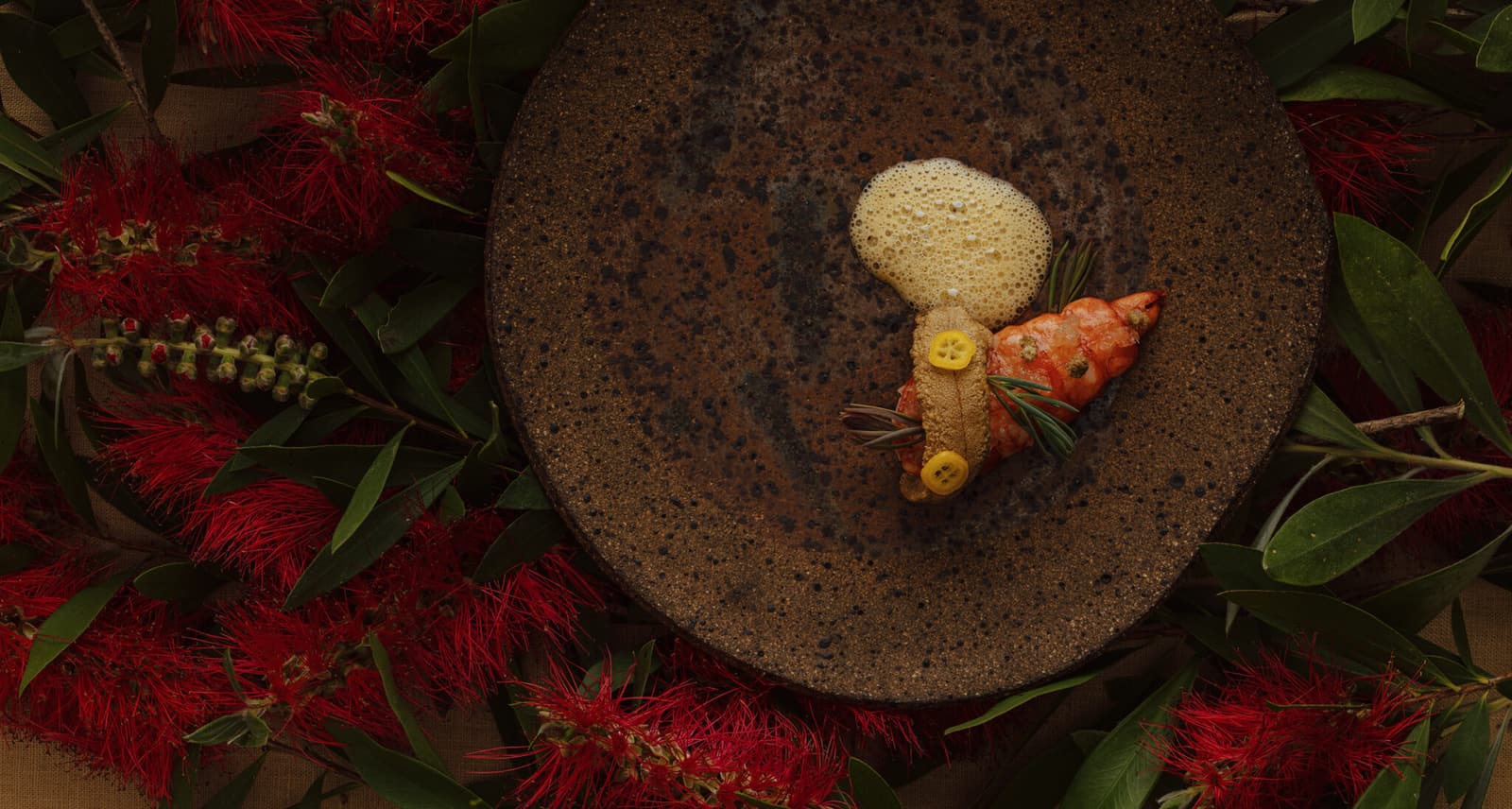
Image context: this post uses Restaurant Botanic's official food photograph because the argument is about a plate that still remembers the landscape around it. The red bottlebrush, leaves, dark ceramic, shellfish, foam, and native garnish are doing visual work: they show how the restaurant frames Australian ingredients as living material rather than as a list of exotic names.[1]
1. The garden is not just scenery
The World's 50 Best Discovery profile gives the basic physical fact: Restaurant Botanic is set inside Adelaide's 51-hectare botanical gardens, and the kitchen uses ingredients plucked from the surrounding gardens.[3] The Botanic Gardens and State Herbarium's 2022 announcement, written when the restaurant was named Gourmet Traveller's Restaurant of the Year, uses the same scale marker and frames the restaurant as a modern Australian experience rooted in the garden setting.[5] Those two descriptions are useful because they prevent the garden from becoming mere backdrop.
A restaurant inside a garden has two possible failures. It can turn the setting into decoration, where the menu could be moved anywhere and still behave the same way. Or it can become didactic, forcing every course to perform botany before it performs appetite. Restaurant Botanic's current sourcing language aims for the narrower path between those traps. The garden supplies immediacy, but the menu still has to work as dinner: texture, heat, bitterness, smoke, acidity, sweetness, and drink pacing all have to arrive before the guest feels as if they are being lectured.[1][3][4]
The public ingredient list is especially telling because it mixes familiar and less familiar materials. Sorrel, thyme, shiso, gooseberry, horseradish, kumquat, and juniper can speak to a broadly international fine-dining palate. Quandong, lemon aspen leaf, mountain pepper leaf, Geraldton wax, scented emu bush, bunya, karkalla, and wattleseed pull the meal back toward a more specific Australian pantry.[1] The point is not to make every guest recognize every word. The point is to make the meal dependent on a pantry that cannot be swapped for generic European luxury.
2. Native ingredients need kitchen infrastructure
The strongest sourcing stories are rarely the prettiest ones. They are logistical. Restaurant Botanic's official About Us page says chef Jamie Musgrave works with artisan producers and rare native ingredients, bringing experience from Vasse Felix, Rockpool Bar & Grill, and One Star House Party into the restaurant's current direction.[2] Broadsheet adds that Musgrave joined the team in 2021 and now carries the restaurant after Justin James' highly recognized period, building an over-20-course menu on garden produce and suppliers around South Australia.[4]
That transition matters. A restaurant can inherit a setting, but it has to renew the sourcing system under each chef. Musgrave's task is not simply to keep the room famous. It is to keep turning native and regional ingredients into a menu that has enough structure to survive repeat scrutiny. Broadsheet's current dish examples show why this is difficult: crocodile fat, squid tentacles, saltbush, emu, paperbark smoke, bluefin tuna garum, bush tomato, desert lime, wattleseed, fermented onion, preserved truffle, strawberry gum, and macadamia all ask for handling decisions before they ask for praise.[4]
The useful word here is "infrastructure." Rare native ingredients do not become luxury by being rare. They become luxury when a kitchen knows which ones can carry fat, which ones sharpen seafood, which ones need fermentation, which ones belong in a sauce, which ones should stay aromatic, and which ones can disappear into a drink or dessert without losing identity.[1][2][4] Restaurant Botanic's ingredient list reads like a pantry map, but the real value is in the unseen sorting work behind it.
3. The drink program completes the sourcing report
Fine-dining sourcing articles often stop at the plate. Restaurant Botanic makes that too narrow. Its current Food & Beverages page leads with "sunrise lime kombucha" and links a wine tasting menu, while the About Us page says sommelier Elle Foster curates rare and expressive wines and that the restaurant was recognized for Australia's Best Food & Wine Matching List at the 2025 Australia Wine List of the Year Awards.[1][2] The same About Us page says general manager Alma Pasalic leads a temperance program built around native Australian ingredients, with the restaurant receiving 2025 Best Non-Alcoholic Pairing recognition.[2]
Those details change how the sourcing story should be read. If the kitchen is using wattleseed, lemon myrtle, saltbush, native ginger, finger lime, paperbark, Illawarra plum, quandong, and Davidson plum, then wine alone cannot be the only interpretive tool.[1] A temperance pairing can become a second map of the landscape: infusions, kombucha, garden teas, mocktails, and native aromatics can echo ingredients without flattening them into sweetness. Broadsheet's listing supports this reading, noting ferments in the temperance menu, including kombucha, infused juices, garden-blend teas, mocktails, and cocktails such as a koji Old-Fashioned and wattleseed Espresso Martini on the alcoholic side.[4]
This is where the restaurant feels more mature than a simple "garden restaurant" label. The drinks are not a sidecar. They are another way of carrying place through time. A plant can enter as garnish, acid, smoke, tea, infusion, ferment, spirit-adjacent aroma, or dessert register. The more forms the restaurant can manage, the less likely the meal is to become a parade of rare ingredients presented one at a time.
4. The room keeps the sourcing visible
Restaurant Botanic's 2021 reopening matters because the room was rebuilt to show more of the work. Broadsheet records the shift clearly: after a closure and revamp, the restaurant reopened with a new open kitchen and hearth, a curved 12-seat chef's table watching the action, a 650-bottle wine cellar, and a refreshed dining room.[4] That design is not separate from sourcing. A kitchen that depends on a wide native pantry benefits when the guest can sense prep, fire, plating, and handoff as part of the experience.
The 50 Best Discovery profile describes sage interior beams, pendant lights, rustic accents, pairing options, and the garden setting as the restaurant's romantic frame.[3] Broadsheet's design note makes the connection more explicit: green and brown tones, timber, marble, leather, stone, reclaimed timber cutlery rests, and a ceiling installation of garden foliage that changes seasonally.[4] The danger would be theme-park botany. The stronger reading is that the room keeps giving the guest small reminders of material source, season, and craft.
That physical continuity helps the menu stay legible. When the dining room, ceiling foliage, garden, drinks, and ingredient list all point in the same direction, native produce does not have to carry the entire symbolic load alone.[1][3][4] The plate can be smaller and more precise because the rest of the house is already doing contextual work.
Why it matters now
Restaurant Botanic is useful in 2026 because it shows a version of fine-dining luxury that does not start with imported prestige codes. Its prestige begins upstream: garden proximity, producer relationships, native pantry fluency, fermentation, drink authorship, and a room that makes the guest aware of where the meal is coming from.[1][2][3][4][5] The restaurant still sells ceremony, but the ceremony is attached to a working landscape rather than to generic opulence.
That is the harder achievement. A native ingredient list can impress once. A garden address can seduce once. A high-ranking restaurant can ride reputation for a while. The durable version requires a loop: the garden gives reference, producers extend range, the kitchen converts raw material into sequence, the drinks translate the same pantry into another register, and the dining room keeps the system visible without turning it into a lesson. At Restaurant Botanic, Adelaide's garden is not just outside the window. It is upstream of the meal.
Sources
- Restaurant Botanic, "Food & Beverages" - current page for the restaurant's botanical ingredient vocabulary, official food photograph used in this post, wine tasting menu link, and page update metadata.
- Restaurant Botanic, "About Us" - current page covering Jamie Musgrave, rare native ingredients, artisan producers, Elle Foster's wine program, Alma Pasalic's temperance program, and 2025 pairing-list awards.
- 50 Best Discovery, "Restaurant Botanic - Adelaide" - venue profile covering the 51-hectare botanical-garden setting, ingredients from the surrounding gardens, pairing options, tasting-menu price marker, address, and service notes.
- Broadsheet Adelaide, "Botanic Gardens Restaurant" - venue guide updated March 30, 2026, covering the 2021 revamp, Jamie Musgrave, over-20-course menu, garden produce, South Australian suppliers, dish examples, drink program, room design, 12-seat chef's table, and 650-bottle cellar.
- Botanic Gardens and State Herbarium, "Restaurant Botanic named Restaurant of the Year by Gourmet Traveller" - 2022 institutional announcement covering the restaurant's garden setting, 51-hectare scale, national recognition, and modern Australian positioning.