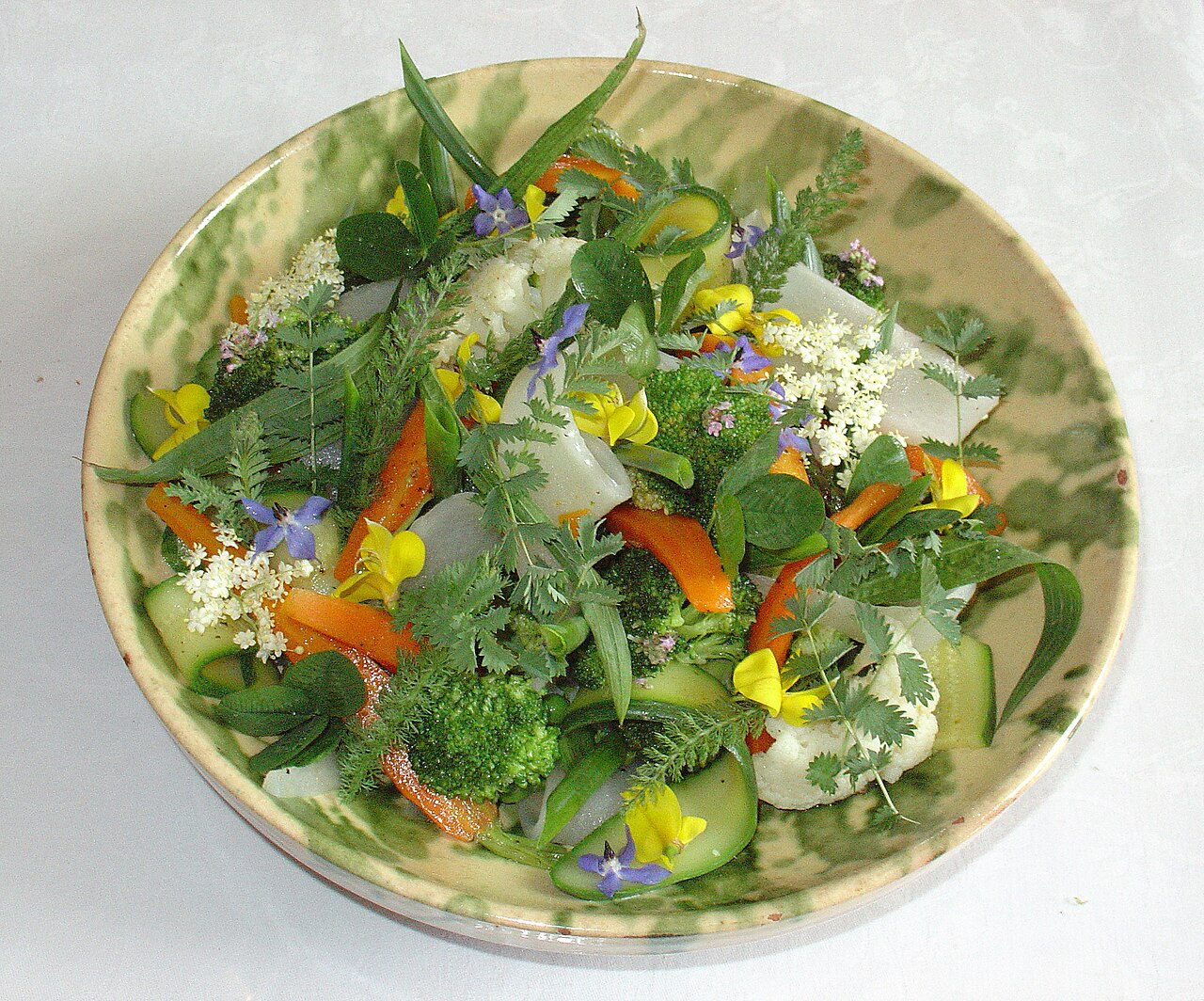
Gargouillou is often described as a salad because the English language needs somewhere to put it. On the plate, though, the dish behaves more like weather. Small vegetables, herbs, flowers, sprouts, roots, seeds, sauces, and warm-cool contrasts appear in a scatter that looks loose for half a second, then tightens into a rule: the vegetable has stopped acting as support and has become the main event.[1][2][3]
Michel Bras's own account, presented through his official Japanese project, traces the inspiration to the Aubrac plateau in June 1980, when flowers and herbs were in bloom. The same page describes Gargouillou as an ever-changing composition of roughly 80 vegetables, flowers, herbs, sprouts, roots, and seeds, with each element prepared in its own way.[2] The Bras family site gives the shorter family version: the Gargouillou of young vegetables brings together more than 60 shoots, seeds, and flowers, and Sébastien Bras keeps giving it pride of place in new forms.[3]
That range, 60 to 80, can sound like a stunt. It is more useful to read it as a labor count. Gargouillou asks the kitchen to make many tiny decisions before the guest ever sees abundance: what gets cooked, what stays raw, what is warmed, what is barely dressed, what needs a seed, what needs bitterness, what needs a floral note, and what should disappear into the background so another ingredient can speak. The drama is not the heap. The drama is the sorting.
Image context: this post uses the Commons photograph because it shows the dish type clearly while also making its limit visible. The photographed plate was prepared by Eric Sapet from Bras's original recipe, rather than being a current Le Suquet service plate; that distinction matters. The image is best read as a photographic reference for the form, not as proof of today's exact plating at Laguiole.[1]
1. The plate starts with a place, then refuses postcard logic
The dangerous way to talk about Gargouillou is to make Aubrac do all the work. A high plateau, wild herbs, flowers in June, a chef running through bloom: the origin story is beautiful enough to become a poster.[2] Bras's achievement is sharper than that. He did not simply put a landscape on a plate. He built a way for the plate to change with the landscape.
Le Monde's 2025 report on the Bras family makes the operating system visible. At Lagardelle, the garden connected to the family restaurant contains more than 250 varieties of shoots, stems, and roots, grown outdoors and across five greenhouses. The garden sits about 15 kilometers from Le Suquet, and a part of the brigade goes out before dawn with Sébastien Bras to gather what will shape the day's menu.[6] That matters because the dish is not only about inspiration. It is about morning work.
The current Le Suquet menu keeps the plate inside that living loop. The "Le Goût de l'Aubrac" menu, listed at 300 euros as a sample menu, includes "le gargouillou de jeunes légumes, herbes & graines germées" with green pepper, set inside a longer sequence of Aubrac and seasonal products.[4] The menu language is calm, but the implication is demanding: this is a classic that has to be remade through today's leaves, shoots, herbs, and timing.
2. The number matters because each piece keeps its edge
The charm of Gargouillou is easy to photograph and hard to cook. A weaker version of the idea would treat "many vegetables" as the point. Bras's version depends on separateness. His official Japanese page says each of the roughly 80 elements is prepared differently.[2] A Connexion France profile makes the same operational point from another angle: Bras describes the dish as a daily coming-together of young bulb vegetables, roots, pods, flowers, seeds, and herbs; the same profile places Michel Bras in the garden at 5:30 a.m. and Sébastien Bras on the road to the Rodez market to find ingredients for the day's dishes.[5]
This is why Gargouillou feels lighter than its labor. The plate does not ask the diner to admire technique as a heavy object. Instead, technique appears as freshness that has survived handling. A small carrot can still taste like carrot. A flower can carry scent without turning decorative. A sprout can stay crisp. A seed can interrupt softness. A warm element can keep the plate from becoming a cold arrangement. The dish's refinement is in making that many interventions feel like field notes rather than choreography.
It also changes what "seasonal" means. In a generic tasting menu, seasonality often means swapping spring peas for autumn mushrooms. Gargouillou works at a smaller grain. It can change because a leaf is ready, a shoot is tender, a flower is fading, a herb has sharpened, or the garden has given a different balance that morning.[5][6] The plate becomes a daily weather report written in edible pieces.
3. Vegetable-first fine dining starts here, then gets harder
The Bras page frames Gargouillou as a dish that helped move vegetables from garnish to main course, influencing French cuisine and the wider international scene.[2] That claim is large, but the plate earns it because it changed the vegetable's job. Before Gargouillou, haute cuisine could be brilliant with vegetables, yet the prestige grammar still tended to gather around meat, fish, truffle, foie gras, sauces, and service ritual. Gargouillou gave the vegetable a different stage: not austerity, not health signaling, not a side dish polished into luxury, but multiplicity.
That history is why the dish still feels contemporary in 2026. Many ambitious restaurants now speak fluently about gardens, regenerative agriculture, low-waste cooking, and plant-forward menus. The vocabulary has spread. Gargouillou's lesson is sterner than the vocabulary. It says the vegetable-first plate only works when the kitchen has enough botanical knowledge, picking discipline, mise en place, sauce intelligence, and confidence to let small things remain small.[2][5][6]
There is a useful restraint inside the abundance. A dish with 60 or 80 elements can easily become a chef's inventory list. Gargouillou avoids that when the diner experiences variety as movement: tender to crisp, sweet to bitter, herbaceous to earthy, warm to cool, quiet to aromatic. The plate is full, yet its real luxury is attention. Every small item has to justify its place through texture, temperature, scent, or rhythm.
4. The rating story is a side light, not the center
Le Suquet's relationship with Michelin is famous enough to distract from the dish. In 2018, Eater reported that Michelin removed Le Suquet from the France guide after Sébastien Bras asked to step away from the three-star pressure, quoting his desire to work with a freer spirit and less stress.[7] That episode matters here only because it clarifies the house's self-image. The Bras story is not best understood as a chase for external polish. It is a restaurant culture built around a place, a family, a garden, and a long argument with repetition.
The Connexion profile gives the more useful working lens. Michel Bras describes Gargouillou as a concentration of Aubrac, while Sébastien Bras describes the cooking as a personal mixture of Aubrac, travel, landscape, memory, people, and stories brought home.[5] That is the harder form of consistency: the dish must remain recognizably Gargouillou while refusing to freeze.
In that sense, Gargouillou is closer to a language than a recipe. A recipe promises that a cook can repeat a result. A language lets a cook say a new thing inside a known grammar. Young vegetables, herbs, sprouted seeds, green pepper, garden harvest, market luck, high-plateau memory: these are not ornamental nouns. They are the available words of the day.[3][4][5]
Why this plate still teaches
Gargouillou remains useful because plant-forward fine dining can still lose its nerve in two opposite directions. It can become severe, asking vegetables to prove moral seriousness. Or it can become decorative, covering the plate with flowers and leaves while leaving the old luxury structure untouched. Bras's dish points to a more pleasurable middle path: abundance without heaviness, technical work without visible strain, landscape without postcard sentiment.
The plate is beautiful, but beauty is not the main trick. The main trick is that it turns a restaurant's relationship with place into a sequence of edible micro-decisions. A leaf picked too late, a flower used as decoration, a root cooked without character, a sprout added only for height: any of those choices would weaken the grammar. When the dish works, the guest does not simply see a garden. The guest feels time, weather, labor, and appetite arranged into one bright field.
Sources
- Wikimedia Commons, "Gargouillou de légumes.JPG" - 2009 photograph by Yelkrokoyade showing a vegetable gargouillou prepared from Michel Bras's original recipe by Eric Sapet at La Petite Maison in Cucuron.
- Michel BRAS Côté Japon, "Le Gargouillou" - official presentation describing the dish's June 1980 Aubrac inspiration, roughly 80 elements, separate preparations, and influence.
- Bras, "The Inheritance" - official family page describing Le Suquet, the Gargouillou of young vegetables, more than 60 shoots, seeds, and flowers, and Sébastien Bras's continuing versions.
- Bras, "Menu Le Goût de l'Aubrac" - current sample menu listing the Gargouillou of young vegetables, herbs, and sprouted seeds within the Aubrac tasting menu.
- Connexion France, "Nature is the key to my dishes" - 2016 profile and interview covering Michel Bras's Aubrac garden routine, the daily composition of Gargouillou, the Rodez market run, and the dish's link to local stew.
- Le Monde, "At Michel and Sébastien Bras' restaurant, a taste for the world passes from father to son" - 2025 report on Lagardelle garden, more than 250 varieties, five greenhouses, and pre-service gathering for Le Suquet.
- Eater, "Michelin Takes Back 3-Star Rating at Chef's Request" - 2018 report on Sébastien Bras, Le Suquet, and the restaurant's request to leave Michelin's France guide.