The easy way to describe Reale is as a temple of purity: pale room, short dish titles, expensive restraint, and the kind of three-star calm that can look severe from a distance. That description catches the surface and misses the engine. Reale works because its quiet keeps acting like pressure. The setting at Casadonna, the stripped plate design, the bread program, and the dining-room tone all push in the same direction, compressing attention until small changes in flavor start to feel enormous.[1][3][4]
As of April 27, 2026, the public record is unusually coherent about that point. Niko Romito's own site still calls Reale the focus and driving force of his creative universe, a research and testing laboratory where all projects begin and where dishes are expected to open new paths rather than merely please.[1] The current menu page translates that philosophy into concrete form: a 230 EUR tasting menu, 120 EUR pairing, whole-table ordering, and dish names so reduced they read like concentrated prompts rather than sales copy.[2] Michelin's 2026 text then gives the strongest outside summary, describing a former 16th-century monastery whose austere simplicity mirrors a culinary language of rigorous minimalism, sensory depth, and just a few ingredients handled with almost ascetic precision.[3]
50 Best Discovery adds the useful bridge between those two worlds. Its current profile says the monastery once served as the family bakery, places Reale at No. 18 in the 2025 World's 50 Best Restaurants ranking, and describes Romito's work as "the Italian food of tomorrow," built through intense research, overlooked ingredients, and techniques such as pressure cooking.[4] Read together, the sources suggest that Reale's real luxury is not visual abundance or ingredient theater. It is concentration.
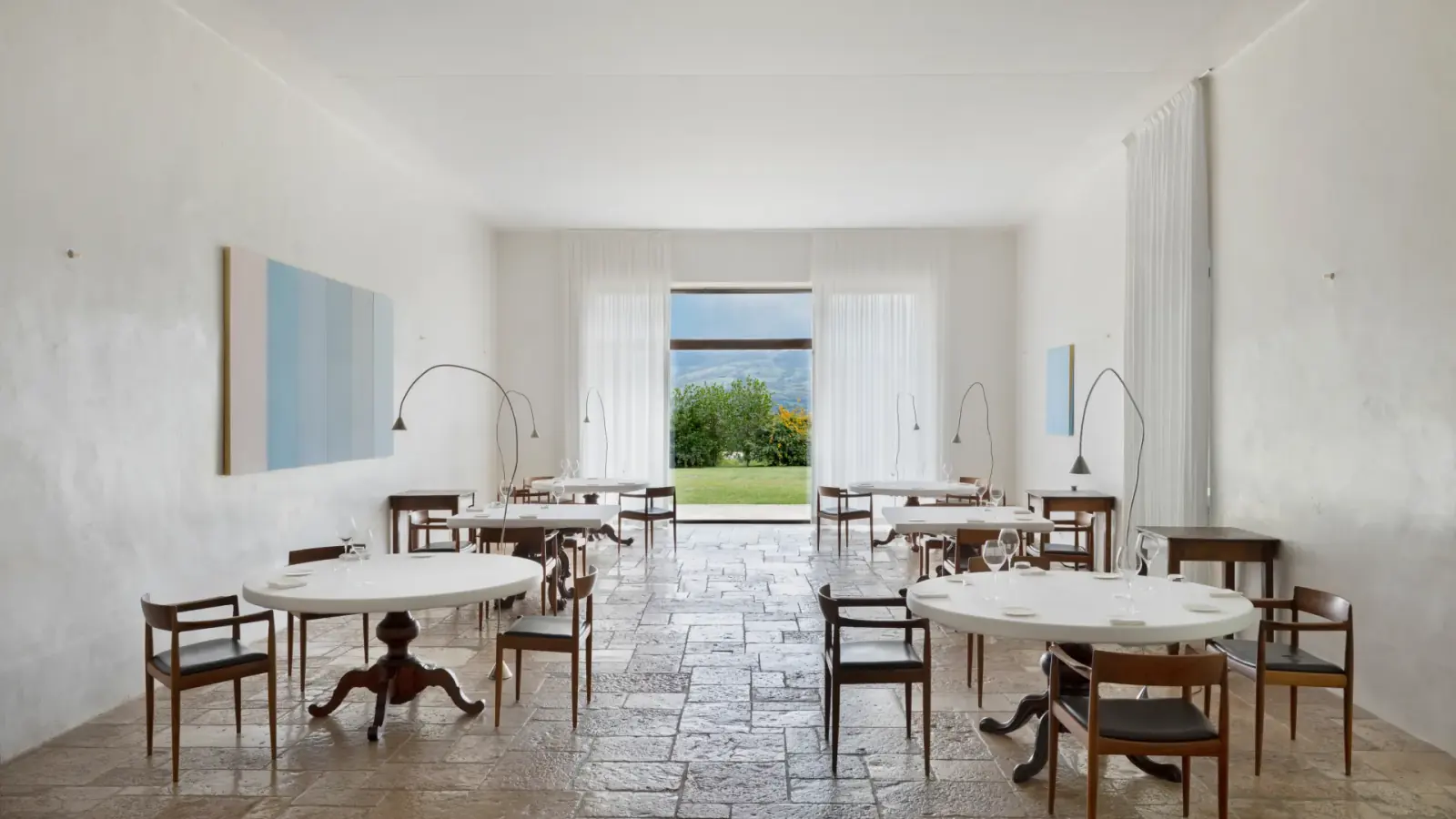
Image context: the lead image uses Reale's official dining-room photograph because the room itself explains the cuisine. The white walls, broad stone floor, spare tables, and framed view out to the garden make the meal feel less like a decorated event than a controlled field for perception. That is exactly how the cooking behaves too.[1]
1. Casadonna is not backdrop; it is part of the method
Reale does not sit in a generic luxury shell. Michelin places it on the first hilly slopes above the village, among vineyards and silent gardens, inside a former monastery whose austerity reflects the food.[3] 50 Best Discovery uses nearly the same architecture as interpretation, stressing that the old monastic setting and bakery history already hint at the restaurant's philosophy before any course arrives.[4]
That matters because Reale does not appear to want the room competing with the plate. Many destination restaurants use grand architecture to pre-inflate emotion. Reale lowers the temperature instead. The official image shows large pale walls, stone paving, dark wood, and daylight carrying the eye straight through to the greenery outside.[1] Nothing in that room asks for applause. Everything in it asks for steadier attention.
This is why the Casadonna setting feels functional rather than romantic. Reale's cuisine depends on tiny changes in intensity, texture, and aromatic release. A room with too much visual chatter would work against that logic. The monastery calm is not there to signify seriousness after the fact. It is there because the food needs a quieter acoustic, visual, and emotional field in order to register fully.[1][3][4]
2. Reale's minimalism comes after research, not before it
Romito's own definition of the restaurant is revealingly technical. On the official page he calls Reale a laboratory for ingredients and flavours, built on unrelenting study, constant research, and dishmaking that should become food for thought.[1] The house credo is phrased in similarly exact terms: start from the matter itself, catch its deepest essence, then develop complex processing techniques that enhance flavor in its purest and most vivid form.[1]
That language matters because it keeps Reale's minimalism from being mistaken for natural simplicity. Michelin's 2026 note describes dishes with very few ingredients, vegetables and proteins alike, orchestrated with almost ascetic precision while still holding full flavor intensity and palate clarity.[3] 50 Best Discovery makes the same point through examples rather than abstractions: cod with fig leaf, pigeon with pistachio, liquorice granita reimagined with vinegar and white chocolate.[4] The effect is stripped. The route there is not.
The live menu makes this visible. Course names such as "Celery, carrot and onion," "Duck and juniper," and "Spaghetti with Swiss chard" look almost disarmingly plain on the page.[2] Yet that plainness is part of the authorship. Reale is asking the guest to encounter ingredients after research has already done its hidden work. The title gives only the final nouns; the kitchen keeps the processing intelligence in reserve.[1][2]
This is where Reale separates itself from a lot of contemporary minimalism. In weaker versions, reduction becomes a style of omission. At Reale, reduction reads as compression. Fewer visible elements are carrying more pressure.[1][3]
3. Bread keeps the house tied to memory and labor
If Reale's short dish titles risk making the restaurant sound abstract, the bread program pulls it back to earth. Michelin's 2026 review goes unusually far on this point. It says the bread and baked goods are excellent, produced through almost maniacal flour selection, long controlled proving, and a bakery dedicated exclusively to doughs and breads of all kinds, so carefully made that bread could be treated as a course in its own right.[3]
That is not a side note. It connects directly to the deeper history of the house. On the official story page, Reale begins in 2000 when Niko and Cristiana Romito took over the trattoria his father Antonio had opened in Rivisondoli, a place that had previously been the family pastry shop.[1] 50 Best Discovery preserves the same continuity in one compact image: a monastery that used to be the family bakery.[4] Bread therefore functions on two levels at once. It is a technical object, and it is a memory object.
The result is important for how the whole restaurant feels. Reale can look cerebral from afar because the plates are so reduced and the philosophy is so rigorously articulated. Bread prevents that rigor from floating away into pure idea. It reminds the guest that Romito's research is still grounded in fermentation, flour choice, proofing time, crust, crumb, and repetition.[1][3] The restaurant's future-facing claims remain connected to one of the oldest and most labor-intensive forms of hospitality.
That grounding also explains why Reale's minimalism feels warm even when the visuals are spare. The bread arrives with the weight of craft, lineage, and daily work already inside it.[1][3][4]
4. Cristiana Romito keeps precision from turning cold
The final reason Reale reads as a complete restaurant rather than a brilliant laboratory is the dining room. The official page says Cristiana Romito guides guests through the journey and makes the experience the best it can be.[1] Her longer profile fills in the operating logic behind that sentence: hospitality should be authentic, flexible, and free of stiff ritual; the team is built on communication and a flatter structure rather than oppressive hierarchy; explanations should be clear without becoming overwhelming.[1]
That approach matters especially at Reale because the food could easily become intimidating in the wrong room. A menu at 230 EUR, a pairing at 120 EUR, and a requirement that the tasting menu be ordered by the entire table all create a strong house rhythm.[2] In a rigid dining room, those rules could harden into ceremony. Cristiana's stated service model softens the experience without diluting the restaurant's seriousness. Guests are given structure, but the interaction adjusts to what they actually want from the evening.[1]
You can see the larger coherence there. Reale reduces ingredients, removes visual noise, and writes short menu titles. The dining room responds by reducing friction rather than adding explanatory performance. Hospitality follows the same principle as the cuisine: take away what blurs perception, keep what deepens it.[1][2]
Why Reale still feels singular
Plenty of elite restaurants talk about seasonality, locality, innovation, and purity. Reale still feels singular because all of those claims are made to answer one stricter objective: sharpen the guest's perception instead of merely impressing it. Casadonna's monastery calm, the research-first kitchen language, the bread program, and Cristiana Romito's warm but unsentimental service all serve that single aim.[1][2][3][4]
That is why Reale's minimalism does not read as denial. It reads as concentration. The room strips away distraction; the menu strips dish naming back to essentials; the kitchen strips ingredients toward clarity; the service strips hospitality of stiffness while keeping exactness intact. What remains is unusually intense, because so much has been removed before the plate reaches the table.[1][3]
For diners, that means Reale is best understood as a restaurant of disciplined quiet. If you want overt theater, plenty of famous three-stars will give it to you. If you want to see how a modern Italian flagship can turn monastery calm, research, bread, and hospitality into one coherent pressure system, Reale remains one of the clearest examples in Europe.[1][2][3][4]
Sources
- Niko Romito, "Reale Ristorante" - official restaurant page covering Reale as a research laboratory, the evolving culinary credo, the story of the restaurant and Casadonna, Cristiana Romito's hospitality philosophy, the cellar, and the official dining-room image used here.
- Niko Romito, "Reale tasting menu" - current menu page covering the 230EUR tasting menu, 120EUR pairing, whole-table ordering rule, and the live course list including Celery, carrot and onion; Duck and juniper; and Spaghetti with Swiss chard.
- MICHELIN Guide, "Reale - Castel di Sangro" - 2026 guide entry covering the former 16th-century monastery setting, rigorous minimalism, sensory depth, Abruzzo linkage, and the bread program as a near-course in itself.
- 50 Best Discovery, "Reale - Castel di Sangro - Restaurant" - profile covering the former family bakery, No. 18 ranking in The World's 50 Best Restaurants 2025, the "Italian food of tomorrow" framing, and representative dishes such as cod and fig leaf, pigeon and pistachio, and liquorice granita with vinegar and white chocolate.