At a lot of globally acclaimed tasting-menu restaurants, the expensive mistake is obvious: you book the biggest format, add the most prestigious pairing, and only later discover that the last increment of spend bought status more than understanding. At FYN, the math is more interesting. The restaurant's own materials make clear that this is not just another luxury room with a generic menu ladder attached. It is a fifth-floor Cape Town restaurant built around a Japanese way of reading seasonality, restraint, and ingredient character through a modern African lens.[1][4]
That matters because FYN's current public pricing is unusually legible. The live Experience Dinner menu is R2,475, with three beverage lanes stacked above it: Experience Pairing at R1,690, South African Terroir Pairing at R2,790, and Cellar and Rarities Pairing at R6,590.[2] Lunch, by contrast, is R1,675 with a wine pairing at R1,295.[3] A discretionary 13.5% service charge sits on top of both services.[2][3] Once you lay those numbers beside the restaurant's concept, one conclusion emerges quickly: FYN's best value usually sits in the first pairing step, not the last one.
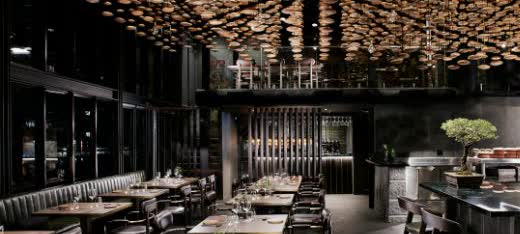
Image context: the lead image uses a real dining-room photograph from 50 Best Stories rather than a close-up of one plated course. That choice is deliberate. FYN's premium begins with the room, the ceiling of suspended wooden discs, the open kitchen, and the sense that Cape Town's downtown energy has been lifted into a more controlled altitude rather than shut out entirely.[5]
1. First price what you are actually buying
The easiest way to misread FYN is to think the bill is mainly paying for ingredient rarity. The official home page argues for something broader: "land and sea," memory, texture, and a Japanese culinary philosophy of seasonal restraint are all treated as part of the house style.[1] The 50 Best Discovery profile sharpens that into a dining-room picture, describing an industrial space under a cloud of wooden discs where South Africa is interpreted through techniques rooted in Japan.[4]
That framing matters for value because it tells you where the fixed costs of the experience really sit. You are paying for:
- a destination room on the 5th floor of Speakers Corner in central Cape Town,[1][2][3]
- a kitchen language that keeps Japanese discipline and South African product in tension,[1][4]
- and a menu structure that reads as a designed sequence rather than a string of one-off luxury plates.[2][3]
If that core proposition interests you, the restaurant already starts delivering before the top beverage tier enters the conversation. If it does not, no prestige pairing will rescue the booking.
2. Lunch is the cleanest first contract
The strongest value case at FYN is lunch. At R1,675, lunch is not cheap by any ordinary standard, but it is meaningfully cheaper than the dinner tasting while still keeping the restaurant's grammar intact.[3] The current lunch menu runs through the same South African-Japanese logic: Cape Point tuna fin-to-tail, Atlantic Ridge kingklip, Outeniqua springbok, a grain-beer and citrus course under Coastal Winds, then a fruit-and-nut close.[3] That is a serious read of the house, not a diluted sampler.
More important, the lunch pricing keeps the beverage decision in proportion. Add the published R1,295 wine pairing, and you are at R2,970 before service.[3] That still sits below dinner with even the base Experience Pairing, which totals R4,165 before service.[2] Put differently: lunch plus pairing costs less than dinner without any pairing at all once the service charge is added. For first-time diners trying to understand whether FYN's style actually lands for them, that is the most forgiving high-end contract on the table.
Lunch is therefore the correct lane for three groups:
- first-time diners who want the clearest introduction,
- travelers fitting one serious meal into a larger Cape Town eating schedule,
- and diners who care more about style recognition than about maximal length.
What lunch does not buy is the fullest evening atmosphere. If the room at night, the longer arc, and the heavier beverage theater are part of why you booked, dinner still has a stronger claim.
3. Dinner becomes worth it when you want the whole room to speak
Dinner at R2,475 earns its premium when you want a more complete house statement.[2] The current Experience Dinner menu moves with bigger amplitude: Cape Peninsula via tuna fin-to-tail, Sea Plants with kelp and abalone and sea lettuce and octopus, Wild African Game with springbok and ostrich, Warm Agulhas Current through KZN langoustine and plankton, then Cape Farms with Karoo lamb.[2] The narrative is broader, and the ingredient map stretches further across sea, veld, and coastline.
This is where FYN's pricing stops being merely arithmetic and starts becoming editorial. Dinner is the better booking when you want the restaurant's full geographic and emotional range. The extra spend is not buying a simple increase in course count. It is buying a wider map of the house.
The catch is that dinner makes the pairing ladder much more consequential. Once you choose the evening service, you are no longer deciding only whether the restaurant is worth its headline price. You are deciding how much more you want to spend to refine your reading of it.
4. The first pairing step is the real sweet spot
The numbers make the hierarchy clear:
- dinner only: R2,475[2]
- dinner + Experience Pairing: R4,165[2]
- dinner + South African Terroir Pairing: R5,265[2]
- dinner + Cellar and Rarities Pairing: R9,065[2]
The first jump, from food only to the standard pairing, costs R1,690.[2] That is a large uplift, but it is still comprehensible. It likely buys what many serious diners actually need: a more guided read of the meal's rhythm, enough beverage structure to keep the kitchen's transitions legible, and a smoother handoff between the Japanese side of the house and the Cape-side ingredients.
The second jump is where value becomes more specialized. Moving from the standard pairing to the South African Terroir Pairing costs another R1,100.[2] That only makes sense if you specifically want the regional wine argument to become part of the meal's thesis. The final jump, to Cellar and Rarities, is the clearest luxury premium of all: an extra R3,800 above the terroir tier, or R4,900 above the standard pairing.[2] At that point you are not mainly paying to understand FYN better. You are paying to drink deeper.
That does not make the upper tiers bad. It just clarifies their audience. The base pairing is interpretation. The top tiers are collection access.
5. The shortest useful recommendation
The best first booking at FYN is usually one of two forms:
- Lunch with the wine pairing if your goal is best information per rand.
- Dinner with the Experience Pairing if your goal is the fullest first read of the room without drifting into trophy-spend territory.
Dinner without pairing can still work for diners who drink lightly or prefer to build their own bottle strategy, but it removes one of the cleaner ways to understand a restaurant whose style depends on nuance and pacing.[1][2] The higher pairing tiers are for repeat visits, cellar-minded diners, or guests who explicitly want beverage prestige to become part of the event.
There is one more quiet value variable worth pricing in. FYN's current public dietary policy is relatively accommodating with notice, but it explicitly says the restaurant cannot handle severe or fatal allergies or allium and garlic allergies, and it disallows cakeage and corkage.[2][3] That matters because this is a highly authored room. If your dining style depends on heavy customization or on bringing your own bottle, part of the restaurant's value proposition disappears before you sit down.
The broader premium, then, is easy to name. You are paying for a restaurant that has been independently recognized not just for ambition but for coherence, including 50 Best's sustainability recognition and a reputation strong enough to make Cape Town look less peripheral to the global fine-dining map.[4][5] The smartest way to spend at FYN is to buy enough of that system to feel it clearly, then stop before the prestige add-ons outrun your own appetite.
Sources
- FYN official homepage - concept framing, Japanese-influenced modern African positioning, and location context.
- FYN official Experience Dinner menu - current dinner dishes, pairing ladder, pricing, service charge, and dietary/corkage policy.
- FYN official Lunch menu - current lunch dishes, lunch wine pairing, pricing, service charge, and dietary/corkage policy.
- 50 Best Discovery, "Fyn Restaurant" - independent profile of the room, concept, and Cape Town positioning.
- 50 Best Stories, "A Fyn story: from ancient South Africa to the top of the culinary tree via Japan" - background on the restaurant's sustainability recognition and the photographic material used for the lead image.