The easiest way to misread Auberge de l'Ill in 2026 is to treat it as a venerable French classic that survived long enough to become heritage. That description is respectful and still too static. The more useful reading is harder and more material. This is a house whose lineage was built through damage, rebuilding, repetition, and service memory: a country inn on the banks of the Ill, destroyed at the end of the Second World War, rebuilt into the Auberge de l'Ill, then pushed upward through decades of family labor until its signatures became part of French gastronomic memory.[1][2]
That history is still visible in the present tense. The official restaurant page continues to frame the house as a two Michelin star destination in Illhaeusern, still grounded in family spirit, regional products, and a cuisine that connects Paul Haeberlin's famous dishes to Marc Haeberlin's alliance of the classic and the contemporary.[2] The current menu makes the continuity even plainer: the Auberge de l'Ill salmon soufflé, the Paul Haeberlin frog-leg mousseline, and the Haeberlin family peach are not museum relics in a commemorative paragraph. They are still being served.[2]
That is why the restaurant remains interesting now. Its lineage is not a story told after the meal. It is the meal's working structure.
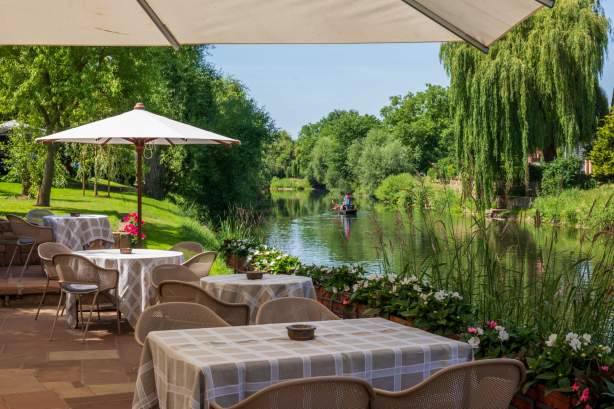
Image context: the lead image uses the official terrace photograph rather than a plated close-up because this article is about a riverside house before it is about one plate. Auberge de l'Ill's continuity begins with a location and a family occupation of that location, then extends outward into dishes, rooms, and service habits.[1][2]
1. The river is part of the lineage, not decoration around it
The family history page starts at the only place it really can: more than 150 years ago, on the banks of the Ill, where the Haeberlins ran a small country inn beside a farm in what became Illhaeusern, literally the houses along the river.[1] That setting matters because Auberge de l'Ill does not use water, garden, and Alsatian scenery as ornamental atmosphere pasted onto a luxury room later. The geography was there first. The cooking culture grew out of it.
The same history page makes the deeper point even clearer by refusing to romanticize continuity. Alsace's dual culture is described through wartime fracture: one son under the French flag, another conscripted into the Wehrmacht, families divided by politics and borders they did not control.[1] Then comes the decisive material event. In 1945, the Illhaeusern bridge was bombed, the Arbre Vert was destroyed, and the rebuilt postwar house became the Auberge de l'Ill.[1]
That sequence changes how the restaurant should be read. The house is not simply old. It is reconstructed. Its continuity was earned after rupture. A lot of grand restaurants inherit prestige through stable walls and stable routines. Auberge de l'Ill inherited a riverbank, then had to rebuild the institution around it.[1]
2. Paul and Jean-Pierre turned a family inn into a classical French grammar
The starred ascent is one of the cleanest lineage arcs in European fine dining. On the official family history page, Paul and Jean-Pierre Haeberlin combine their talents, transform the site, win the first Michelin star in 1952, the second in 1957, and the third in 1967.[1] Read narrowly, those are guide milestones. Read properly, they are markers of a much deeper conversion: a rural Alsatian inn becoming one of the canonical houses of French haute cuisine without severing itself from family scale or regional identity.
The official restaurant page shows how that conversion still survives on the plate.[2] The house continues to define itself through dishes that behave like inherited sentences. The salmon soufflé remains listed under fish and shellfish. The frog-leg mousseline still carries Paul Haeberlin's name. The peach remains the dessert specialty that turns family identity into something edible and repeatable.[2] These dishes matter because they demonstrate that lineage here is not abstract influence. It travels through preparations that stayed alive long enough to become a dialect of the house.
That durability is easy to underrate in a period when fine dining often prizes novelty over memory. Many restaurants keep a signature dish for branding value while the real energy has already moved elsewhere. Auberge de l'Ill's current page suggests a stricter logic. The classics are still being served inside a living menu rather than displayed as relics from a golden age.[2] The lineage is therefore not retrospective. It is still operational.
3. The present-day house preserves its classics by editing, not embalming
The restaurant page is especially revealing because it does not present the Auberge as a shrine to static grandeur.[2] Alongside the canonical dishes and the Haeberlin Menu, the house currently offers a Vegetable Experience, a Traditional Menu, a Business Menu, and a Formule Jeune Menu for diners under 35 during a specific seasonal window.[2] This is not the structure of a restaurant content to live on reputation alone. It is the structure of a house trying to keep the classical room socially and gastronomically usable across different kinds of guests.
That matters for lineage. A family restaurant dies when inheritance becomes stiff performance. Auberge de l'Ill appears to avoid that trap by holding onto its signatures while widening the ways the room can be entered.[2] Marc Haeberlin is described on the official page as the chef who makes the alliance between classic and contemporary dishes.[2] That sentence could sound generic if the menu did not back it up. But the current menu does back it up: foie gras terrine and lobster share space with a vegetable tasting sequence; old house desserts remain, but so do newer savory constructions and lighter entry points into the experience.[2]
This is a more serious survival strategy than it may first appear. A lot of famous French houses know how to remember. Fewer know how to stay permeable without dissolving the house style. Auberge de l'Ill's current format suggests it is trying to do both at once.[2]
4. Service memory is one of the restaurant's main inherited ingredients
The most persuasive part of the lineage story may not even be bloodline. It may be staff continuity. The family history page stresses that some employees stayed for decades: Daniel Rederstorff, first apprenticed under Paul in 1954; Michel Scheer, working there since 1967; and a broader philosophy that every task, from dishwashing to the plate set before the guest, must deserve the same standard.[1] That language is old-fashioned in the best sense. It treats excellence as a house discipline rather than a chef's aura.
The current extended family page shows that this culture is still central.[3] Serge Dubs, who began at the Auberge at nineteen, is presented not just as head sommelier but as a figure whose distinction reached world level, including Best Sommelier in the World in 1989.[3] The three maîtres d'hôtel are described as having been part of the extended family for 20 years.[3] That is not a decorative biography page. It is an operating document. It tells you that hospitality here is inherited through long tenure, internal transmission, and repeated guest-facing memory.
This helps explain why Auberge de l'Ill still feels more alive than many classical institutions. The restaurant is not relying on genealogy alone. It keeps expanding the meaning of family until key non-blood collaborators become part of the house line.[1][3] In that sense, the cuisine's real companions are not only sauces and desserts, but also sommellerie, welcome, and the accumulated calm of people who have practiced the same room for years.
Why Auberge de l'Ill still matters
Auberge de l'Ill matters because it shows that classical French fine dining does not survive through prestige by itself. It survives when a house can keep four different continuities in motion at once: place, family, dishes, and service culture.[1][2][3][4] The riverbank setting and postwar rebuild keep the origin story concrete.[1] The menu keeps the classics alive without sealing the room off from present needs.[2] The service structure keeps long memory visible rather than hiding it backstage.[3] And the continued Michelin presence confirms that the house remains part of the live top tier rather than only the historical record.[4]
That is why the restaurant reads best as a lineage piece instead of a nostalgia piece. Nostalgia freezes the past into mood. Auberge de l'Ill keeps translating the past into dinner. The salmon soufflé and frog-leg mousseline are still there. The peach still closes the arc. The river is still close by. The family name still matters, but so do the workers who turned the name into a durable room.[1][2][3]
In a dining world crowded with restaurants trying to look new, that kind of continuity feels unusually hard to fake. Auberge de l'Ill's real luxury is not oldness. It is the fact that the house has found a way to keep inheritance legible, edible, and current all at once.[1][2][3][4]
Sources
- Auberge de l'Ill, "Haeberlin Family History" - official family chronicle covering the riverside inn, the 1945 destruction of the Arbre Vert, the postwar rebuild into Auberge de l'Ill, the 1952/1957/1967 Michelin progression, and the house philosophy of long service.
- Auberge de l'Ill, "Restaurant" - official current restaurant page covering the two-Michelin-star positioning, Paul Haeberlin's signature dishes, Marc Haeberlin's classic-contemporary balance, the current menus, service framing, room descriptions, and the official terrace image used here.
- Auberge de l'Ill, "The extended Haeberlin family" - official team page covering Serge Dubs's long tenure and 1989 world sommelier title, plus the longtime maîtres d'hôtel and other dining-room continuity signals.
- MICHELIN Guide, "Auberge de l'Ill - Illhaeusern - a MICHELIN Guide Restaurant" - current guide listing URL for the live Michelin record of the house.