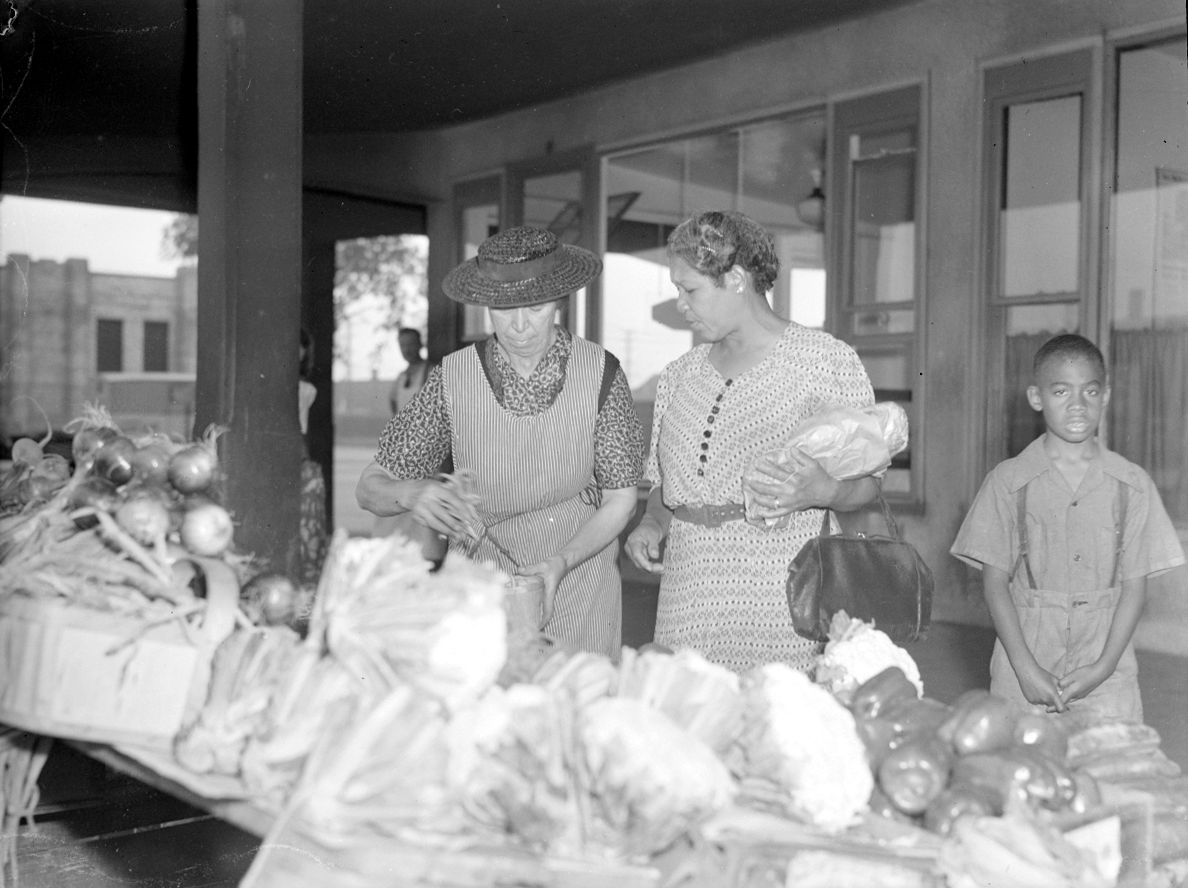
The cover photograph catches Atwater Market doing the least glamorous and most important thing a food institution can do: being used. In 1945, vegetables crowd the foreground while two women shop and a young boy watches from the edge of the stall. There is no tasting-menu reveal, only selection, exchange, and food leaving a public counter in human hands.[9]
Nearby Joe Beef now carries the corridor's loudest culinary reputation. Its room promises French technique without palace manners: chalkboards, oysters, dark wood, generous plates, serious wine, and service warm enough to loosen the cuffs. Michelin currently describes steaks, seafood, rabbit à la royale, and calf sweetbreads delivered with efficiency and good humor; Canada's 100 Best still finds an oyster-bar spirit and a Québécois appetite for richness in the 2026 kitchen.[3][4]
But a dining room is not a neighborhood, however influential it becomes. A few blocks along the same commercial corridor, Atwater Market has been selling meat, fish, cheese, produce, flowers, and prepared food since 1933. Beyond both addresses lies a Little Burgundy history shaped by industry, Black railway workers, churches, community organizations, jazz, expropriation, and rebuilding.[6][7]
The useful way to read this piece of Montreal is therefore not as a pilgrimage to one famous table. It is to hold three kinds of appetite in view at once: the destination restaurant, the public market, and the community whose history cannot be reduced to the moment outsiders decided the street was desirable.
The bistro arrived in 2005, not at the beginning
Joe Beef's own history starts plainly. David McMillan and Frédéric Morin opened the bistro in Little Burgundy in 2005; the official site still defines the idea as French cuisine meeting Montreal hospitality.[1] Morin's account makes the choice of address sound less like urban strategy than proximity and chance. The founders lived around Atwater, the owner of the café in the future Joe Beef space no longer wanted it, and the young partners went with a place that felt right.[2]
This origin matters because hindsight can turn every successful restaurant into the inevitable discovery of a neighborhood. It was not inevitable. Tastet's interview calls Joe Beef one of the first restaurants of the area's later boom; a 2014 Eater profile remembers the early Little Burgundy address as scruffy and the purchased room as a divey café.[2][5] Those descriptions belong to their authors and moments, not to the whole truth of the district. They do establish that the restaurant entered before Notre-Dame West became an obvious global dining corridor.
The restaurant then grew without abandoning its small-room fiction. Locals embraced the wainscoting, music posters, crowded chalkboards, and sociable closeness. In 2011, Joe Beef doubled its space into the luncheonette next door and developed the rear garden and terrace. Liverpool House and Le Vin Papillon made the block feel less like one hit restaurant than a loose hospitality compound, with different emphases on bistro cooking, wine, and vegetables.[5]
The cover photograph predates that success by sixty years. Its shoppers are not foils in a chef's origin story, and Atwater Market is not waiting for a famous restaurant to make the area legible.[9] The image disciplines the present-day scene: food commerce, ordinary appetite, and neighborhood life were already visible here long before a reservation became the corridor's most sought-after object.
Embedded does not mean ordinary. Joe Beef is a destination, and scarcity changes how a room belongs to its surroundings. Eater warned as early as 2014 that the funky setting did not imply a cheap bill and that the menu made over-ordering easy.[5] The bistro look lowers ceremonial distance; it does not erase price, demand, or the privilege of securing a table.
Fine dining, with the formal hardware removed
Joe Beef's most durable innovation was not a single rich dish. It was the decision to keep high-level cooking while discarding signals that told diners to sit straighter. Morin recalls opening without decanters, crystal glasses, or uniforms, while serving oysters at the bar and aioli in the garden. That combination now feels familiar. In 2005, he argues, it did not.[2]
The current guides still recognize the same operating grammar. Michelin emphasizes classical French preparations, but tells readers to roll up their sleeves and notes the unusually large napkin. Canada's 100 Best names Jean-Philippe Miron as executive chef and describes signatures that survive because they are both exact and excessive: lobster spaghetti bound with fumet, lardons, and brandy cream; oeuf en gelée carrying Madeira, ham, and black truffle; a wine list in which Quebec has a growing role.[3][4]
The pleasure comes from friction between registers. Gelée, truffle, rabbit à la royale, and a serious cellar belong to the vocabulary of formal dining. Chalkboards, big napkins, bar stools, jokes, and food built for appetite rather than daintiness pull in the opposite direction. Joe Beef does not democratize luxury merely by making it convivial. It does make luxury feel less like obedience.
That distinction protects the restaurant from its own mythology. "Unpretentious" can describe a service manner, a room, or a refusal of decorative ceremony. It cannot by itself describe access. The most honest account lets both things be true: Joe Beef helped make fine dining more relaxed, and it became the kind of famous reservation around which travelers organize a trip.[3][5]
Atwater Market keeps another scale of food visible
Follow Notre-Dame toward Atwater and the culinary scene changes scale. Atwater Market stands near the Lachine Canal in an Art Deco building that has operated since 1933. Its official directory places butchers, charcutiers, cheesemongers, a fishmonger, produce growers, bakers, specialist grocers, and ready-to-eat counters under and around the same roof.[6]
The market even changes architecture with the weather. Around the first frost, temporary walls go up so shoppers can keep using it through winter; when warmth returns, the enclosure comes down and the market opens outward again. In summer, prepared-food stalls and picnic tables extend the eating space toward the canal.[6] That seasonal conversion is a more revealing Montreal luxury than climate control made invisible. The building admits that winter is part of dinner.
It is tempting to make Atwater Market the wholesome pantry behind Joe Beef. The available sources do not justify that neat sentence. They establish proximity, Morin's life around Atwater, his early work at Jean-Talon Market, and Joe Beef's market-minded, frequently changing cooking; they do not provide a current supplier ledger connecting particular Atwater stalls to particular Joe Beef plates.[2][5][6]
The relationship worth keeping is spatial rather than contractual. A public market and an internationally known restaurant occupy the same food corridor, but they distribute expertise differently. At Joe Beef, selection is compressed into the evening's chalkboard and explained by a server. At Atwater, shoppers can compare cases, speak with individual merchants, carry raw ingredients home, or eat something immediately. One room edits abundance; the other displays its competing possibilities.
Nor is the market merely picturesque ballast for an expensive dinner. It works year-round, contains everyday retail alongside gourmet goods, and serves producers, artisans, restaurateurs, and residents.[6] Its public character prevents the neighborhood's food identity from becoming identical to its hardest reservations. The corridor can contain a celebrated kitchen without becoming a theme park built around celebrity chefs.
The name “Joe Beef” carries an older promise
The restaurant's name reaches beyond Little Burgundy to another part of working Montreal. Charles McKiernan, an Irish-born former British Army sergeant known as Joe Beef, opened a tavern after leaving the military. By 1875, Joe Beef's Canteen stood near the port at de la Commune and de Callière streets, serving sailors, laborers, unemployed people, and anyone who needed food or lodging.[8]
McKiernan's hospitality was not a branding mood. Montreal's MEM records that he sent an employee into the streets at night to offer shelter and supported striking Lachine Canal workers in 1877 with 3,000 loaves and 500 gallons of soup. He was celebrated by working people and condemned by respectable Montreal for drink, disorder, atheism, and political provocation.[8]
The modern restaurant's homage is legible: appetite, generosity, noise, opposition to stiffness, and the belief that a tavern can matter more than polite society admits. Eater's early history says the founders chose McKiernan precisely as a storied man of the people.[5] The large portions and loose service channel that legend more convincingly than a portrait on the wall would.
Still, homage is not continuity. McKiernan fed people who could not pay; the modern Joe Beef is an acclaimed destination with limited tables. The 1877 soup line and the 2026 lobster spaghetti should not be folded into one frictionless tradition of generosity. The name is best understood as a standard the restaurant invokes, not a social role it automatically inherits.
That tension makes the choice more interesting, not less. Fine dining often names itself after aristocratic rooms, grand hotels, owners, or abstract ideals. Joe Beef chose a working-class canteen keeper whose hospitality was inseparable from labor conflict. Every luxurious plate arrives under a name that asks who gets fed and what welcome is for.
Little Burgundy has a history no restaurant can confer
The same boundary must be applied to the neighborhood. The Canadian Museum of History traces St. Antoine, later called Little Burgundy, to the growth of Montreal's railway economy around 1887. Black migrants from the United States, the Caribbean, and the Maritimes found work, often restricted by racism to low-paid railway porter jobs, and built lives close to the railyards.[7]
Out of those conditions came institutions: the Coloured Women's Club, Union United Church, the Negro Community Centre, Black-owned businesses, and a jazz culture that carried local musicians onto an international stage.[7] This is not background color for a restaurant story. It is the neighborhood story.
It is also a story of forced rupture. The museum records that urban-renewal expropriation and demolition in the late 1960s and 1970s displaced 14,000 residents, with Black Canadians bearing much of the loss.[7] Any account that jumps from “scruffy” streets to celebrated dining performs a second demolition in language: it makes a place appear empty until investment arrives.
Joe Beef did not create Little Burgundy's conviviality, working identity, or cultural importance. Its founders opened a remarkable bistro in a neighborhood where those qualities already had histories, and where residents had also experienced exclusion and displacement. The restaurant deserves credit for changing North American expectations of what serious dining could look and feel like. It does not need the larger claim of having invented the place around it.
This is why scene writing has to resist the word revival unless it names what was revived, by whom, and for whom. A dining corridor can gain energy while housing pressure rises. An old café can become a world-famous restaurant while older community institutions disappear. A public market can serve residents and visitors at once. None of these facts cancels the others.
A famous table can be a good neighbor without becoming the narrator
Read together, Joe Beef and Atwater Market explain something real about Montreal dining. Both distrust sterile luxury. One keeps classical French craft close to jokes, appetite, Quebec wine, and a crowded bar; the other keeps butchers, growers, fish, cheese, winter walls, and canal-side eating in public view.[3][4][6] Their proximity gives the corridor texture that no isolated tasting room could manufacture.
But Little Burgundy supplies the harder lesson. A restaurant can participate in a neighborhood's present without owning its past. It can borrow a working-class name without claiming equivalence to a worker's canteen. It can look unpretentious while remaining exclusive. It can help make a street famous while recognizing that the street was never waiting to be discovered.
That is the richer version of the scene. Begin with the flowered brick storefront and the promise of lobster, cream, smoke, offal, and wine. Keep walking until the market turns ingredients back into public choices. Then look beyond food long enough to see railyards, churches, clubs, homes, demolitions, and memory.
Joe Beef belongs in that view. It simply should not fill the whole frame.
Sources
- Joe Beef, official restaurant site — current address, opening year, founders, Little Burgundy location, and the restaurant's description of its French-and-Montreal bistro identity.
- Tastet, “Frédéric Morin: The backbone of the Joe Beef group” (March 31, 2022) — reported interview on Morin's training, the founders' connection to Atwater, the choice of the former café, and Joe Beef's early rejection of formal dining hardware.
- The MICHELIN Guide, “Joe Beef – Montréal” — current account of the restaurant's French bistro dishes, room atmosphere, service, and operating hours.
- Canada's 100 Best, “Joe Beef” (2026, No. 51) — current executive-chef attribution, enduring dishes, wine-list direction, and assessment of the restaurant's Lyonnaise and Québécois character.
- Bill Addison, “Montreal's Joe Beef Lives Up to Absurd Expectations,” Eater (August 18, 2014) — contemporary review and reported history of the 2005 opening, 2011 expansion, changing chalkboard menu, rear garden, and neighboring restaurant group.
- Marchés publics de Montréal, “Atwater Market” — official current history, location, seasonal enclosure, merchant categories, and year-round public-market format.
- Canadian Museum of History, “St. Antoine/Little Burgundy (Montréal)” — institutional history of Black railway workers, community organizations, jazz, urban-renewal expropriation, and displacement.
- MEM – Centre des mémoires montréalaises, “Charles McKiernan, dit Joe Beef” (January 18, 2016) — municipal-history account of the original canteen keeper, his port-side tavern, social aid, and support for the 1877 Lachine Canal strike.
- Conrad Poirier, “Feature. St. Henri – Marché Atwater,” Bibliothèque et Archives nationales du Québec / Wikimedia Commons — August 29, 1945 archival photograph of customers buying vegetables at Atwater Market, public domain in Canada and the United States.