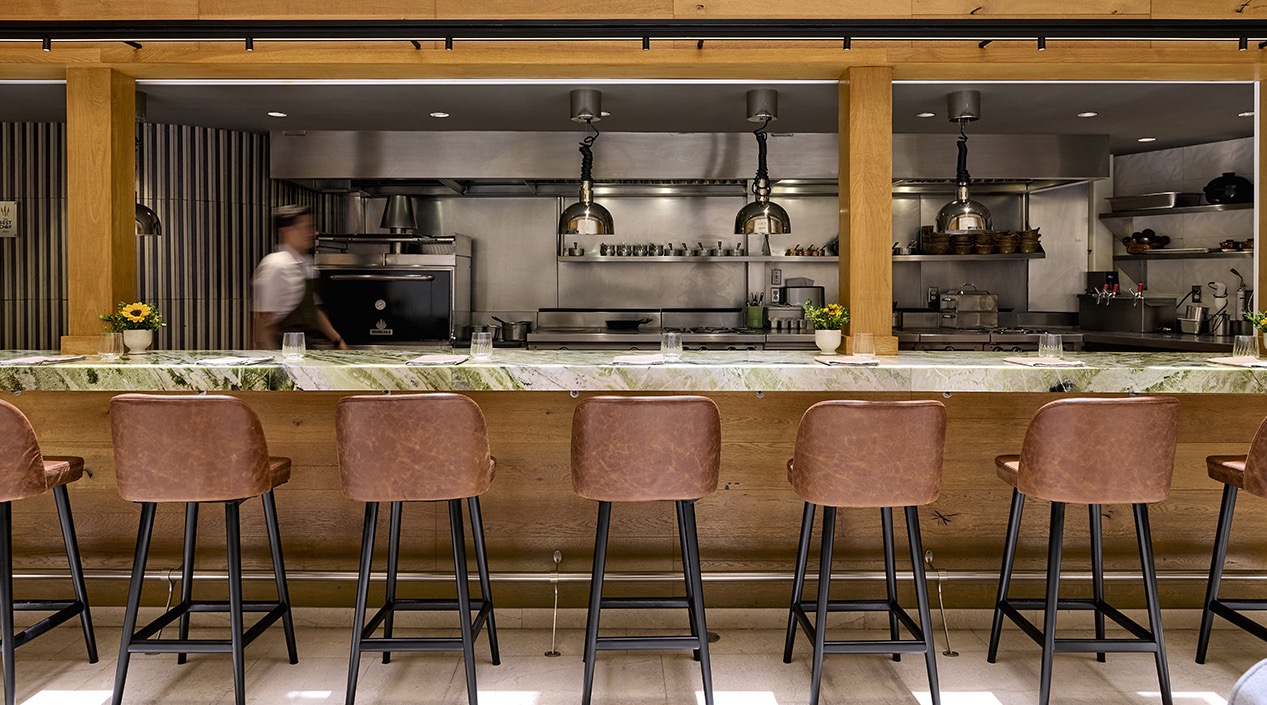
Quintonil does not behave like a flagship that needs to keep reminding you of its importance. That is the first thing that makes it distinctive. The restaurant's own material, outside reviews, and its long-running international recognition all point toward the same conclusion: Jorge Vallejo and Alejandra Flores built a room in Polanco that makes high-end Mexican cooking feel controlled, breathable, and urban, even while it stays deeply tied to ingredients, gardens, and regional producers.[1][3][4][5]
That balance is harder than it looks. Plenty of ambitious restaurants can tell a story about territory. Far fewer can turn territory into a complete dining grammar, where the room, the service cadence, the tasting-menu structure, and the ingredient logic all point in one direction. Quintonil's strength is that it keeps those pieces in the same register. The restaurant feels planted rather than overloaded.
The flagship identity starts with clarity
Quintonil's official overview still presents the project in direct terms: opened in 2012, headed by Alejandra Flores and Jorge Vallejo, and built to express Mexican flavors with a personal touch.[1] Michelin's current listing adds the other half of the picture by continuing to mark Quintonil as a Two Stars restaurant in the 2025 MICHELIN Guide Mexico.[5] Put together, those facts explain why the restaurant carries unusual weight in Mexico City. It is old enough to have a settled identity and current enough to keep top-guide pressure on that identity.
That matters because Quintonil does not sell itself as a nostalgia machine. The official language on Vallejo's work is more exact: Mexican ingredients and traditional techniques are pushed into today's context, with product and flavor quality tied to regional producers and to the ecosystems where they live.[1] This is a useful sentence to keep in mind while reading the restaurant. It tells you that the point is not heritage as museum display. The point is translation under modern urban conditions.
The garden is part of the operating system
The most revealing outside descriptions of Quintonil keep circling back to plants. On 50 Best Discovery, the restaurant is framed through the herb that gives it its name, with Vallejo gathering ingredients from local gardens, orchards, and around Mexico to express the country's pantry.[3] Condé Nast Traveler's review pushes the same idea into the room itself: blond wood, green-toned surfaces, and a back dining room draped in vines, plus an off-site garden supplying some of the produce used by the kitchen.[4]
Those details do more than set a mood. They show how Quintonil avoids a common fine-dining problem, where "local" stays trapped in menu notes while the dining room tells a completely different story. Here, the vegetable-heavy visual world, the herb-derived name, and the sourcing language all reinforce each other.[1][3][4] The restaurant does not need to shout its ecological credentials because the house style already moves in that direction: roots, herbs, mushrooms, corn, and other staple ingredients are treated as central material rather than supporting garnish.[4]
This is also why Quintonil feels more urban than rustic. The garden is not presented as escape fantasy. It is folded into a city flagship. The result is a room that feels metropolitan without losing contact with soil, seasonality, and producer networks.[1][3][4]
Service looks calm because the structure is tight
Quintonil's public writing on leadership helps explain why the restaurant's atmosphere reads as composed rather than soft-focus. Alejandra Flores is described on the official site as the person whose dining-room and operations background forged Quintonil's hospitality-based strategy, creating effective communication between kitchen and floor.[1] The team page sharpens the point by describing Mónica Oropeza as a force connecting every part of the project, responsible for the talent, discipline, resilience, and warmth that define the restaurant day to day.[2]
That language is unusually useful because it makes front of house legible as production, not decoration. 50 Best Discovery arrives at a similar read from another angle when it calls the front of house chic and understated and names Flores as the leader of that side of the experience.[3] This combination matters. A lot of luxury restaurants can give you polish. Fewer can make restraint feel active. At Quintonil, the room seems designed to lower the noise floor so the food, the sequence, and the explanations can land cleanly.
The bar image that the restaurant uses publicly fits that reading exactly. Bottles, wood, and muted greens are arranged with the same kind of edited calm the menu seems to pursue. It suggests a house more interested in continuity than spectacle.[1]
The menu tells you what kind of confidence the restaurant has
Current menu information on Quintonil's official site gives a simple but revealing structure: a tasting menu at MXN 5,900 per person, with adjustments available for vegan, pescatarian, and lacto-ovo vegetarian diners if arranged during the reservation process.[1] The same page also states a hard boundary: the kitchen cannot accommodate requests excluding corn, chili, and onion.[1] That is one of the clearest indicators of what kind of flagship this is.
The useful part is not the number alone. It is the combination of flexibility and non-negotiable core. Quintonil is willing to translate its menu across several dietary lanes, but it refuses to flatten the cuisine past the ingredients that anchor its identity. That reads as mature confidence. It suggests a restaurant that knows exactly where adaptation remains possible and where the underlying grammar would break.[1]
Condé Nast's review, although older, supports the same interpretation by describing a long tasting menu built around indigenous Mexican ingredients such as corn, beans, squash, chiles, and mushrooms.[4] The article also notes that diners once had an à la carte option if they wanted less commitment.[4] Even if menu formats evolve over time, the through-line remains consistent: the kitchen's authority sits in how it edits foundational Mexican products into a fine-dining sequence rather than how many luxury signals it can stack on the table.
Why Quintonil still matters now
Michelin's two-star designation matters here, but less as a trophy than as a pressure test.[5] A restaurant can reach a globally legible level and still lose its center. Quintonil appears to have avoided that drift because the core idea remains tight: ingredients first, translated through modern technique, disciplined by an urban dining room, and stabilized by hospitality systems strong enough to keep the whole evening readable.[1][2][3][5]
That is why Quintonil still feels current. It offers a way of thinking about luxury that does not require maximal theater. The more persuasive extravagance is precision: a room that looks edited, a menu that knows what it can flex and what it must protect, and a sense that Mexican product memory is being carried forward instead of being embalmed. For diners deciding whether Quintonil deserves one serious night in Mexico City, that is the clearest reason to book it.
Sources
- Quintonil official homepage and menu section, covering the 2012 founding statement, Jorge Vallejo and Alejandra Flores leadership, current tasting-menu price, dietary adjustments, and core ingredient exclusions.
- Quintonil official team page, including the profile of Mónica Oropeza and the restaurant's framing of discipline, resilience, warmth, and operational coordination.
- 50 Best Discovery, "Quintonil - Mexico City - Restaurant," on the herb-derived name, local gardens and orchards, presentation style, Alejandra Flores's understated front of house, and the Mexican wine pairing.
- Condé Nast Traveler, "Quintonil - Restaurant Review," on the vine-lined room, off-site garden, vegetable-and-herb focus, and the tasting menu's indigenous Mexican ingredient spine.
- MICHELIN Guide, "Quintonil - Miguel Hildalgo - a MICHELIN Guide Restaurant," confirming Quintonil as a Two Stars restaurant in the 2025 MICHELIN Guide Mexico.