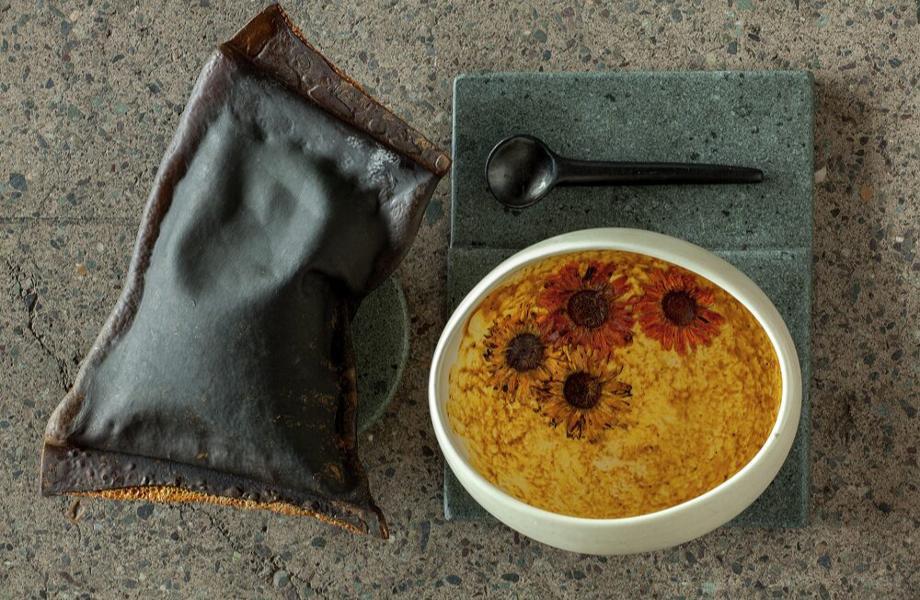
Many fine-dining restaurants talk about terroir. Boragó is more interesting because it behaves as if geography were a supply chain before it became a story.
That difference matters. In Santiago, Rodolfo Guzmán's restaurant does not merely decorate a tasting menu with local references. Its Endémica menu is built around what arrives from Chile's long vertical territory: collectors, fishermen, growers, foragers, and the restaurant's own nearby farm all feed the room's nightly structure.[1][3][6] The useful way to read Boragó, then, is not as "South American luxury with a sustainability halo." It is better understood as a sourcing system that happens to end in a dining room.
That is also why the restaurant still matters in 2026. Boragó sits at No. 23 on The World's 50 Best Restaurants 2025 list and No. 6 on Latin America's 50 Best Restaurants 2025.[4][5] Those rankings explain attention, but they do not explain the mechanism. The mechanism is the harder part: how one kitchen makes Chile's enormous ecological range operational night after night without flattening it into generic "local produce" rhetoric.
1. The pantry is the operating model
The strongest Boragó fact is also the simplest one. Official and 50 Best materials converge on the same structure: the restaurant works with more than 200 collectors, small producers, and foragers across Chile, while also drawing vegetables from its own farm about 30 minutes away from the restaurant.[1][3] In the 2021 Sustainable Restaurant Award feature, 50 Best adds the broader frame: Guzmán thinks in terms of Chile's full 4,000-kilometre length, and the resulting larder includes 700 varieties of seaweed, rock plants, and fungi.[6]
That combination is what separates Boragó from restaurants that simply buy excellent regional product. It runs two supply lanes at once:
- a near lane for vegetables and controlled farm output close to Santiago
- a long lane for wild or highly place-specific ingredients gathered across the country
The effect is not abundance for its own sake. It is editorial range. A kitchen can serve one Chilean ingredient and still feel narrow; Boragó tries to serve Chile as a sequence of climates, elevations, and ecosystems.
The official "Eat" page is unusually explicit about the hierarchy behind that sequence. It says much of the food comes from soils "not intervened," gathered by collecting communities and small producers throughout Chile, and it treats those producers as having the same role as the rest of the team.[1] That is more than ethical branding. It is an admission that the restaurant's authorship is distributed. Boragó can only look singular at the table because, upstream, it has chosen to look plural.
2. Endemica means arrival governs the menu
The word Endémica can sound like a branding flourish until you read how the restaurant and its external profiles describe the meal. Boragó's official reservations page currently lists 12 to 18 preparations for the menu, priced at CLP 199,000 per person.[2] 50 Best Discovery describes the same dinner not as a fixed canon but as a menu that changes according to what reaches the kitchen door each day, with each course explained through its ingredient origin by a pop-up menu.[3]
That is the important operational clue. Boragó does not seem to begin by asking, "What permanent signature dishes must we preserve?" It begins closer to, "What ingredients have arrived in the right condition, from the right place, in the right moment, and how do we translate that into tonight's sequence?"[1][3]
For a diner, that means the luxury purchase is different from a classic grand-restaurant purchase. You are not mainly paying for repetition and perfected sameness. You are paying for curation under seasonal pressure.
This is also why Boragó's sourcing story carries more weight than the usual foraging romance. In many restaurants, foraged or hyperlocal ingredients appear as a flourish around a stable core. At Boragó, the official language suggests the opposite: the core itself moves. Wild fruit that exists for a few weeks, mushrooms from a specific forest, sea plants, farm vegetables, family-scale wines, and direct-purchase seafood are all presented as structural inputs rather than side notes.[1][6]
3. The menu works because Boragó balances control and volatility
A sourcing-first restaurant only becomes convincing when it can manage volatility without losing dinner rhythm. Boragó's system looks built around that tension.
The farm-and-orchard lane provides controllable supply close to the city.[3][6] The restaurant's own page says it grows vegetables in the most natural way it can, while 50 Best's sustainability profile adds milks and ducks to that nearby ecosystem.[1][6] That gives the kitchen a reliable base.
The wild-and-coastal lane does the opposite. It introduces ingredients that are harder to standardize but richer in identity: seaweeds, fungi, mountain fruits, marine products obtained directly from fishermen, and other ingredients whose value comes from being tied to a specific place and season.[1][6] That lane keeps the menu from drifting into generic luxury produce.
Put together, the restaurant is not choosing between rigor and discovery. It is trying to keep both. The nearby farm protects coherence; the national network prevents boredom.
This is also where Boragó becomes fun rather than merely admirable. Discovery's description of a mushroom-shaped ice cream or an asparagus-and-zucchini course styled like a sunflower painting captures something essential.[3] The restaurant is not content to tell you where an ingredient came from. It wants origin to land with theatrical clarity. In other words, sourcing has to survive translation into memory.
4. Beverage and booking rules show the same philosophy
Even Boragó's beverage program reads like an extension of sourcing logic. The official site says the restaurant does not run a conventional wine list; instead it keeps a "wine pool" built around family projects and bottles that express distinctive Chilean conditions.[1] That matters because it keeps the beverage side from becoming an imported luxury catalog disconnected from the food's territorial argument.
The reservations page makes the practical structure equally clear. Alongside the main menu, Boragó lists a wine pairing at CLP 99,000 and a juice pairing at CLP 49,000.[2] Service runs Tuesday to Saturday from 17:15, vegetarian menus need 24 hours' notice, cancellations inside 24 hours trigger a USD 100 per person charge, and tables are held for a maximum of 30 minutes.[2]
These are not glamorous details, but they tell you how the sourcing model is protected. A restaurant that relies on volatile product and tightly sequenced service cannot afford vague attendance behavior. The reservation policy is part of ingredient discipline.
5. What Boragó is actually selling
The easiest way to misunderstand Boragó is to treat it as a trophy reservation whose value comes mainly from ranking prestige.[4][5] The better reading is more specific.
Boragó is selling access to a national ingredient intelligence system:
- more than 200 producers and foragers feeding one menu logic[1][3]
- a nearby farm stabilizing the kitchen's daily base[1][3][6]
- a tasting structure that accepts movement instead of denying it[2][3]
- a beverage program that stays inside the same territorial argument[1][2]
That does not make the restaurant automatically right for every serious diner. If your ideal luxury meal is built on classic continuity, deep cellar breadth, and total predictability, other rooms may feel more reassuring. Boragó asks for a different appetite: curiosity about terrain, seasonality, and ingredients that do not arrive with universal recognizability already attached.
But if that is the appetite you have, Boragó remains one of the clearest cases in fine dining where sourcing is not background virtue-signaling. It is the product itself.
Chile is a famously long country. Plenty of restaurants can mention that. Boragó's achievement is harder: it turns that length into dinner without making the meal feel like a lecture. That is why the restaurant still matters. The plate is polished, the room is beautiful, the rankings are real, but the deeper luxury is organizational: getting a whole country to arrive at the pass in time.[1][3][4][5][6]
Sources
- Boragó, "Eat" page. Official overview of the Endémica menu, 200-plus collectors and small producers, farm-grown vegetables, direct-from-fishermen sourcing, and the restaurant's wine-pool philosophy.
- Boragó, "Reservas" page. Official menu pricing, pairing prices, opening schedule, vegetarian notice window, cancellation terms, and late-arrival policy.
- 50 Best Discovery, "Boragó" (Santiago profile). Ranking snapshot, 12-18 course structure, 30-minute farm reference, daily-arrival menu logic, and pop-up origin explanations.
- The World's 50 Best Restaurants 2025, "Boragó". Official 2025 global ranking page confirming the restaurant's current placement.
- Latin America's 50 Best Restaurants 2025, "Boragó". Official regional ranking page confirming the restaurant's 2025 Latin America placement.
- 50 Best Stories, "What inspires the mind behind Boragó, the world's most sustainable restaurant" (2021). Interview and background on the 4,000-kilometre sourcing frame, 700 varieties of seaweed/rock plants/fungi, the biodynamic farm, and the Food Made Good assessment.