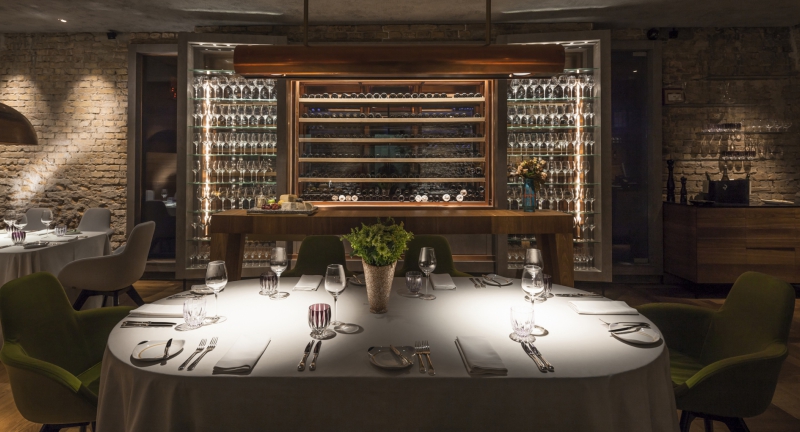
Babel Budapest has an advantage that many expensive restaurants spend heavily to imitate: it has a room that refuses to feel newly invented. The restaurant sits in an 180-year-old building on Piarista köz, and its own public story points to a visible mark left by the 1838 Pest flood. Founder Hubert Hlatky-Schlichter has made that wall part of the restaurant's origin myth rather than hiding it behind a smoother luxury surface.[1]
That matters because Babel's best argument is not simply that Hungary can sustain a Michelin-starred tasting menu. The Michelin Guide currently lists Babel as a One Star restaurant in Budapest, and the restaurant presents itself through 13-serving and 8-serving tasting formats with wine pairings and a vegan menu.[1][3] Those facts put it inside the international fine-dining system. The more interesting question is whether the system flattens the place, or whether the place keeps pressuring the system back.
At Babel, the old wall helps answer that question. It keeps the dining room from becoming placeless. The flood mark, the small historic room, and the restaurant's downtown intimacy make the meal feel like an encounter with memory under active service pressure, not a museum dinner staged for sentiment. Best of Budapest describes the restaurant as a Hungarian regional fine-dining address in a redesigned 19th-century building, with Hungarian and Transylvanian roots and an intimate scale.[6] That is the frame in which Babel becomes most persuasive: not as a monument to heritage, but as a modern restaurant that lets heritage set limits.
The room is not background
Restaurant rooms often tell guests what kind of performance to expect. Some rooms promise spectacle before food arrives. Others insist on calm neutrality, as if the meal could happen in any wealthy city. Babel's room does something quieter. It makes age and damage visible, then asks the tasting menu to behave with equal control.
The distinction is important. An old building can easily become decorative branding. A flood mark can be turned into a caption, a tour-guide fact, or a bit of romantic grit. Babel's stronger move is to let the room remain a constraint. The public materials do not separate the restaurant's current identity from the 1838 flood story, the founder's early attachment to the building, or the address itself.[1] That continuity changes how the food is read. A course is not only a plated object. It has to survive comparison with a wall that has already carried disaster, repair, and urban time.
This is why the restaurant's scale matters. Best of Budapest emphasizes a 30-person intimacy in its local profile, while Four Magazine frames the dining room less as a formal stage than as a comfortable, living-room-like space inside the historic Piarist setting.[4][6] The exact number is less important than the operational impression: this is not a dining room designed to swallow the guest in volume. It is close enough that service, wine, masonry, glassware, and pacing all share the same field of attention.
The menu edits memory
Babel's current tasting-menu PDF is useful because it shows how the restaurant translates regional memory into a contemporary sequence. The published format lists 13 servings at HUF 89,000 and 8 servings at HUF 65,000, with Hungarian, premium Hungarian, international, and signature-drink pairing options.[2] The menu language moves through ingredients such as leek, kohlrabi, quince, deer jelly, paprika, beetroot, trout, pike-perch, duck, and coffee.[2] It is not a catalogue of tourist signs. It is a set of local and Central European references placed inside tasting-menu rhythm.
That editing is the restaurant's central fine-dining skill. Hungarian and Transylvanian identity can become heavy very quickly if a kitchen treats it as costume. The 50 Best Discovery profile situates Babel around Budapest fine dining and its Hungarian and Transylvanian sense of place, while Four Magazine identifies Daniel Berlin as consultant chef and Kornél Kaszás as executive chef in its team profile.[4][5] That combination is revealing. Babel is not trying to prove modernity by abandoning region. It is trying to prove region by subjecting it to modern discipline.
The dish examples Four Magazine highlights push in that direction: layered potato reworked from a Hungarian Sunday-lunch staple, casino egg rebuilt with Russian salad, egg cream, and caviar, semolina turned from childhood breakfast memory into dessert, and Eszterházy cake treated as a celebratory final gesture.[4] Those are not casual references. They suggest a restaurant interested in texture, nostalgia, acidity, sweetness, and Central European richness rather than only photogenic plating. The food's job is to make regional memory sharper, not louder.
Wine keeps the argument local
The pairing structure is not a side issue. Babel's menu gives guests a specific Hungarian wine pairing, a premium Hungarian wine pairing, an international pairing, and a non-wine signature-drink path.[2] Best of Budapest also describes a cellar with nearly 140 Hungarian and foreign wines.[6] That tells us something about the restaurant's confidence. Hungarian wine is not treated as a charming optional detour from the "real" pairing. It is given structural space.
For a restaurant built on Hungarian and Transylvanian references, that matters. Food can gesture toward place through ingredients, but wine often tests whether the restaurant believes its own geography. A Hungarian pairing asks guests to experience the meal through acidity, texture, sweetness, volcanic soils, Tokaj associations, or Central European white-wine precision rather than defaulting immediately to more familiar luxury signals. The international pairing still exists, which is sensible hospitality. But the Hungarian path is allowed to be a main reading, not a footnote.
That choice also protects Babel from nostalgia. Regional fine dining becomes more convincing when it can connect old memory to current producers, cellar choices, staff judgment, and the economics of a real menu. The restaurant's stated formats and price points make the experience legible as a contemporary business, not a heritage tableau.[1][2] The old wall is present, but it is not asked to do all the work.
The vegan menu is a pressure test
Babel's vegan menu deserves attention because it complicates the easy version of regional fine dining. A restaurant can talk about memory through game, fish, dairy, pastry, and sauce without much trouble. A vegan version forces the kitchen to ask which parts of the restaurant's identity are essential and which are only habitual.
The official site notes a vegan menu alongside the tasting-menu structure.[1] That does not automatically prove excellence. But it does suggest that Babel wants its regional language to be portable across constraints. The question becomes whether kohlrabi, beetroot, paprika, quince, mushrooms, grains, ferments, herbs, and wine logic can carry enough emotional weight without leaning on the animal proteins that often make Central European restaurant cooking feel anchored.
In a room marked by flood history, that kind of adaptation feels appropriate. The restaurant's larger story is not purity. It is continuity after interruption. The old wall survived by changing around the damage; the current menu survives by translating memory into forms that can be served now.
Why Babel matters
Babel Budapest matters because it gives fine dining a credible answer to the problem of place. It does not reject the international tasting-menu grammar. It uses the grammar: fixed courses, pairing architecture, Michelin recognition, named staff, a precise address, and public prices.[1][2][3][4] But it keeps introducing friction from the building, the city, Hungarian and Transylvanian memory, and the wine list.
The result is not rusticity. It is also not luxury detached from ground. Babel's most compelling promise is that a restaurant can be modern without sanding away the evidence around it. The flood mark is not the meal, and the old room is not a substitute for cooking. But they establish the terms. In that room, a dish has to be more than polished. It has to belong somewhere.
Sources
- Babel Budapest, official homepage and booking entrypoint - current restaurant framing, opening hours, 2019 Michelin-star note, Piarista köz address, 1838 flood-mark building story, 13- and 8-serving menu and pairing overview, and vegan-menu note.
- Babel Budapest, "Babel Tasting Menu" PDF - current 13- and 8-serving menu prices, Hungarian, premium Hungarian, and international wine pairings, signature drinks, and published course sequence.
- The MICHELIN Guide, "Babel - Budapest" - current One Star listing in the 2025 Michelin Guide Hungary.
- Four Magazine, "Babel: The Best of Budapest" - 2023 profile covering Babel's historic Piarist setting, 2015 move, 2019 Michelin-star milestone, Daniel Berlin consulting role, Kornél Kaszás, interior atmosphere, team philosophy, and memory-driven dishes.
- 50 Best Discovery, "Babel - Budapest" - venue profile situating Babel within Budapest fine dining and its Hungarian and Transylvanian identity.
- Best of Budapest, "Babel Budapest" - local profile of the redesigned 19th-century downtown building, Hungarian and Transylvanian roots, intimate scale, wine cellar, and source page for the lead photograph.