Peking duck becomes fine dining at the moment the room asks the bird to perform twice. First it has to perform in the oven: skin tightening, fat rendering, fruitwood smoke or heat doing quiet work, the body drying into lacquer. Then it has to perform at the table, where the guest sees the carving, the first shard of crisp skin, the pancake, the scallion, the sauce, and the small choreography of wrapping something that has already taken hours.
Quanjude's achievement was to make that double performance feel repeatable. The Beijing group dates the brand to 1864, during the Qing dynasty, and describes more than 160 years of inherited palace-style hanging-oven roast-duck craft.[1] That founding date matters, but not because oldness by itself tastes good. It matters because the restaurant turned an imperial cooking language into a public dining-room ritual: a bird suspended in heat, a cook trained to manage fire and timing, a server trained to slice, and a guest trained to understand the meal as ceremony.
The lineage is older than Quanjude. National Geographic traces roast duck through Hangzhou, Nanjing, the Ming move of the capital to Beijing, and Qing elite appetite before Yang Quanren opened Quanjude in 1864.[2] The restaurant therefore did not invent roast duck from nothing. It did something more useful for fine dining: it gave a traveling technique a house, a brand, and a service format stable enough to outlive court cuisine, republican upheaval, war, state banquets, tourism, and modern franchise expansion.
The Oven Is The Signature
The central difference is the hanging oven. Our China Story explains the broad split between Beijing duck traditions: Bianyifang's closed-oven method and Quanjude's open, hanging-oven roast duck, fueled by fruitwood and finished through a craft sequence that includes preparation, roasting, and slicing.[3] The Vancouver iDen & Quanjude site gives the sensory version of the same claim: non-smoky hardwoods such as Chinese date, peach, or pear add a subtle fruit note while the open oven helps produce golden crisp skin.[4]
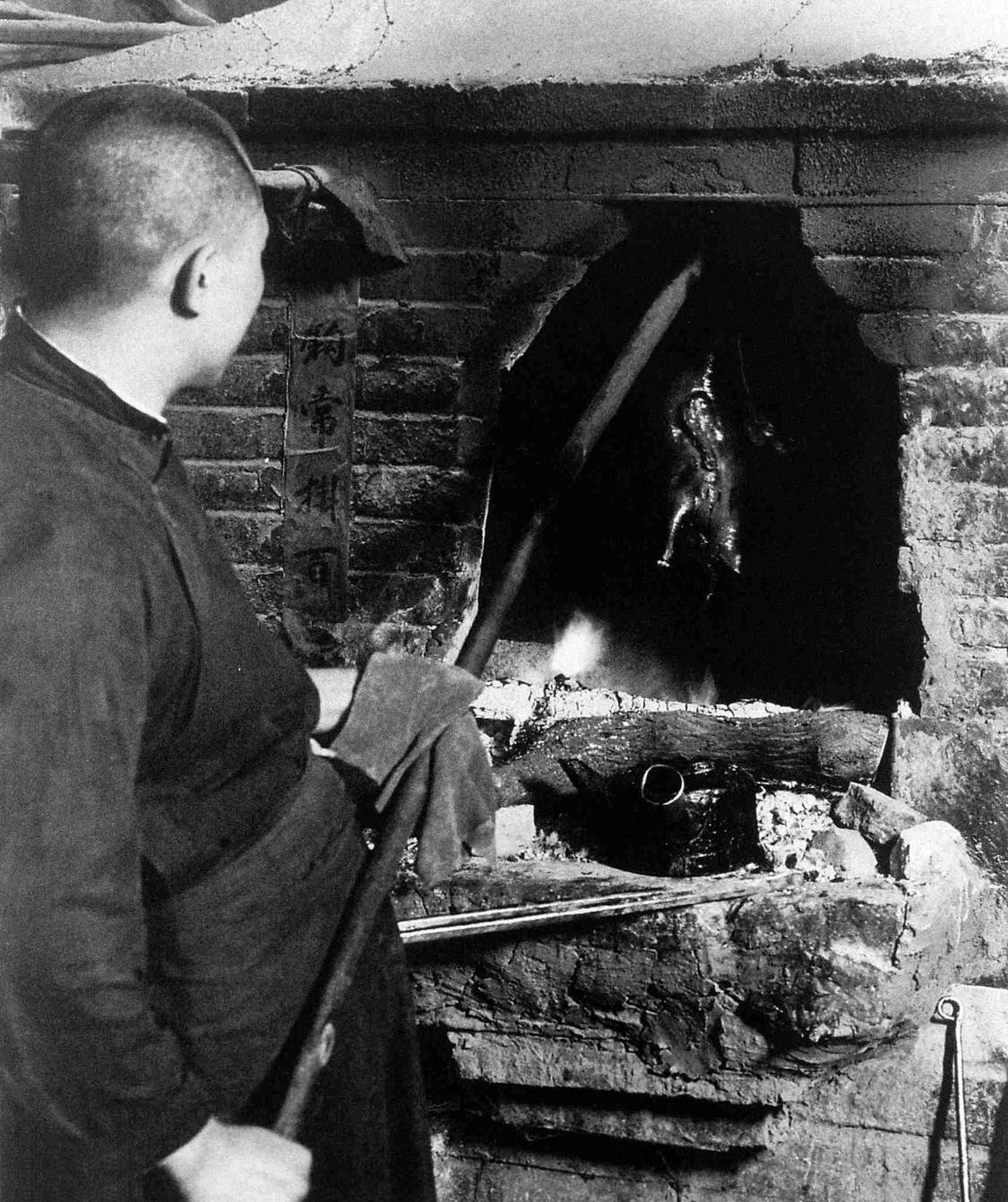
That is not a technical footnote. It is the restaurant's grammar. Closed-oven duck can be superb, but it hides more of the action. Hanging-oven duck makes verticality part of the dish. The bird is not lying down like a roast. It is displayed to heat. Fat falls away. The skin dries and colors. The kitchen becomes a kind of backstage theater, and Helen Morrison's 1933 photograph of ducks in a Quanjude oven captures exactly that: luxury as a row of bodies suspended in a working fire chamber, not luxury as garnish.[6]
Fine dining often uses equipment as invisible authority. Quanjude does almost the opposite. The oven gives the dish a visible origin story. When the duck arrives glossy and carved, the room can point backward to a craft object: not a pan, not a vague tradition, but the hanging oven itself. That is why the dish survives modernization better than many ceremonial plates. Even when the dining room changes, the bird still has a machine of memory behind it.
Slicing Turns Heat Into Hospitality
The second signature is service. A whole roast duck can be eaten casually; Peking duck at Quanjude is structured so the diner receives the bird in stages. The crisp skin is not merely texture. It is an opening gesture. The meat is not simply protein. It becomes a sequence of slices thin enough to wrap, season, and share. The pancakes make the guest a participant without making the meal feel like assembly-line work.
The Woks of Life's practical Peking duck guide is useful here because it treats the table sequence as part of the dish rather than as decoration. It describes spreading sauce on a warm pancake, adding duck slices, then finishing with cucumber, melon, and scallion before wrapping.[5] That is the practical heart of the ritual. The restaurant does not just sell the duck; it sells a shared method of handling richness.
The best version of that method is neither fussy nor casual. Too much ceremony and the duck turns into a museum object. Too little and it collapses into roast poultry with condiments. Quanjude's format works because it gives the guest a small repeated action: take pancake, add sauce, place duck, add scallion or cucumber, fold, eat before the skin loses its edge. Fine dining here is not about removing the guest from the work. It is about giving the guest just enough work to feel the structure.
Public Luxury, Not Private Court Food
This is where the story becomes more interesting than imperial nostalgia. Quanjude's official site states that the brand has received more than 200 heads of state and political figures and operates across more than 100 stores, with overseas footprints listed in the United States, Japan, Canada, and France.[1] China Daily's report on the New York franchise frames the modern version similarly: Quanjude is a 1864 restaurant chain whose duck has become a national icon, with North American expansion through iDen & Quanjude and a Michelin-starred Vancouver branch.[7]
That scale creates a tension. A dish built on slow craft can become diluted when it travels. A famous brand can become souvenir dining. A ritual can become a photo opportunity. But Peking duck has one advantage over many exported luxury foods: its core sequence is unusually resilient. The restaurant still has to explain the oven. The server still has to carve. The table still has to wrap. The guest still has to manage crispness against sauce and steam.
The overseas rooms also clarify what was already true in Beijing. Quanjude made roast duck public luxury. It took a technique associated with court kitchens and upper-class appetite and turned it into something visitors, officials, families, and business diners could recognize as Beijing on a table.[2][7] The point is not that every branch can carry the same atmosphere as Qianmen. The point is that the brand's fine-dining logic can move because the service ritual is portable.
The Craft Survives By Being Specific
The danger in writing about Peking duck is that it becomes a generic symbol of Chinese cuisine. Quanjude's lineage resists that only when the details stay specific: hanging oven rather than any oven; fruitwood rather than anonymous heat; skin first rather than meat as the only prize; carving as service rather than prep; pancake wrapping as a controlled release of richness.
Our China Story notes that Beijing's 2019 technical specifications for Peking duck attempted to preserve both hanging-oven and closed-oven methods, down to roasting times and condiment quantities.[3] Specifications cannot create soul, but they can mark what a culture is afraid of losing. In this case, the fear is reasonable. The more famous Peking duck becomes, the easier it is for weak versions to borrow the name while skipping the drying, fire control, slicing discipline, and timing that make the dish feel alive.
Quanjude's modern challenge is therefore not to remain frozen in 1864. It is to keep the ritual legible while serving a world that wants convenience, global branches, photographs, shorter meals, and sometimes the status of the name more than the discipline of the craft. That is a real fine-dining problem. Heritage has to be refreshed without becoming theme decor. Technique has to be standardized without turning mechanical. Service has to feel ceremonial without making diners feel trapped by instruction.
Why The Ritual Still Works
The reason Quanjude remains a useful fine-dining case is that the duck makes the whole restaurant visible. Many signature dishes hide their operating system. Quanjude's duck reveals it. You can see the oven in the lineage, the cook in the skin, the server in the slice, the room in the shared wrapping, and the brand in the way the same sequence can travel from Beijing to Vancouver or New York without losing its basic grammar.[1][4][7]
That is why the dish should not be reduced to crisp skin alone. Crisp skin is the hook, but the achievement is the chain of custody from fire to hand. The bird is selected, prepared, hung, roasted, carved, wrapped, and eaten in a rhythm that turns richness into social order. Fat could make the meal heavy; the pancake, scallion, cucumber, and sauce make it quick and bright. Ceremony could make it stiff; the wrapping makes it intimate.
Quanjude made roast duck durable because it understood that fine dining is often a ritual technology. The oven gives the dish authority. The carving gives it presence. The pancake gives it release. The brand gives it memory. Put together, they explain why a duck can be more than a famous Beijing order. It can be a room teaching guests how to eat history while it is still hot.
Sources
- Quanjude Group official site - founding date, brand scale, global locations, and 160-plus-year hanging-oven craft framing.
- National Geographic, "Peking duck: the complex history of a Chinese classic" - historical lineage from Hangzhou and Nanjing to Beijing, Qing appetite, and Quanjude's 1864 founding.
- Our China Story, "Peking duck: A century-old recipe for the future" - comparison of closed-oven and hanging-oven methods, Quanjude craft stages, and 2019 technical-specification context.
- iDen & Quanjude, "About Us" - Quanjude heritage account, fruitwood open-oven description, intangible-cultural-heritage note, and Vancouver fine-dining branch context.
- The Woks of Life, "Easy Peking Duck with Mandarin Pancakes" - practical table-sequence notes on sauce, duck slices, cucumber, melon, scallion, and wrapping.
- Wikimedia Commons, "File:Quanjude Oven.jpg" - Helen Morrison's circa-1933 archival photograph of Peking ducks roasting in a Quanjude hanging oven, used as the article image.
- China Daily, "Famous Peking duck restaurant serves up a tasty treat in New York" - modern franchise context, New York location, Vancouver branch, and Quanjude as a national-icon restaurant brand.