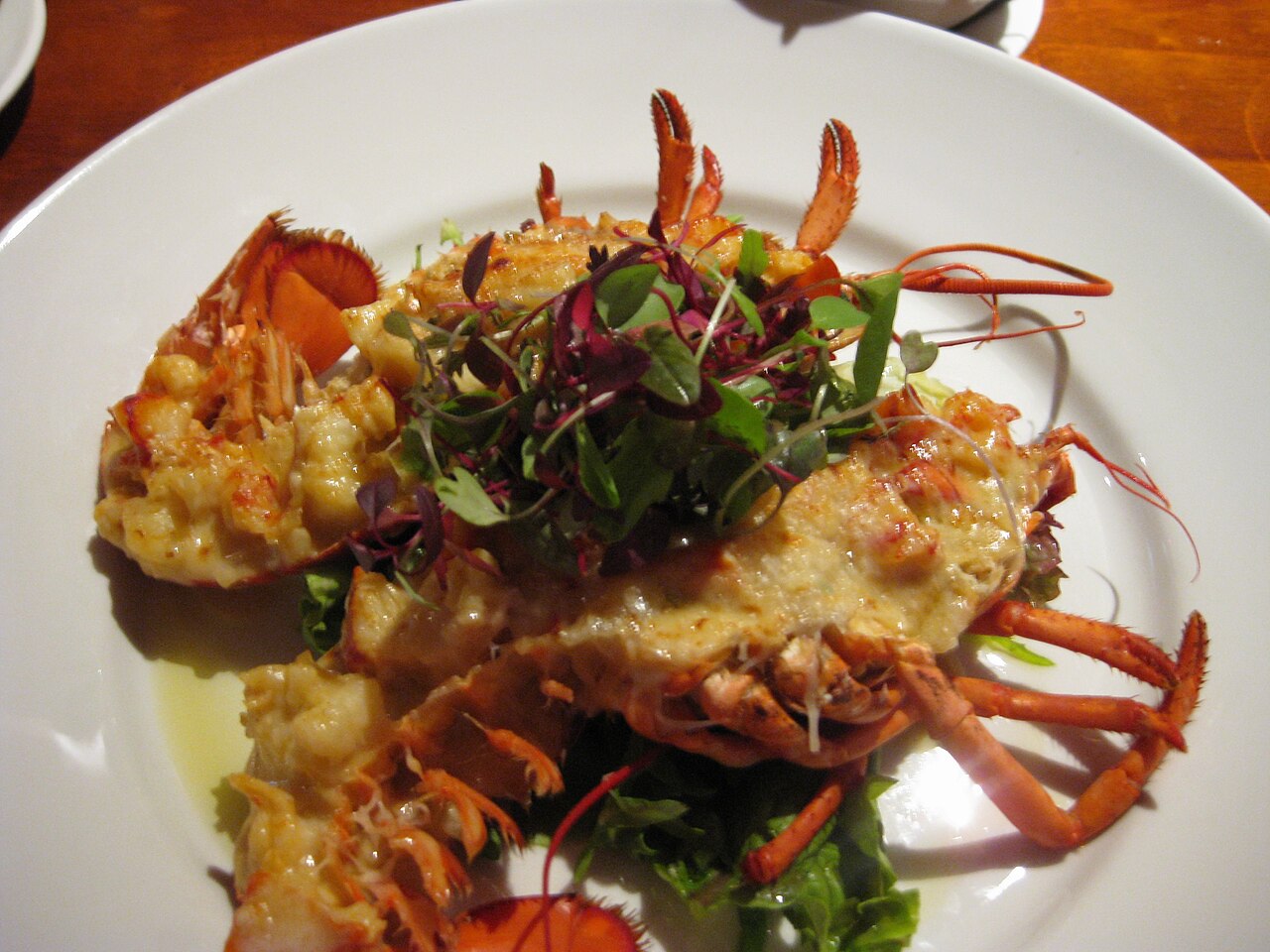
Lobster Thermidor is easy to mock because it carries every old luxury signal at once: lobster, cream, brandy or wine, mustard, gratin, a split shell, and a name that sounds like a Paris dining room trying to remember the theater. But the dish is more interesting than the joke. Its best versions are not rich because they add richness until the plate gives up. They are rich because the shell makes the kitchen organize excess.
That shell is the whole argument. Without it, Thermidor risks becoming lobster in a creamy sauce, a pleasant but shapeless category. Returned to the carapace, the meat has to be cut, sauced, layered, and browned in a way that still lets the diner recognize the animal. The plate says luxury, but it also says editing. The lobster is not hidden under sauce. It is reassembled as a service object.
Escoffier's codified version, as preserved in the ckbk page for Le Guide Culinaire, keeps the construction surprisingly spare: split the lobster lengthwise, season and gently grill it, remove the flesh, cut it into thick slanted slices, place a cream sauce finished with English mustard in the half shells, return the lobster neatly, coat with sauce, and glaze.[1] That is not the overloaded hotel version many people imagine. It is a sequence of control points: heat first, slicing second, mustarded sauce third, shell structure last.
Mustard saves the dish from softness
The key flavor is not cheese, and it is not cream. It is mustard. Thermidor needs a sharp line because lobster is already sweet and the sauce is already generous. Cuisine Actuelle's modern overview describes the classic Escoffier frame as roasted lobster medallions placed back into the shell, covered with mustarded bechamel, sprinkled with Parmesan, finished with melted butter, and gratineed.[3] The danger is obvious: cream, butter, cheese, and sweet shellfish can turn plush in the worst sense.
Mustard prevents that. It gives the sauce a stern edge without making the lobster taste pickled or aggressively acidic. A good Thermidor sauce should not shout. It should make the next bite of lobster clearer. The mustard's heat and bitterness cut through dairy fat, while the gratin adds a roasted top note that keeps the surface from reading as merely pale and soft.
Kitchen Project's historical recipe page is useful here because it shows how the modern idea expanded: creamy chunks or slices of lobster, sometimes mushrooms, a veloute or Mornay-like sauce, Dijon mustard, wine or brandy, bread crumbs, and a cheese topping.[5] That list explains both the appeal and the failure mode. The dish can absorb many restaurant habits, but each addition makes the central balance harder. Mushrooms can deepen the sauce or muddy it. Brandy can perfume the lobster or make the plate taste hot. Cheese can brown beautifully or bury the shellfish. Thermidor is not difficult because it uses obscure ingredients. It is difficult because every "luxury" move has to stay subordinate.
The theater in the name matters
The dish's name gives it an unusually theatrical origin story. The Institut de France history-and-gastronomy episode connects Homard Thermidor to Victorien Sardou's play Thermidor, first performed on January 24, 1891, and to the late nineteenth-century fashion for naming restaurant dishes after plays, operas, and performers.[2] The episode also notes the political scandal around Sardou's treatment of the French Revolution, the backlash, and the way the lobster dish outlived the stage controversy.[2]
That history is more than trivia. It explains why the dish feels like a performance even before it reaches the table. Thermidor is named after a public event, not after an ingredient or region. The shell becomes a stage set. The browned sauce is the curtain. The diner receives not a quiet preparation but a composed entrance.
This is also why the dish belongs to fine dining rather than simply to home celebration. A home cook can make an excellent version, but the restaurant frame gives Thermidor its natural pressure. Someone has to judge the lobster before it dries. Someone has to handle the shells without breaking them into sad fragments. Someone has to glaze the sauce deeply enough for color while keeping the meat tender. The dish asks the kitchen to perform abundance while concealing most of the labor.
The lobster must remain legible
The most common bad Thermidor is not too old-fashioned. It is too anonymous. If the sauce is thick enough to turn the shell into a casserole dish, the lobster has been demoted. The best versions keep the meat in visible pieces, often sliced or arranged so the diner can still read tail, claw, and shell as related parts. Escoffier's instruction to cut the flesh into thick slices on the slant matters because it keeps texture in the foreground.[1]
That texture is the dish's moral boundary. Lobster can be tender, springy, and sweet, but it turns rubbery when overcooked and watery when mistreated. Cuisine Actuelle's practical guidance stresses temperature control, giving different targets for tail and claw meat because the textures do not behave alike.[3] Even if a restaurant uses its own exact method, the principle holds: Thermidor only works if the sauce arrives after the lobster has been respected, not as a disguise for damage.
The shell then does a second job. It slows the diner down. A plate of sauced seafood can disappear as spoonable richness. A shell asks for attention. It gives the portion edges, makes the gratin visible, and keeps the diner aware that the dish began as a whole animal. That awareness is important. Thermidor is luxurious, but it should not be boneless luxury. It should still have shape.
Gratin is a timing device
The browned top is often treated as decoration, but it is really a timing device. Glazing has to happen at the end, after the lobster is arranged and the sauce is in place. Too little heat and the surface looks unfinished. Too much heat and the meat underneath pays for the color. That short final exposure is why Thermidor feels more like service craft than recipe nostalgia.
It also explains the shell's engineering value. The carapace protects and frames. It holds sauce close to the meat without letting the preparation spread flat across the plate. The diner sees a compact object, not a pool. The photo used for this article makes that structure visible: the lobster shell contains the browned, creamy center while the surrounding plate remains relatively calm.[4] The dish may be maximal in ingredients, but its presentation depends on containment.
Modern chefs can lighten Thermidor, reduce cheese, sharpen the mustard, use a cleaner shellfish reduction, or borrow the idea for langoustine, crab, or even vegetables. But if the shell logic disappears, the name becomes mostly costume. The durable idea is not "lobster plus cream." It is "luxury returned to its own frame."
Why it still earns a place
Thermidor survives because it understands a fine-dining truth that newer plates sometimes forget: richness needs architecture. A tasting menu can scatter prestige ingredients across porcelain and still feel flat if the diner cannot tell what is organizing them. Thermidor gives the organizing job to the shell. Everything else has to answer to it.
That is why the dish is most compelling when it resists both extremes. It should not be a museum piece, stiff with reverence and heavy sauce. It also should not be modernized into abstraction until the lobster disappears. The pleasure is in the old contract made exact: sweet shellfish, mustarded cream, heat, gratin, and a vessel that tells the diner where to look.
Lobster Thermidor is not subtle in the quiet-minimalist sense. It is subtle in the way old restaurant dishes can be subtle: the balance hides inside a gesture that looks obvious. Split the lobster. Cook it carefully. Cut it so the meat still has bite. Put it back where it came from. Add sauce with enough discipline to lift rather than smother. Brown the top at the last moment. Serve it before luxury turns soft.
Sources
- Auguste Escoffier, "Homard Thermidor," from Le Guide Culinaire on ckbk - codified recipe sequence with split lobster, gentle grilling, mustarded cream sauce, shell assembly, and glazing.
- Institut de France, "Le homard: a l'americaine ou Thermidor?" - French history-and-gastronomy episode covering the Sardou play, the naming fashion, the scandal around Thermidor, and the dish's afterlife.
- Cuisine Actuelle, "Qu'est-ce que le homard Thermidor et comment le preparer a la perfection" - modern French overview of the Escoffier-style construction, mustarded bechamel, gratin finish, and cooking-temperature cautions.
- Wikimedia Commons, "File:Lobster Thermidor.jpg" - real 2010 photograph by thefoodplace.co.uk used as the article image.
- Kitchen Project, "The History of Lobster Thermidor" - historical recipe survey noting mustard, wine or brandy, creamy sauce variants, crumbs, cheese, and Escoffier's circa-1903 formula.