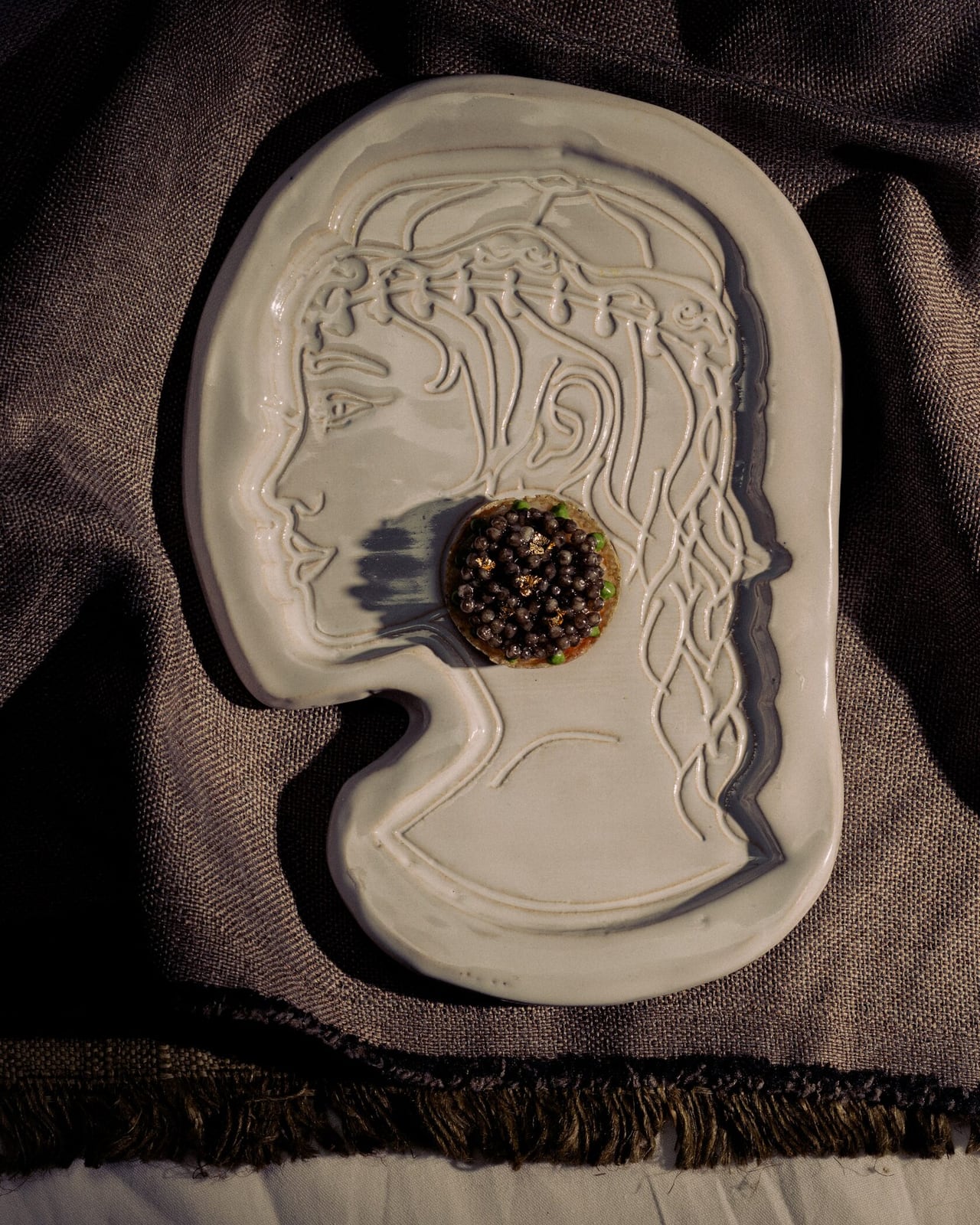
On a cream-colored ceramic profile, a small caviar-topped bite sits exactly where an earring would hang. The plate is not neutral china. It supplies the verb.
The dish appears on Qazaq Gourmet's page for Ómir, an 11-course tasting menu served by pre-order in Astana. Its third course, Syrǵa salu, combines unagi sturgeon, black caviar, and garlic chives; the name belongs to the Kazakh wedding custom in which earrings are placed on a bride as a sign of agreement.[1][3] Before a guest knows the temperature, texture, or seasoning, the photograph has already explained the course's dramatic action.
That image gives away the larger idea. Ómir means life, and the menu is organized less like a parade of signature ingredients than a compressed social biography. Matchmaking leads to engagement and the unveiling of a bride. Pregnancy leads to labor and a child's fortieth day. First steps lead to a first horse. The final movement turns toward care for elders and a departing blessing.[1][3][5][6]
This is a reading of Qazaq Gourmet's current published menu, not a first-person restaurant review. The distinction matters: an ingredient list can reveal sequence and intent, but not whether the lamb arrived juicy, the broth was balanced, or the service made the cultural references legible. What the menu does make unusually clear is that its most important ingredient is order.
The first movement joins two families
The opening course, Aq súiek, is simply listed as camel's milk and lemon. Then Qudalyq brings qurt, liver, coconut, cappuccino, honeysuckle, and uyz into the same composition.[1] The official cultural guide defines qudalyq as matchmaking and the formal introduction of two families.[3] The plate's ingredient list performs its own meeting: preserved dairy and offal sit beside coconut and the borrowed café vocabulary of cappuccino.
Qurt is not a vague pastoral accent. It is strained, dried sour milk or yogurt, dense and salty enough to travel and keep; red irimshik, which appears later, is cooked longer and sun-dried for storage.[8] Those preservation traditions give the menu a material base. Qazaq Gourmet can use polished plating and international references, but the meal begins with foods shaped by time, movement, and the need to make milk last.
Syrǵa salu follows the matchmaking course. Kazakhstan's government guide describes the ritual as the placement of a bride's earrings to mark agreement.[3] On the restaurant's photographed plate, the caviar does not merely signal expense. It occupies the position that lets the course be read. This is a much stronger use of luxury than scattering roe over an anonymous canapé: the costly ingredient is subordinated to the gesture.
The fourth course, Betashar, pares the list back to kymyz, saumal, and mountain honey.[1] UNESCO describes Betashar as the wedding ceremony in which an akyn sings of the groom's family and ancestors, the bride bows as relatives are named, and her veil is lifted before she is welcomed into the family. The ritual was inscribed on the Representative List of the Intangible Cultural Heritage of Humanity in 2024.[4]
The menu answers that public unveiling with two forms of mare's milk and honey. Kymyz is fermented mare's milk—lightly alcoholic, fizzy, and sharply tangy.[8] On paper, its pairing with saumal and mountain honey makes the change from the crowded Qudalyq list to this short liquid course feel deliberate. The wedding movement opens outward through meetings, agreement, and presentation, then resolves in a drink rather than another constructed centerpiece.
The cauldron races the child
The middle of Ómir is where the tasting-menu clock and the life-cycle clock lock together. Course five, Qursaq toi, lists red irimshik, cherry, ziziphora, and Parmesan. Course six, Jarysqazan, moves to lamb, smoked onions, and sur et, or preserved meat. Course seven, Qyrqynan shyǵaru, is reduced to sorpa and sherry.[1]
The progression is pregnancy, labor, and early postnatal care. Ethnographic research on Kazakh pregnancy and childbirth records a small celebration when a young wife became pregnant, with relatives bringing foods intended to please her. When contractions intensified, women prepared zharys kazan—literally a competition with the cauldron—from meat kept in the house. The question was whether the pot would finish cooking before the baby arrived.[5]
That history makes the sixth course the menu's conceptual hinge. Lamb and smoked onion would be easy to read as generic steppe gravitas. Under the title Jarysqazan, preserved meat becomes part of a race. A tasting menu is always governed by clocks: firing, resting, saucing, carrying, and the interval before a plate cools. Here the old cauldron contest gives that kitchen timing a human stake. The dish is about labor in both senses—childbirth and the work of cooking around it.
Then the sequence grows quieter. The government cultural guide describes qyrqynan shyǵaru as the child's fortieth-day ceremony, including bathing in silver water and the first cutting of hair and nails.[3] Qazaq Gourmet answers with sorpa and sherry.[1] After the crowded dairy course and the smoked-meat course, broth is not a weak interlude. It reads as care: warmth and extraction after the cauldron's urgency.
The sequence also shows why this menu should not be reduced to "nomadic flavors." Pregnancy customs, women gathering around a person in labor, a timed cauldron, bathing, hair, and nails are domestic and relational. They locate heritage inside acts of attention, not only in horses, yurts, and open steppe.
First steps become a first saddle
Course eight is Tusau kesu: horse meat and grape leaf with ginger and ishek. Course nine is Ashamaıǵa (atqa) mińgizu: cheek, milk, and melilot.[1] The pair advances the child from walking to riding.
Tusau kesu is the cutting of a child's symbolic fetters when the child begins to walk. A respected person performs it as a wish for an easy and prosperous path.[3] The second rite historically marked a later threshold. The Qazaqstan Tarihy portal describes ashamayga mingizu as giving a six- or seven-year-old boy a horse and whip, followed by elders' blessings and a family celebration.[6]
The menu's adjacency is more revealing than either plate in isolation. Horse meat appears at the first-steps course; the next title places the growing child on a horse. Livestock is therefore not confined to the role of premium protein. Across two courses, it belongs to food, mobility, education, and social recognition.
There is also a boundary worth keeping visible. The historical description is specifically gendered as a boy's initiation, while the restaurant's English menu offers only the ritual title and ingredients.[1][6] Ómir is not a universal biography of every Kazakh person. It selects one inherited ceremonial route, with marriage, childbirth, and a male-coded riding rite at its center. Calling the menu a life cycle is useful only if "a" remains in the sentence.
The ending grows lighter as the person grows older
The last savory-to-sweet turn is unexpected. Bel kóterer, course ten, lists dried melon, steppe herbs, and oleaster. Bata beru, course eleven, closes with milk, currant leaf, and raspberry leaf.[1]
The government guide defines bel kóterer as special food prepared for elderly guests and bata beru as a blessing pronounced by elders when a guest leaves.[3] Rather than ending with a monument of chocolate, the menu moves toward fruit, herbs, leaves, and milk. The first course began with camel's milk; the last returns to milk in another form. That circularity makes the close feel less like a finale than a handover.
It also reverses the usual authority at a tasting-menu table. For much of the meal, the kitchen explains and the diner receives. A final bata places the elder's spoken blessing above the chef's last flourish. Whether service actually creates that exchange cannot be known from the web page, but the title establishes the intended direction: the meal should end with words moving back across the table.
This is interpretation, not preservation under glass
Qazaq Gourmet says brand chef Artem Kantsev traveled across Kazakhstan to study regional food heritage, local diets, and seasonality before building the restaurant's menu. The restaurant has operated since 2016, and 50 Best Discovery describes Kantsev's work as an effort to preserve the integrity of Kazakh gastronomic heritage while producing contemporary dishes.[2][7]
Yet Ómir is plainly not an ethnographic reconstruction. Coconut, cappuccino, unagi, Parmesan, sherry, and ginger share the list with qurt, kymyz, red irimshik, horse meat, and sorpa.[1] That mixture is not a defect to explain away. It is the restaurant's actual proposition: Kazakh rituals determine the dramatic structure, while a cosmopolitan pantry helps articulate contrasts inside it.
The harder question is whether the named customs remain subjects or become décor. Qazaq Gourmet's English menu page gives each course a title and an ingredient line, but almost no explanation of the ritual itself.[1] For a guest who does not already know the references, the difference between Qudalyq, Jarysqazan, and Bata beru must be carried by a server, menu card, tableware, or another layer of narration. Without that layer, eleven precise names can flatten into eleven exotic labels.
The photographed Syrǵa salu plate shows the better possibility. The earring placement communicates before translation, while the cultural record supplies what the image cannot: agreement between families, the bride's role, and the ceremony's place in a longer wedding sequence.[3] Plate and explanation do different jobs. Neither has to pretend to be the other.
That is why Ómir is more interesting than a checklist of modernized national dishes. It makes ritual control pacing. The opening course and three wedding customs occupy the first four positions; pregnancy and birth take three; childhood takes two; elder care and blessing take the final two. The meal's argument is built into what must come next.
A conventional tasting menu moves from light to rich to sweet. Qazaq Gourmet adds a second form of progression: from joining a family to being cared for, learning to move, growing old, and giving the blessing that sends somebody else onward. Eleven courses cannot contain a culture or a life. They can, however, make time itself arrive on the plate.
Sources
- Qazaq Gourmet, "Signature degustation set 'Ómir'" — current official 11-course sequence, ingredient lists, pre-order note, and source of the article photograph.
- Qazaq Gourmet, official restaurant site — restaurant history, chef Artem Kantsev's research journey, menu philosophy, address, and current operation.
- Government of the Republic of Kazakhstan, "Culture of Kazakhstan" — official overview of wedding, child-rearing, hospitality, blessing, elder-care, and culinary traditions.
- UNESCO Intangible Cultural Heritage, "Betashar, traditional wedding ritual" — description of the ceremony and its 2024 inscription on the Representative List.
- Meruyert K. Yegizbayeva et al., "Kazakh Pregnancy, Childbirth and Childcare Traditions," Journal of Ethnology and Folkloristics 17, no. 2 (2023), pp. 100–116 — ethnographic context for pregnancy celebrations and the zharys kazan cauldron ritual.
- Qazaqstan Tarihy, "Material culture of Kazakhs. Customs and ceremonies" — national-history portal account of matchmaking, Betashar, and the ashamayga mingizu riding rite.
- 50 Best Discovery, "Qazaq Gourmet – Astana" — independent restaurant profile covering Kantsev's research, dining room, and contemporary treatment of Kazakh cuisine.
- Nagima Abuova, "Traditional Fermented Dairy Products: Taste of Heritage, Modern Health Insights," The Astana Times (March 30, 2025) — descriptions of kymyz, qurt, and red and white irimshik.