The first sound should be failure: a brittle roof giving way under the serving knife. Then the apparent wreckage starts to make sense. Under the cinnamon-marked sugar is crisp pastry; under the pastry, spiced bird, soft egg, onion, herbs, and almond. Pastilla does not blend these things into one polite flavor. It lets them arrive in quick collisions.
That is what makes the Moroccan pie a fine-dining dish rather than merely a rich one. Its ingredients advertise abundance, but its pleasure depends on restraint at the joins. The shell must be thin without turning papery-dry. The braise must be concentrated without soaking the wrapper. Almond must remain granular, egg must bind without becoming breakfast, and sugar must perfume the savory filling without annexing it as dessert.
WIPO's Morocco gastronomy project places pigeon pastilla among the country's emblematic culinary traditions and situates Moroccan cuisine more broadly among Arab, Amazigh, Jewish, sub-Saharan African, and South Asian influences.[2] That wide frame matters. Pastilla is not useful as a mascot for one tidy origin story. It is more revealing as a piece of living culinary engineering: a celebratory dish whose identity survives because cooks keep renegotiating its layers.
Historian Anny Gaul's kitchen-history research gives that movement a modern social shape. She traces bastila from a delicacy of the Andalusi-influenced urban cuisines of Fez, Rabat, and Tetouan to a national celebratory dish during the twentieth century, carried through Moroccan family migration and the expanding urban middle class.[6] The recipe did not become national by standing still.
The wrapper is not packaging
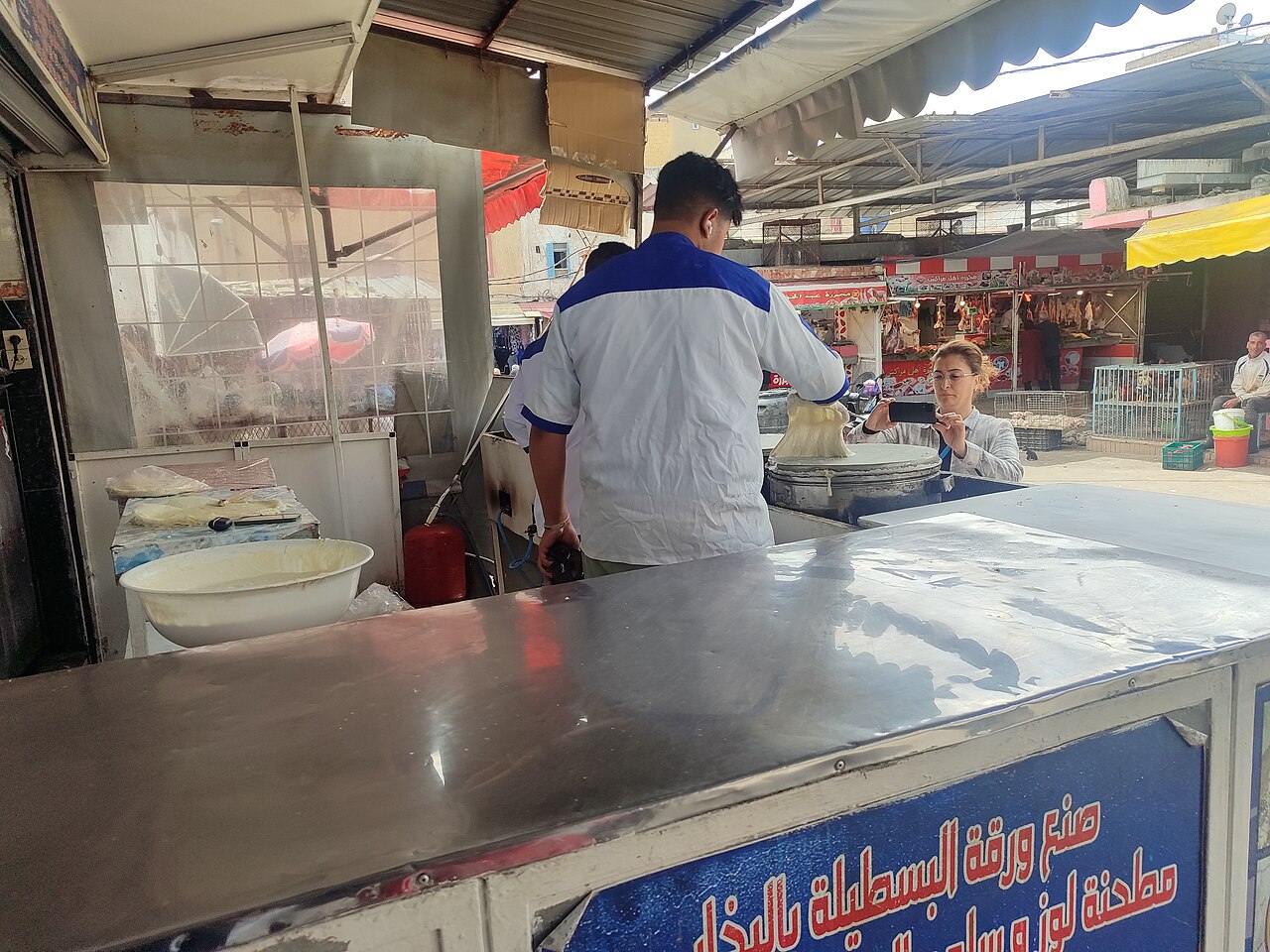
Warqa is the dish's first argument. It resembles filo once baked, but it begins through a different gesture. A 2021 study hosted by the World Intellectual Property Organization describes a loose flour, water, and salt dough applied in a very thin layer to a heated tarada, then oiled so the finished sheet does not crack or dry out.[1] The method makes the wrapper a craft in its own right, not a neutral envelope bought on the way to the filling.
The cover photograph shows that craft in a Casablanca market rather than in a spotless demonstration kitchen. At Souk Jmiaa, a worker stands over round hot plates; pale batter, metal surfaces, and finished sheets occupy the stall around him.[8] It is an unusually honest image for a luxurious dish. Before the patterned sugar and the silver serving tray, there is heat, repetition, and a specialist making fragile rounds one by one.
Warqa has two contradictory jobs. It must be supple enough to overlap, fold, and seal around a heavy filling, then dry into a shell that fractures cleanly. Butter or oil between sheets creates separation; heat turns that separation audible. Substitute filo can give an excellent result, and contemporary recipes routinely allow it, but it changes the labor story. Jane Baxter and Henry Dimbleby's chicken bisteeya uses overlapping sheets of buttered filo while noting that the feasting dish is more commonly made with squab.[4] The substitution reproduces the architecture more easily than the craft that produced it.
This is why an intact pastilla can look almost too composed. Its smooth dome conceals a wrapper assembled from overlaps. The perfection is provisional. The whole point is to build a surface beautiful enough to destroy at the table.
Wet filling, dry shell
Pastilla's hardest problem is not sweet versus savory. It is water versus crispness.
The WIPO study's pigeon recipe begins with onions, spices, and birds cooked gently, then moves the pigeons out of the pot. The meat is pulled from the bone; the sauce is reduced; beaten eggs go back into that concentrated liquid and cook over low heat before the components are cooled and assembled.[1] Baxter and Dimbleby's chicken version takes another route toward the same boundary: it reduces the strained stock to about 100 milliliters, scrambles the eggs into it until fairly dry, and cools the components before assembly.[4]
Reduction is doing more than intensifying flavor. It is deciding how much of the braise the pastry can survive. Cooling is equally important. A steaming filling sealed immediately beneath thin sheets carries its own sabotage: vapor softens the shell from inside before oven heat can set it. The dish therefore asks a banquet kitchen to think in stages—braise, reduce, shred, set, cool, layer, wrap, bake—while making the finished round look effortless.
The egg layer is the hinge. It captures onion, spice, poultry juices, and herbs in a soft mass that can be portioned, but it should not erase the meat. Nor is there one immutable arrangement. The WIPO recipe layers egg, shredded pigeon, and crushed almond; Baxter and Dimbleby build a chicken version from separately cooled components; and Hugh Fearnley-Whittingstall's first-hand account from Morocco records both a distinctly layered pastilla and another cook's tender pigeon version made without egg.[1][4][5] The variations do not expose a counterfeit. They show where cooks place the same structural burdens differently.
Pigeon makes celebration legible
Pigeon is not an eccentric garnish added for luxury theater. It belongs to the dish's older celebratory grammar. The WIPO study calls pigeon pastilla a traditional Moroccan preparation, notes chicken, guinea fowl, and more recent seafood variants, and describes pastilla as a course served before the main dish at celebrations.[1] National Geographic likewise reports the Fez custom of sharing a squab pastilla as an early course at a sumptuous gathering.[3]
That position in the meal changes how the pie should eat. It cannot behave like a heavy pot pie whose purpose is satiety. A shared wedge has to create appetite even while delivering bird, egg, nuts, pastry, and sugar. Thinness is therefore not delicacy for its own sake. It is portion control built into the crust.
Chicken makes pastilla more accessible and can be delicious, but it also changes the signal. The WIPO report identifies limited pigeon availability and the replacement of pigeon by farmed chicken as pressures on the older form.[1] That is not a reason to police every chicken pastilla out of legitimacy. It is a reason to name what a menu serves. “Pigeon” should describe an actual ingredient and a different sourcing burden, not act as antique atmosphere around chicken.
The finest version is not automatically the one with the rarest bird. It is the one in which the cook understands what the bird contributes to the filling's density, seasoning, and moisture, then adjusts the other layers around it.
Sugar belongs on the threshold
The sugar on top is often treated as pastilla's charming paradox. That undersells it. Powdered sugar and cinnamon are not random sweetness sprinkled over a savory pie; they are the first aromatic layer and the last one applied. Both the WIPO and Baxter-Dimbleby preparations finish the baked crust this way.[1][4]
Placed outside, the sugar behaves differently than it would dissolved into the braise. It touches the tongue early, then disappears into butter, warm spice, onion, and poultry. Cinnamon connects the surface to the seasoning below. Coarsely ground toasted almond extends the sweet register while keeping texture in the filling. The result is not a compromise halfway between dinner and dessert. It is a sequence in which the diner keeps crossing the line.
Balance remains cook-specific. Fearnley-Whittingstall found one layered version too dominated by nuts, sugar, and spice, then preferred a pie whose almonds and herbs were integrated with tender pigeon.[5] That judgment is subjective, but the comparison exposes a useful technical truth: authenticity does not rescue bad proportion. A ceremonial recipe still has to be edited bite by bite.
This is where restaurant refinement can help or harm. A kitchen may reduce the sugar, shrink the pie to an individual portion, change the bird, or sharpen the herbs. Those choices can clarify the dish. They can also sand away the very friction that makes it memorable. If every layer is softened into one smooth farce and the sugar becomes a timid decorative dust, pastilla loses its argument.
A history with seams showing
The dish's past is often narrated as a straight road from al-Andalus to Morocco. Gaul's archival work makes the road less convenient. In two thirteenth-century Andalusi cookbooks, she found fillings that resemble the inside of modern bastila, but neither the fine pastry enclosure nor the dish's name. She also presents a competing line of evidence that the name and paper-thin wrapper may have reached Tetouan through Ottoman-influenced Algerian migration after 1830, while clearly labeling the larger reconstruction as unfinished and partly speculative.[7]
That uncertainty is worth preserving. Gaul's peer-reviewed kitchen histories tell a firmer modern story: families moving among Moroccan cities helped turn a regional bourgeois delicacy into a national celebration food during the twentieth century.[6] WIPO's Morocco project, meanwhile, describes a national cuisine shaped by several traditions rather than a single inheritance.[2] These are histories of formation, not a birth certificate.
Pastilla makes that plurality edible, but it should not be turned into a vague “meeting of cultures” slogan. Its present identity is concrete: Moroccan warqa craft, Moroccan celebration service, regional associations with Fez, Rabat, and Tetouan, and generations of cooks deciding whether the bird is pigeon or chicken, whether egg forms its own layer, and how boldly sugar should speak.[1][5][6][7]
The seams are the history. They are also the method.
The last luxury is timing
Pastilla cannot wait indefinitely for the room. The WIPO study explicitly lists storage after preparation as a weakness of the dish.[1] Once baked, the shell is on a clock: trapped steam migrates outward, the filling cools, and crispness gives way. Fine-dining service adds one final piece of technique by deciding when to fire, how long to rest, and when to cut.
That makes the serving knife more than theater. It opens the dish at its narrow best moment, when the crust still splinters but the filling has settled enough to hold a wedge. A clean slice is not the only measure; some collapse is desirable. Pastilla should reveal layers, not stand like masonry.
Its extravagance is easy to list: pigeon, saffron, almond, butter, spice, sugar, many hands. Its precision is harder to see. Precision lives in the liquid cooked away, the filling allowed to cool, the sheet kept supple, the almond left coarse, and the few minutes between oven and table. The pie feels abundant because so much is inside it. It feels elegant because, for one crackling moment, none of those things become mush.
Sources
- Kamal Rahal Essoulami, Scoping Study on the Gastronomic Tourism Sector in Morocco (2021), hosted by the World Intellectual Property Organization — pigeon-pastilla ingredients, celebration context, warqa craft, assembly sequence, substitutions, and storage constraints.
- World Intellectual Property Organization, “IP and Gastronomic Tourism: Morocco” — institutional project overview naming pigeon pastilla among Morocco's emblematic traditions and describing the country's plural culinary heritage.
- Nicole Cotroneo Jolly, “The Sweet Taste of Pigeon Pie,” National Geographic Traveler (November 15, 2013) — Fez and squab pastilla as a shared early celebration course.
- Jane Baxter and Henry Dimbleby, “Take Your Sweet Time with a Moroccan Meat Pie,” The Guardian (June 12, 2015) — a detailed chicken bisteeya recipe documenting stock reduction, dry-set egg, separately cooled layers, buttered filo, almonds, cinnamon, and sugar.
- Hugh Fearnley-Whittingstall, “Confessions of a Kitchen Tart,” The Guardian (December 8, 2002) — first-hand comparison of differently layered Moroccan pastillas and the effect of proportion on the finished dish.
- Anny Gaul, “'Kitchen Histories' and the Taste of Mobility in Morocco,” Mashriq & Mahjar 6, no. 2 (2019) — peer-reviewed research on bastila's twentieth-century movement from an urban regional delicacy to a national celebration dish through family and middle-class mobility.
- Anny Gaul, “Bastila and the Archives of Unwritten Things,” Maydan / George Mason University (November 27, 2019) — archival essay separating similar Andalusi fillings from the later wrapper and name, and presenting the competing Tetouan and Ottoman-Algerian evidence with explicit uncertainty.
- Mounir Neddi, “Pastilla Sheets from Souk Jmiaa in Casablanca 13,” Wikimedia Commons (photographed April 13, 2025) — documentary photograph of warqa production used for the cover image.