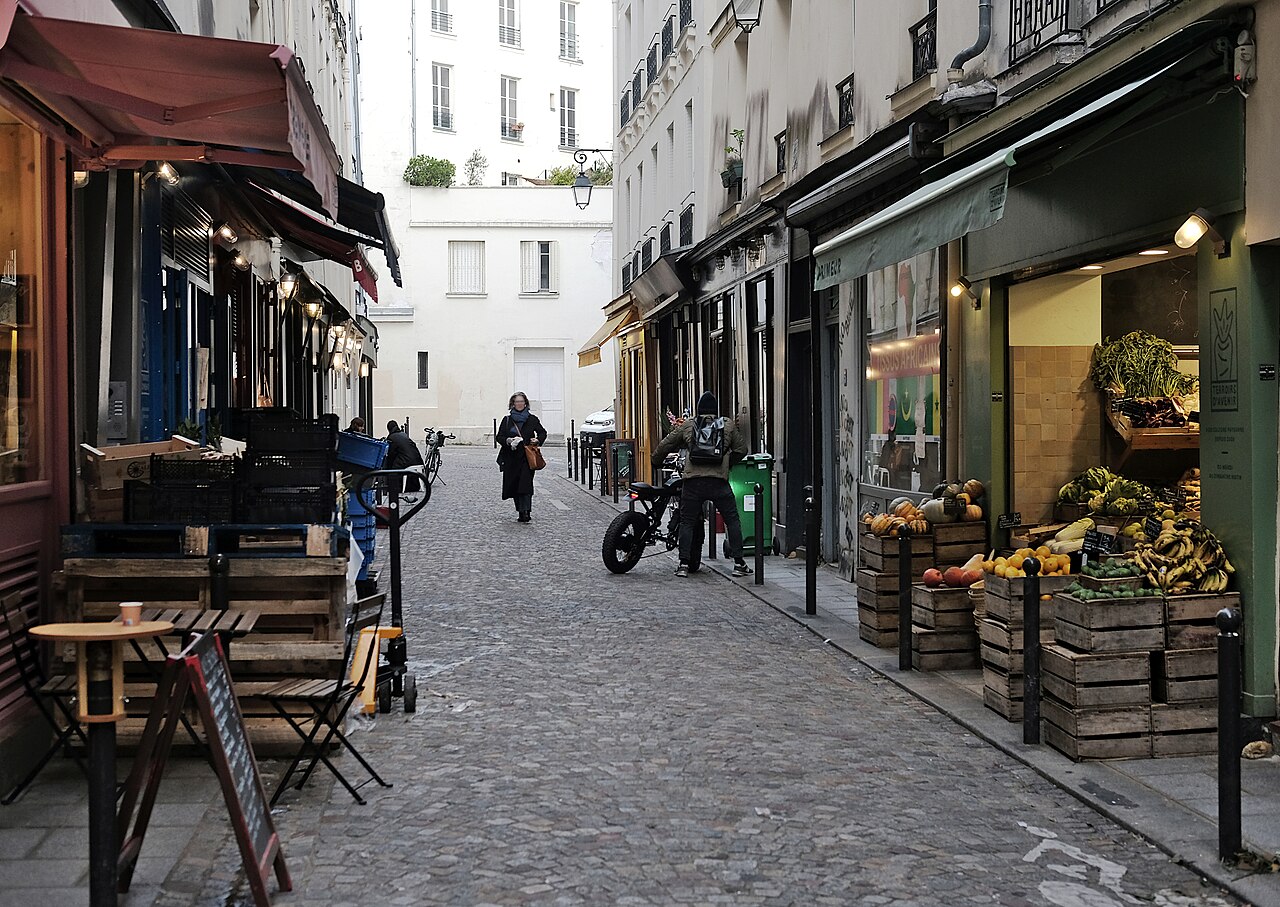
Rue du Nil is almost comically small for the argument made on it. The short cobbled lane in Paris's second arrondissement runs between rue des Petits-Carreaux and rue de Damiette.[1][2] Yet within that sliver sit a Michelin-starred restaurant and a row of specialist food shops: bread at number 3, Frenchie at 5, butcher at 6, produce at 7, and fish and cheese at 8.[7][8]
Fine dining normally hides this sequence. A guest sees the final plate; the receiving door, fish boxes, flour sacks, whole carcass, rejected tomato, delivery route, and supplier conversation remain backstage. Rue du Nil moves part of that backstage onto the pavement. It does not eliminate the supply chain. It gives the chain a visible interface.
That is why the street is more interesting than a cluster of fashionable addresses. Its real attraction is not that dinner, wine, coffee, bread, and shopping happen close together. It is that proximity allows a chef, a supplier, a butcher, a baker, and a diner to read the same day's ingredients from different sides.
The cover photograph catches the street in use rather than at its most polished. Old facades lean into a narrow corridor; wooden produce crates reach toward the cobbles; pedestrians and a cargo bicycle share the narrow lane.[9] Rue du Nil looks less like a grand gastronomic quarter than a working passage with unusually good mise en place.
The restaurant arrived before the market
The street was carrying stories long before it carried tasting menus. France's National Archives records that the lane existed by 1590 and passed through several names, including rue de la Corderie, rue Boyer, cour des Miracles, and rue Neuve-Saint-Sauveur. It received its present name by decree in 1867; the archive ties that name to the Nile and neighboring Place du Caire.[1]
Its modern food identity began from a less romantic condition: closed shutters and affordable space. Grégory and Marie Marchand opened Frenchie in 2009, when friends warned that almost nobody passed down the street. A wine bar followed across the way in 2011. Samuel Nahon and Alexandre Drouard, already supplying Paris restaurants through Terroirs d'Avenir, then established shops on the block; the first Rue du Nil boutiques opened in 2012.[2][4]
The order matters. This was not a picturesque market that attracted a chef. A restaurant helped create demand, then invited its suppliers to become neighbors, and the suppliers gave the street a daily life beyond the reservation book. The result was a compact feedback loop: ingredients could move toward the kitchen, while the public could buy from the same network that fed professional dining rooms.
A 2024 report supplies the scene that explains the system better than any slogan. Chef Masayoshi Haraguchi finished shopping with corn and figs on his bicycle, choosing seasonal ingredients for that day's recipes and naming puntarella and radicchio among the products he had discovered there.[3] The luxury was not marble or a velvet rope. It was the reduction of social distance between the people selecting food and the people cooking it.
Before the pretty crates, there is a night shift
Rue du Nil can tempt a visitor into a charming but incomplete story: tiny shops receive perfect produce from virtuous farms, a chef steps outside, and dinner writes itself. Terroirs d'Avenir's own description of its operations is usefully less dreamy. Between midnight and 8 a.m., teams receive fresh goods, assemble orders, and dispatch them to restaurant clients and shops.[5]
That hidden clock is the street's first lesson. Seasonality is not a decorative sentence on a menu. It is an operating constraint delivered overnight. Terroirs describes its shops' first challenge as teaching the public to adapt demand to supply, rather than the reverse.[4]
For a kitchen, that changes creativity from unlimited choice to alert response. A box of exceptional radicchio is not just a better version of an ingredient already specified in a recipe. It may be the reason the recipe changes. At the fish counter, the display follows weather and early-morning arrivals; Terroirs says much of the catch was landed the previous day or two. Its bakeries use population wheats and older grains with long fermentation, which the company says helps express their aromas.[5]
Michelin's current entry for Frenchie describes a compact room whose modern cooking is rooted in meticulous sourcing, specifically naming fruit and vegetables from Terroirs d'Avenir or La Ferme de l'Envol.[7] The important word is not local. It is meticulous. Proximity makes a last-minute conversation possible, but discernment still has to happen: which lot, which maturity, which cut, which handling, and whether today's arrival deserves a place at all.
A whole animal needs more than one fashionable cut
The butcher shop reveals the harder edge of that relationship. Terroirs d'Avenir says its butchers work with whole carcasses in order to maintain what it calls material balance: every part needs a route to a customer, not only the prestigious steaks and quick-cooking pieces.[5]
That balance begins before a neighboring restaurant orders. Drouard explains the whole-animal logic bluntly: a buyer cannot reasonably ask a small-scale livestock farmer to supply only two racks.[3] Purchasing the animal makes the imbalance explicit; kitchens and retail counters still have to create demand for the less fashionable parts.
This is fine dining at its most useful. Technique raises the value of what the retail counter cannot move easily. Menu flexibility gives slower cuts another season. The supplier, meanwhile, describes outdoor husbandry, rustic breeds, named origins, and long-term producer relationships—more specific information than an anonymous cut provides.[4][5][6] The relationship works because neither side pretends that every part of a carcass has equal demand.
The same principle runs down the block. The fish counter follows weather and coastal availability; the bakery works with population and older wheat varieties using long fermentation; the produce shop builds its display around arrivals rather than visual sameness.[5] Each specialty has a different clock. Putting them side by side does not synchronize nature. It makes those clocks easier to notice.
The shops turn sourcing into public knowledge
Most restaurant sourcing claims ask for trust. A menu names a farm or a waiter names a boat, and the guest has little way to understand what sits between producer and plate. Rue du Nil does not prove every claim, but it changes the reader's position. The diner can look into the fish shop, see that the butcher must sell more than fillet, buy the bread, and recognize that the produce assortment is contingent rather than encyclopedic.
The current addresses make the idea almost diagrammatic without needing a diagram: bakery at 3, butcher at 6, produce at 7, then fish and cheese at 8.[8] Frenchie sits at 5.[7] The sequence lets an ordinary shopper encounter restaurant-grade procurement as commerce rather than theatre. Product knowledge is carried by people behind counters who advise on cultivation, ingredient histories, older wheats, and the day's arrivals; it is not sealed inside the chef's prestige.[5]
The exchange also runs the other way. Chefs create an audience for ingredients that might otherwise be obscure, while retail gives those ingredients a life beyond one dining room. Terroirs d'Avenir calls chefs its first ambassadors, but its 2012 shop opening was a wager that the public could also learn to adapt demand to the season.[4] The street made that wager visible.
Current directories still show the basic geometry: Frenchie at number 5 and the Terroirs d'Avenir bakery, butcher, produce shop, fishmonger, and cheese shop at numbers 3, 6, 7, and 8.[7][8] The names can turn over; the more durable feature is the short path between a supplier's constraint and a cook's response.
The street is not the terroir
There is one romance the block cannot support. Rue du Nil may look hyperlocal, but the ingredients do not all originate within sight of a Paris curb. Terroirs d'Avenir says its network includes more than 300 farmers, growers, fishers, livestock producers, fish merchants, and artisans across France, Italy, and Greece.[6] Its midnight logistics operation is part of how that larger geography reaches Paris.[5]
This does not weaken the Rue du Nil idea; it defines it honestly. The street is a coordination point, not the terroir itself. Its proximity is organizational: restaurant near butcher, chef near produce, shopkeeper near diner. The farms, fields, coasts, mills, and boats remain elsewhere, subject to their own weather and economics.
Nor does shortening one segment of a chain automatically make the whole system fair or sustainable. Terroirs d'Avenir states commitments to long-term relationships, direct purchasing, transparent origins, and secure, fair remuneration despite natural uncertainty.[4][6] Those are meaningful claims, but the street scene alone cannot audit them. A beautiful crate is evidence of a product, not a complete account of labor, transport, margin, or ecological impact.
The better reading avoids both cynicism and pastoral fantasy. Logistics do not spoil provenance; they make provenance possible at restaurant scale. A chef cannot serve coastal fish in Paris merely by caring about small boats. Someone must receive the catch, prepare the orders, and send them onward overnight.[5] The romance becomes credible only after the night shift is put back into the picture.
A neighborhood can be part of the cooking
Rue du Nil's achievement is spatial. It arranges relationships that fine dining usually scatters across invoices, loading bays, phone calls, and menu footnotes. On one short street, a diner can see the restaurant and several of the trades that make its language possible. The street does not collapse producer into chef or shopping into cooking. It lets the boundaries touch.
That contact creates a particular kind of menu. The kitchen can respond quickly to abundance, the butcher can discuss imbalance, the baker can explain the older grains and long fermentation behind a loaf, and the public can buy into the same seasonal limits.[3][5] None of this guarantees a brilliant plate. It does make the plate's prerequisites harder to treat as anonymous.
The most convincing fine-dining neighborhoods are not collections of expensive reservations. They are places where skill circulates: between farm and buyer, box and counter, butcher and cook, restaurant and resident. Rue du Nil earns its reputation when it behaves like that circulation system—not when it is treated as a gourmet theme park.
Its scale is the final joke. The supply network reaches across countries and works through the night; its Paris interface fits into one short lane. The street turns fine dining's back door outward, just enough for the public to see that dinner begins long before anyone unfolds a napkin.
Sources
- Archives nationales, “rue du Nil (Paris, France)” — official place record documenting the street's names from 1590 onward and its denomination by decree in 1867.
- Clotilde Dusoulier, “In the neighbourhood: Rue du Nil,” SBS Food (published February 19, 2015; updated March 30, 2021) — the tiny street's former textile-storage shops, Frenchie's 2009 opening, the 2011 wine bar, and the arrival of Terroirs d'Avenir's retail cluster.
- Joséphine Lebard, “La rue du Nil à Paris, une ode à l'agriculture paysanne avec Terroirs d'Avenir,” Enlarge your Paris (July 3, 2024) — reported walk with Alexandre Drouard covering the street's shops, seasonal buying, customer education, whole-animal purchasing, and a chef shopping for the day's menu.
- Terroirs d'Avenir, “Qui sommes-nous ?” — official company history covering its 2008 founding, the 2012 Rue du Nil shops, producer-first demand, and stated sourcing commitments.
- Terroirs d'Avenir, “Nos métiers” — official descriptions of sourcing, whole-carcass butchery, population- and older-grain baking, weather-led fish buying, and the midnight-to-8-a.m. logistics operation.
- Terroirs d'Avenir, “Les producteurs” — current account of a direct network of more than 300 producers and artisans across France, Italy, and Greece, with its stated relationship and remuneration model.
- The MICHELIN Guide, “Frenchie – Paris” — current listing at 5 rue du Nil and description of the restaurant's modern cooking, compact room, and meticulous produce sourcing.
- Terroirs d'Avenir, “Nos boutiques” — current official directory confirming the bakery, butcher, produce shop, fishmonger, and cheese shop addresses on Rue du Nil.
- Mbzt, “F6585 Paris 2e rue du Nil rwk.jpg,” Wikimedia Commons — November 22, 2023 street photograph used as the article image.