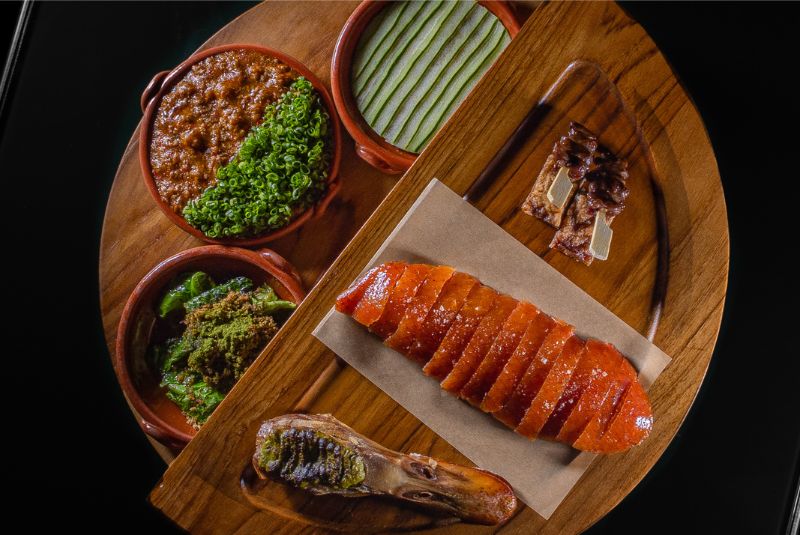
Most signature duck courses in fine dining are built to announce control. The skin shatters, the sauce glows, the carving is exact, and the diner is meant to admire how cleanly luxury has been engineered. Potong's 14-day aged duck does something harder. It is obviously controlled, but it does not finally read as a control exercise. It reads as a memory device: a main course that uses drying, lacquer, heat, and service ritual to turn Thai-Chinese inheritance into the emotional center of the room.[1][3][5][6]
That is why the dish still feels worth studying in 2026. Potong has no shortage of headlines around awards and rankings, yet the duck remains the clearest place to see what the restaurant is actually doing. Michelin's current listing describes a single-set Thai-Chinese tasting menu in a former family Chinese pharmacy, full of storytelling and creative Chinese ingredients.[4] The restaurant's own language is even more explicit: Chef Pam frames Potong through five elements that perfect the dish and five senses that formulate memory.[1][2] The duck is where those ideas stop being branding and become edible structure.
Image context: the lead image uses the duck photograph published in the 50 Best feature on Chef Pam rather than a room shot. That choice fits because this article is really about one course behaving like a summary of the whole house. You can already see the thesis in the platter: polished technique, family-style layout, and side components that refuse to let the bird become just another luxury centerpiece.[6]
1. The aging matters because it rewrites texture before the roast begins
The official tasting-menu page does not oversell the course. It lists the duck under the heading "humble", then names it with almost suspicious plainness: 14-day aged duck.[3] That restraint is useful. It keeps the focus on process rather than poetry. The same page adds a quieter but important operating note: Potong is working more closely with dedicated farmers and producers for its seafood and duck, while letting the menu adapt to seasonality and availability.[3] In other words, the course begins upstream, with product choice and patience, not just with oven drama.
The clearest public account of the method comes from 50 Best's Asia's Best Female Chef feature. Chef Pam says the duck is based on a traditional Chinese roast-duck logic but altered through repeated testing until the skin turns intensely crisp while the meat stays pink inside.[6] The bird is first blanched with hot water, then blanched again with vinegar, glucose, soy sauce, and five spice, and hung in refrigeration for 14 days before a short, very high-heat finish during service.[6] That sequence explains why the course feels more exact than many glossy duck mains. The real work is done long before the dining room sees fire.
This is what gives the skin its authority. The lacquer is not there simply to look beautiful under light. It is the visible result of dehydration discipline. By the time the duck enters the final roast, the kitchen has already narrowed the margin for error and concentrated the bird's outer layer into something almost shell-like. The roast finishes the argument, but the aging writes it first.[3][6]
2. Why the dish is called "humble" when it behaves like a flagship
At first glance, the title looks ironic. Nothing about this course is humble in the usual luxury-dining sense. It takes two weeks of lead time, a carefully chosen bird, and a room trained to present it at exactly the right point in a long menu. Yet the word starts making sense once you place it inside Potong's larger framework.
The restaurant's philosophy page says every dish is governed by the same five-element system, and that each one finds its ultimate statement in the dining-room setting.[2] The elements are not meant to isolate one course as the genius act while the rest merely support it. They are meant to make every dish answer to the same sensory grammar. On the current 50 Best list profile, the duck appears not as a rogue signature but as one stop in a menu that moves through named emotional and narrative stations, from house charcuterie to Bold - 14-day aged duck and then on toward dessert.[5] The duck is famous, but it is still being asked to serve the architecture of the meal.
That is why "humble" works. The dish is not humble because it is simple. It is humble because it remains attached to a larger house story instead of declaring itself above the sequence. Potong is too structured a restaurant to allow one course to act like a detached chef flex.
3. The organ garnishes stop the course from becoming a skin-only stunt
If the story ended with lacquered skin and rosy meat, the duck would already be strong. What makes it more interesting is the rest of the bird. In the same 50 Best feature, Chef Pam says the duck is served with roasted duck brain, heart, and leg.[6] That detail matters because it changes the course from a technically perfect slice into a fuller act of culinary inheritance.
The organ accompaniments do two things at once. First, they deepen flavor. Brain brings richness, heart brings chew and mineral edge, leg brings the darker, slower part of the bird back into the composition. Second, they keep the dish culturally legible. Potong is not presenting duck as a neutral luxury protein that could belong anywhere. It is presenting duck as a whole-animal memory with Thai-Chinese bearings.[1][4][6]
That is a crucial distinction. Plenty of fine-dining mains become cleaner as they rise in prestige, until all roughness, depth, and historical texture are sanded off in favor of universal elegance. Potong goes the other way. It refines the bird, but it also returns some of its density. The course therefore feels less like a maximalist showpiece than like a sharpened family table memory.[1][5][6]
4. Service ritual is doing as much work as the roast
This is where Potong separates itself from other technically serious duck dishes. The 50 Best profile already frames the restaurant as a memory-driven tasting menu inside a restored five-storey family building that housed a Chinese herbal medicine business from 1910 onward.[5] Chef Pam's own site pushes the same line even harder: "Time moves in one direction, but memories in another," and the entire experience is supposed to bring the guest through her memories inside the Potong building.[1] The duck does not arrive outside that narrative. It arrives as one of the clearest vehicles for it.
The strongest example is the serving format. In the 50 Best feature, Chef Pam explains that the duck is presented on a family-style lazy Susan to evoke large gatherings, warmth, and the feeling of sharing at home.[6] That choice is not decorative nostalgia. It changes how the dish is read. A sliced roast duck on an individual plate would underline precision and exclusivity. A sliced roast duck set into a shared turning platform makes the same food feel social, circular, and inherited.
This is exactly where Potong's five-senses idea starts to earn its keep. The homepage says the restaurant uses five senses to formulate memory, while Chef Pam explains in the 50 Best feature that she wants guests to create long-term memories by engaging multiple senses during the meal.[1][6] The duck course does that elegantly. You see the lacquer, smell the sweet spice, hear the platter arrive and turn, touch the pieces as they are shared across the table, and taste a roast that has both brittle surface and soft center.[6] The service ritual completes the cooking logic.
Why this dish still explains Potong best
As of April 12, 2026, Michelin still lists Potong as One Star, describing a room where the traditional and the novel converge inside a historical Sino-Portuguese building, with a single tasting set and optional upgrades.[4] The World's 50 Best Restaurants 2025 list still places Potong at No. 13, with the duck called out directly in the menu description.[5] Those external signals matter, but the duck explains something deeper than prestige. It explains why Potong's momentum has lasted.
The course condenses the restaurant's whole operating grammar. It begins with long-lead preparation and supplier care.[3] It answers to the five-element framework rather than to isolated signature-dish ego.[2] It converts Thai-Chinese culinary ancestry into specific textures and garnishes instead of vague storytelling.[1][5][6] And then it lands in the room through a family-sharing format that turns fine dining back toward belonging.[6]
That is why Potong's duck lands as memory before luxury. Luxury is present, obviously. But it is not the deepest flavor of the course. The deeper flavor is recognition: a roast built with modern discipline, then returned to the table with enough warmth, density, and cultural shape to feel lived rather than merely perfected.[1][3][5][6]
Sources
- Potong official homepage, covering Chef Pam's five-elements and five-senses framework, the memory-driven experience, and the family's Chinese herbal medicine origin in the Potong building.
- Potong, "Philosophy," explaining the five elements: salt, acid, spice, texture, and Maillard reaction, and stating that each dish finds its ultimate statement in the dining-room setting.
- Potong, "Tasting Menu," listing the current course sequence including "humble | 14-day aged duck" and the sourcing note about dedicated duck producers and seasonal adaptation.
- MICHELIN Guide, "Potong - Bangkok," describing the restaurant as a One Star Thai-Chinese fine-dining room in a former family pharmacy, with a single set menu, optional upgrades, and wine pairing guidance.
- The World's 50 Best Restaurants 2025, "Potong | Ranked No. 13," covering the menu's five elements, the 14-day aged duck, and the restored 1910 family building in Bangkok's Chinatown.
- The World's 50 Best Restaurants, "Potong's Chef Pam is Asia's Best Female Chef 2024," detailing the duck's blanching, 14-day drying, high-heat finish, organ garnishes, five-senses memory idea, and lazy Susan service ritual.