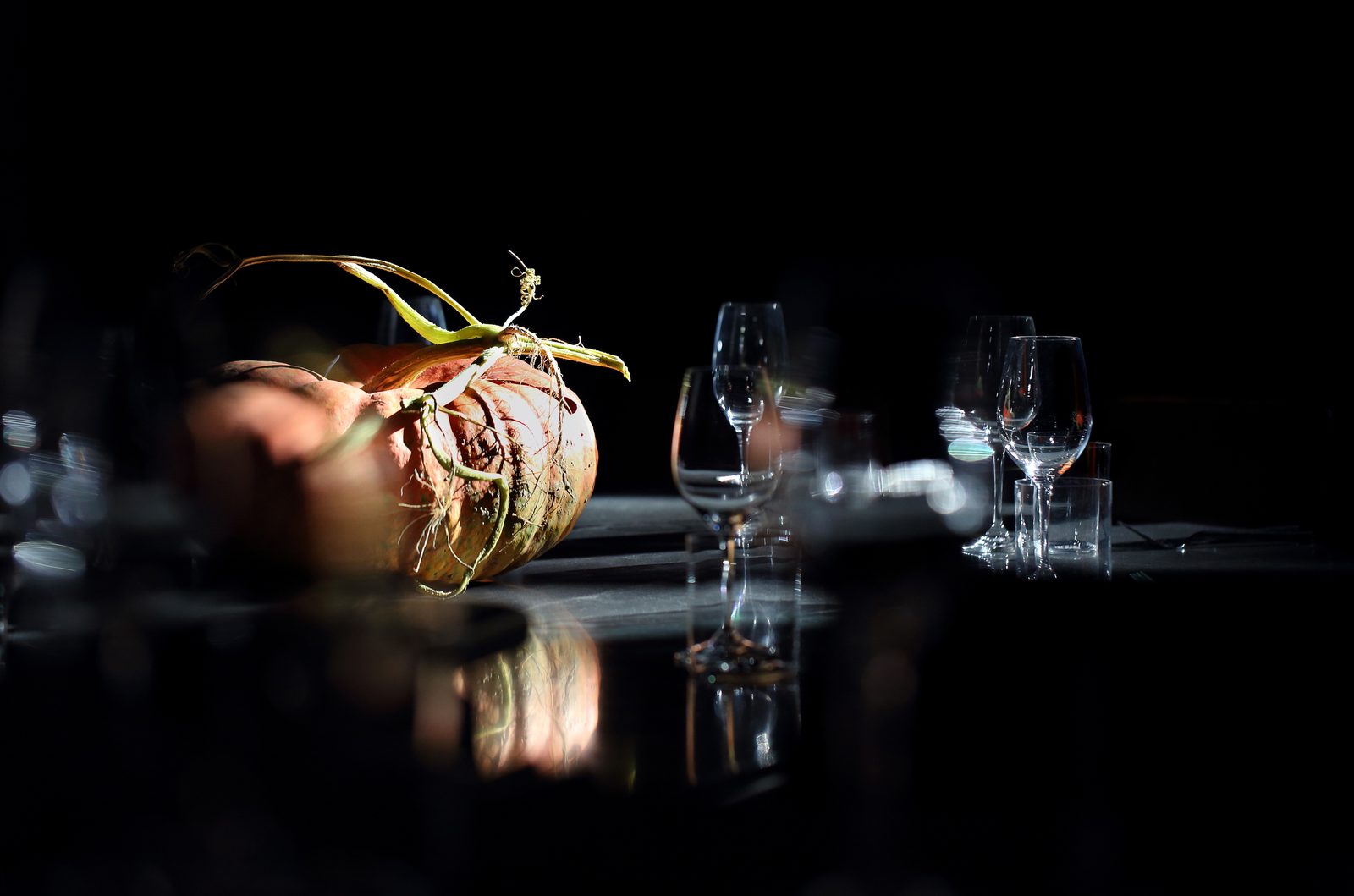
Paris has many ways of teaching diners to respect a room before the first plate arrives. Thick curtains, deep banquettes, hushed spacing, silver that seems to have inherited its own title: the city still knows how to make luxury feel upholstered. Table by Bruno Verjus moves in another direction. It is expensive, exacting, and fully credentialed, but the force of the meal comes from something leaner. The room keeps insisting that the real authority sits with whatever reached the kitchen in peak condition that day.
As of April 13, 2026, Table's official site still presents the restaurant as a two-star house and still foregrounds its rise to No. 3 in The World's 50 Best Restaurants 2024, while 50 Best's current profiles keep it visible at No. 8 in 2025.[1][2][3] Those signals explain why the room is visible. They do not explain why it feels ahead. The sharper explanation is operational. Verjus has built one of Paris's most serious dinners around a simple discipline: the product arrives first, and the restaurant bends toward it.[1][4]
On the official site, that discipline is spelled out unusually clearly. Table defines its work through a cuisine of the instant and says its direct relationship with local producers means they send only what nature is able to offer that day; the restaurant does not order quantities, only quality.[1] Michelin's 2022 France press release used almost the same logic when it promoted Table to two stars, describing cuisine entirely dedicated to exceptional produce and linking the restaurant's earlier Green Star to close relationships with committed producers.[4] Read together, those descriptions make the house easier to understand. Table does not use the market as post-facto storytelling. It lets the market write the night's chain of command.
1. Product is not the theme here. It is the chain of command
Part of what makes Table interesting is that Bruno Verjus does not fit the standard palace-hotel biography. Michelin's 2022 note still emphasized that he is self-taught, while Andy Hayler's earlier review sketches the sideways route that led here: food writer, radio host, blogger, then restaurateur.[4][5] That background helps explain why the room feels less committed to inherited ceremony than to selection itself. The prestige object is not tradition for tradition's sake. It is judgment.
That judgment shows up in how the restaurant talks about producers and in how outside observers describe the food. On the official site, Verjus frames the whole operation around immediate responsiveness to what local growers, fishers, and farmers can actually supply on a given day.[1] 50 Best Discovery then describes an ever-changing seasonal menu that puts ingredient quality at the center, citing recent plates built around Mallemort green and purple asparagus and wild turbot from Ile d'Yeu.[3] Michelin's 2022 release makes the same point more structurally, singling out Utah Beach oysters and saying the stories of the products themselves are part of the restaurant's identity.[4]
The result is that Table sells discernment before it sells invention. Creativity is everywhere, but it is exercised through timing, sourcing, and restraint. A restaurant organized this way does not need to shout about signatures, because the signature is the act of choosing correctly.[1][3][4]
2. The wave counter turns seriousness into conversation
If sourcing were the whole story, Table could still feel doctrinaire. What saves it is architecture. 50 Best's 2025 profile describes a long counter designed like a wave, cut into private nooks, alongside an open kitchen where guests can follow gestures, plating, and finishing in real time.[2] That is one of the smartest luxury decisions in Paris right now because it removes distance without removing control.
Counter dining can easily drift toward demonstration mode, with the diner made to feel like a witness to expertise rather than a participant in pleasure. Table's design avoids that trap. The room gives you visibility, but the wave form softens exposure. You can see how dishes are assembled and still feel tucked into your own orbit of attention.[2] Hayler's earlier account catches the same balance from before the rankings frenzy: a casual atmosphere, bar seats arranged around the kitchen, and an unusually interactive experience because the food is prepared directly in front of you.[5]
This matters because Table's cooking depends on fine gradations. A room built on pomp would make the cuisine read smaller than it is. Here, the architecture does the opposite. It teaches diners how to watch for tiny decisions: how far a vegetable is pushed past rawness, how marine intensity is sharpened rather than buried, how a broth, cream, or sauce exists mainly to make the principal ingredient read more clearly.[2][3][4] The counter is not backdrop. It is part of the method.
3. Couleur du Jour keeps luxury moving
The official reservation material is revealing in its bluntness. Table says bookings open progressively up to three months ahead, and the current Couleur du Jour menu costs 480 euros at both lunch and dinner, runs roughly 10 to 14 dishes, lasts at least 2 hours 30 minutes, and excludes beverages.[1] That framework tells you almost everything about the restaurant's confidence.
First, there is no softened midday version of the house thesis. Lunch and dinner sit at the same price because Table is not trying to split its identity between a lighter gateway product and the "real" experience at night.[1] Second, the menu length is elastic enough to admit what the market and kitchen decide together that day. Ten to fourteen dishes is a meaningful range for a restaurant at this level, and it fits a house that publicly says it does not buy by quantity.[1] Third, the timing makes room for attentiveness. The point is not to maximize how many people can say they went. The point is to keep a sequence of changing ingredients on stage long enough for their differences to register.
That same preference for specificity carries into drink and tone. Hayler praised a wine list that mixed famous producers with harder-to-find pleasures and occasional value surprises, while 50 Best focuses on dishes whose appeal begins with freshness and exact handling rather than baroque composition.[2][5] The house luxury is therefore unusually mobile. It does not sit in velvet or ritual. It sits in the freshness window, the right bottle, the right seat angle, the right amount of explanation, and the confidence to let ingredients remain legible.
Why Table still feels ahead
A lot of high-end dining in Paris still asks guests to submit to atmosphere before they understand the cooking. Table reverses that sequence. It builds atmosphere out of the cooking's premises: producer proximity, day-of-market flexibility, visible technique, and a counter that converts hierarchy into conversation.[1][2][3][4]
That is why the restaurant still feels important in 2026. The rankings explain the visibility. The Michelin history explains institutional validation.[2][3][4] The stronger point is cultural. Table has shown that a top-tier Paris address can be luxurious, urban, intimate, agricultural, and very expensive at the same time without turning padded or antique. It can make the diner feel closer to an onion, an oyster, or a fish than to a mythology of prestige.
Book it if you want to feel product selection acting in real time and if you like restaurants that make precision visible instead of mystified. Diners who want brocade, distance, and a canon performed in the same register every night will find the center of gravity elsewhere. Table's gift is that it keeps seriousness in motion.[1][2][3][4][5]
Sources
- Table - Bruno Verjus official site, covering the restaurant's current two-star positioning, producer-first philosophy, reservation FAQ, Couleur du Jour pricing and format, and the official photograph used here as image provenance.
- The World's 50 Best Restaurants 2025, "Table by Bruno Verjus | Ranked No. 8," covering the wave-shaped counter, open kitchen, Bruno Verjus's motto, and representative dishes from the current house style.
- 50 Best Discovery, "Table - Paris - Restaurant," covering the restaurant's No. 8 2025 and No. 3 2024 placements, the ever-changing seasonal menu, and ingredient-led dishes such as Mallemort asparagus and wild turbot from Ile d'Yeu.
- MICHELIN Guide France 2022 press release, announcing Table - Bruno Verjus's promotion to Two MICHELIN Stars and describing its precise produce-led cuisine, regional sourcing, committed producer relationships, and prior MICHELIN Green Star.
- Andy Hayler, "Table Bruno Verjus," review covering the restaurant's casual atmosphere, open-kitchen bar seating, tasting-menu structure, and wine-list depth.