
Pizzeria Mozza is a useful corrective to the lazy split between "serious" fine dining and "casual" pizza. The room is not trying to behave like a hushed tasting-menu temple, but the work behind the pizza is not casual at all. The official site foregrounds Nancy Silverton's California ingredients and the restaurant's much-discussed crust, while the about page preserves the early critical language that made the crust famous: soft and chewy in some places, crisp and charred in others, lightly sweet, lightly sour, blistered, and smoky from the oven.[2][3] That is not a topping description. It is a structural description.
The HexClad "Open to Close" video is worth embedding because it shows how that structure survives contact with service.[1] A pizza can sound perfect as an object and still fail as a restaurant product if the dough, oven, station work, and table rhythm do not agree. Mozza's particular lesson is that the crust is not a base waiting for glamour. It is the main piece of hospitality engineering. Everything else has to be added in a way that protects its contrast.
That matters for fine dining because Silverton's career sits at the point where bread discipline, Los Angeles produce, and Italian grammar meet. Her official biography names Pizzeria Mozza alongside Osteria Mozza, Mozza2Go, chi SPACCA, La Brea Bakery, and Campanile, which is the cleanest reminder that this pizza style did not appear from a generic restaurant group template.[4] It comes from a baker's eye for fermentation and texture, translated into a crowded dining room where the guest still wants pleasure more than doctrine.
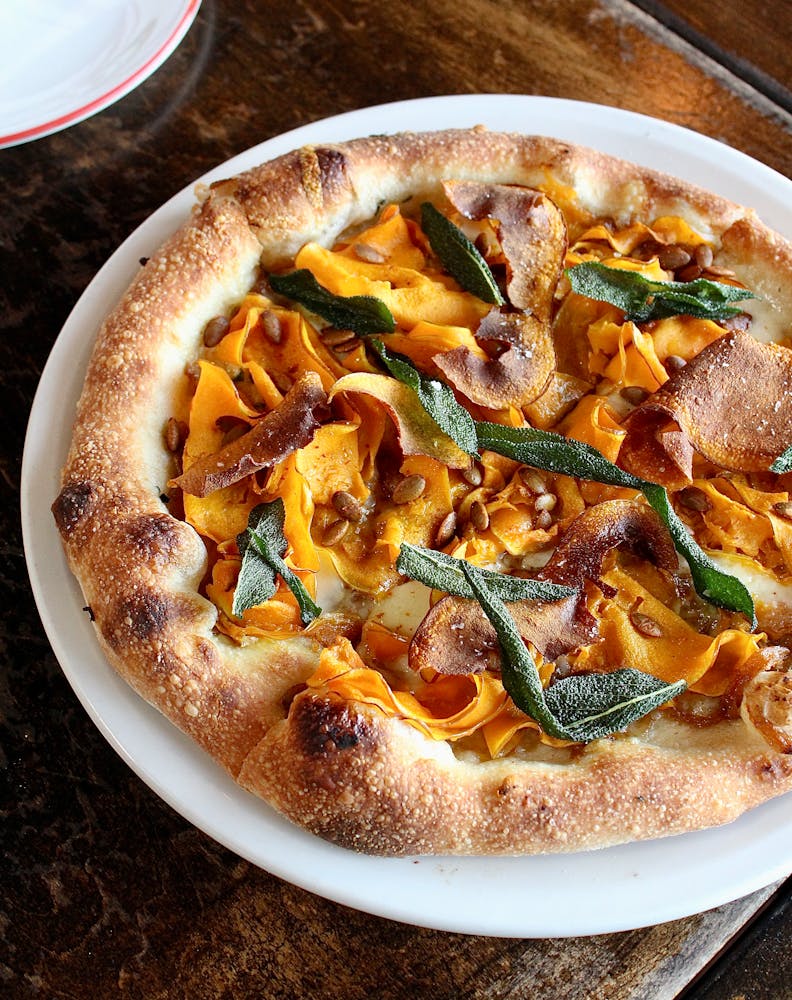
The first thing to watch is not the finished pie. Watch the repeated handoffs. Dough is portioned, held, stretched, topped, fired, watched, turned, and moved out before the room loses pace.[1] In a tasting-menu kitchen, that choreography often hides behind tweezers and synchronized service. At Mozza it becomes more exposed because pizza has fewer places to conceal error. A crust that is stretched poorly will show it. A topping spread too heavily will deaden the middle. A slow pass will turn crispness into limp memory.
That is why the video's service rhythm is more revealing than a recipe clip would be. Recipe logic asks whether you can reproduce a thing. Restaurant logic asks whether a team can reproduce a condition. Mozza's condition is a crust with multiple textures at once: edge lift, bottom crackle, enough chew to make each slice feel alive, and enough char to keep sweetness from going soft.[2][3] The oven does not merely cook the pizza; it edits the dough's fermentation into a readable surface.
Around the middle of the video, the topping work becomes a lesson in restraint.[1] Pizzeria Mozza's public language emphasizes Californian ingredients, but the pizza succeeds only if those ingredients know their place.[2] Seasonal vegetables, cheeses, and oils can make the pie feel local and generous; they can also flatten the dough if they are treated as abundance without discipline. The better reading is that Mozza uses toppings as punctuation. They give aroma, moisture, salt, sweetness, and color, but the sentence remains the crust.
This is also why the restaurant belongs in a fine-dining feed. Fine dining is not only a price category or a star count. It is a way of making constraints visible as pleasure. Pizzeria Mozza's constraints are direct: dough has to be ready when the room is ready, the oven has to be hot enough to create contrast without scorching the whole idea, and the dining room has to move the pies while they still have the texture the kitchen intended. Michelin's Pizzeria Mozza listing currently recognizes the restaurant within its Los Angeles guide, and its separate Osteria Mozza listing anchors the broader Mozza complex inside Michelin-recognized Italian dining in the city.[6][7] The important editorial point is not to turn pizza into ceremony by force. It is to notice when a supposedly casual form is carrying a serious operating standard.
Silverton's biography helps explain the standard. La Brea Bakery and Campanile matter here because they make Mozza's crust obsession feel less like branding and more like accumulated method.[4] A baker learns that flavor is time, not garnish. Fermentation produces aroma before the guest arrives. Hydration and handling set the bite before the toppings appear. The oven can only reveal what the earlier process made possible. In that sense, Mozza's pizza is closer to a well-run bread course than to a flatbread decorated at the last minute.
The closing lesson of the video is that hospitality can be loud, fast, and still exact.[1] Mozza does not need the emotional register of white tablecloth luxury to make a fine-dining argument. Its argument is kinetic: a crowded room, a disciplined oven, an ingredient culture borrowed from California, and a crust that must keep several truths alive at once. The pie has to feel generous but not heavy, rustic but not careless, crisp but not dry, charred but not bitter, authored but not precious.
That balance is why Pizzeria Mozza still rewards close viewing. The video gives the moving system; the restaurant's own materials give the thesis. California ingredients are only persuasive because the crust can carry them. The crust is only persuasive because service protects its timing. And the whole room works because a casual food has been treated with a baker's seriousness without losing the appetite that made it casual in the first place.[2][3][4]
Sources
- HexClad Cookware, "How LA's Only Michelin-Starred Pizza is Made | Open to Close | Episode 2: Mozza," YouTube video.
- Pizzeria Mozza, official homepage - restaurant framing around Nancy Silverton, California ingredients, and the much-discussed crust.
- Pizzeria Mozza, "About" - official page collecting critical descriptions of the crust, the Los Angeles room, sustainability language, and team structure.
- Osteria Mozza, "Nancy Silverton" - official biography covering Silverton's role across Pizzeria Mozza, Osteria Mozza, Mozza2Go, chi SPACCA, La Brea Bakery, and Campanile.
- Pizzeria Mozza / BentoBox, official photographic image asset used as this article's lead image.
- MICHELIN Guide, "Pizzeria Mozza - Los Angeles" - current guide listing for the pizzeria.
- MICHELIN Guide, "Osteria Mozza - Los Angeles" - current guide listing for the Michelin-starred sister restaurant in the Mozza complex.