Carpaccio is easy to mistake for an absence of cooking. Thin raw beef, pale sauce, plate, done. But the dish became a fine-dining standard because it turns rawness into composition. The kitchen does not transform beef with heat; it transforms it with cut, chill, sauce, color, restraint, and the confidence to serve something almost naked.
The origin story is unusually neat. Cipriani's own heritage page places the invention at Harry's Bar in Venice, when Countess Amalia Nani Mocenigo had been told to avoid cooked meat. Giuseppe Cipriani's solution was not steak tartare, not cured beef, not a salad buried under garnish, but fillet sliced so thinly that the plate itself became part of the dish.[1] The meat needed help, so he added a simple sauce he called adaptable enough for meat and fish.[1] The name came from Vittore Carpaccio, the Venetian painter whose red tones were being discussed in Venice because of an exhibition.[1]
That story matters because the plate is not just raw beef with branding. It is a hospitality answer to a constraint. A guest arrives with a dietary restriction. The restaurant does not merely subtract cooked meat from dinner. It invents a form in which the restriction feels elegant.
The Plate Is The Technique
Carpaccio's first technical act is not seasoning; it is geometry. The beef has to be lean enough to slice cleanly and tender enough to eat without the softening work of heat. La Cucina Italiana's basic recipe specifies thin sirloin with no lace fat or nerves, then builds the sauce from egg yolk, olive oil, lemon, mustard, Worcestershire sauce, salt, and pepper.[3] Those details explain why bad carpaccio fails so quickly. A chewy slice cannot hide. A greasy slice looks tired. A heavy sauce turns the dish into cold roast beef dressed as luxury.
The original genius is that the meat is not asked to become rich. It is asked to become precise. Thinness changes appetite. A steak invites force: knife, chew, browned crust, juice. Carpaccio invites attention: the eye follows the red surface, the fork lifts a sheet rather than a chunk, and the sauce lands as punctuation instead of cover. The diner registers texture before temperature.
This is why the dish belongs in fine dining rather than only in a butcher's repertoire. Raw beef already had European cousins: chopped tartare, seasoned raw preparations, cured and dried slices. Carpaccio's difference is its refusal to look rustic. It turns raw meat into a flat visual field. The plate has the composure of a painting without becoming decorative in the empty sense.
Red, White, And The Venice Trick
The painter's name can feel like a gimmick until you look at what it lets the dish do. Vittore Carpaccio has often been overshadowed in popular memory by the appetizer named after him; an Associated Press report on the National Gallery's Carpaccio retrospective notes that the painter's narrative Venetian work was getting renewed attention after long being eclipsed by the dish.[4] The culinary borrowing is therefore slightly unfair to the artist, but it is also revealing. Cipriani was not naming the plate after a flavor. He was naming it after a way color could behave.
The Harry's Bar version depends on red beef against white sauce. The sauce is not just moisture. It is a graphic decision. Too much of it and the plate loses its clean shock; too little and the meat risks feeling clinical. The best versions understand that the white marks should sharpen the red, not bury it.
That visual economy explains why later restaurant carpaccios often drift. Add arugula, Parmesan, capers, truffle, citrus, mushrooms, caviar, or raw fish and the word still survives, but the original lesson can disappear. There is nothing wrong with variation. The term has expanded to cover thinly sliced raw fish and other preparations.[3] But the closer the dish stays to Harry's Bar logic, the more it depends on editing rather than abundance.
Service Makes It Civilized
Harry's Bar is crucial to the story because the room gives the dish manners. The restaurant opened in 1931, and Cipriani's current Harry's Bar page frames it as a small Venetian room shaped by service, familiar company, and ease rather than imposing ceremony.[2] It was later declared a National Landmark by Italy's Ministry of Cultural Heritage in 2001.[2] That institutional aura can make the place sound grander than the dish, but carpaccio works because the room and plate share the same operating principle: little apparent effort, much hidden control.
Serving raw beef is a trust exercise. The guest has to believe in sourcing, storage, slicing, timing, and cleanliness before taking the first bite. The kitchen has to do the quiet safety work without turning dinner into a lecture. The server has to place the dish as if its simplicity is the luxury, not an apology for the lack of heat.
That is the strongest reason carpaccio became portable. A dish built on a long braise or a specific local stove is hard to detach from its place. A dish built on a service idea can travel. Once restaurants understood that "carpaccio" meant thinness plus rawness plus composure, the template could move from beef to tuna, scallop, venison, mushroom, and fruit. Some descendants are excellent. Some are just expensive slicing. The difference is whether the plate still has discipline.
The Luxury Of Not Hiding
Carpaccio's luxury is exposure. The beef is exposed. The sauce is exposed. The plate is exposed. There is no crust, no stock reduction, no smoke, no pastry, no spoonful of caviar to distract from the central bargain. The kitchen is saying: this cut, this knife work, this temperature, this sauce, this much and no more.
That makes the dish modern in a way many older classics are not. It does not perform richness by accumulation. It performs it by taking things away until the remaining decisions become visible. A diner may finish the plate in a few minutes, but the dish's logic lingers because it changes the meaning of restraint. Restraint is not austerity here. It is hospitality with a steady hand.
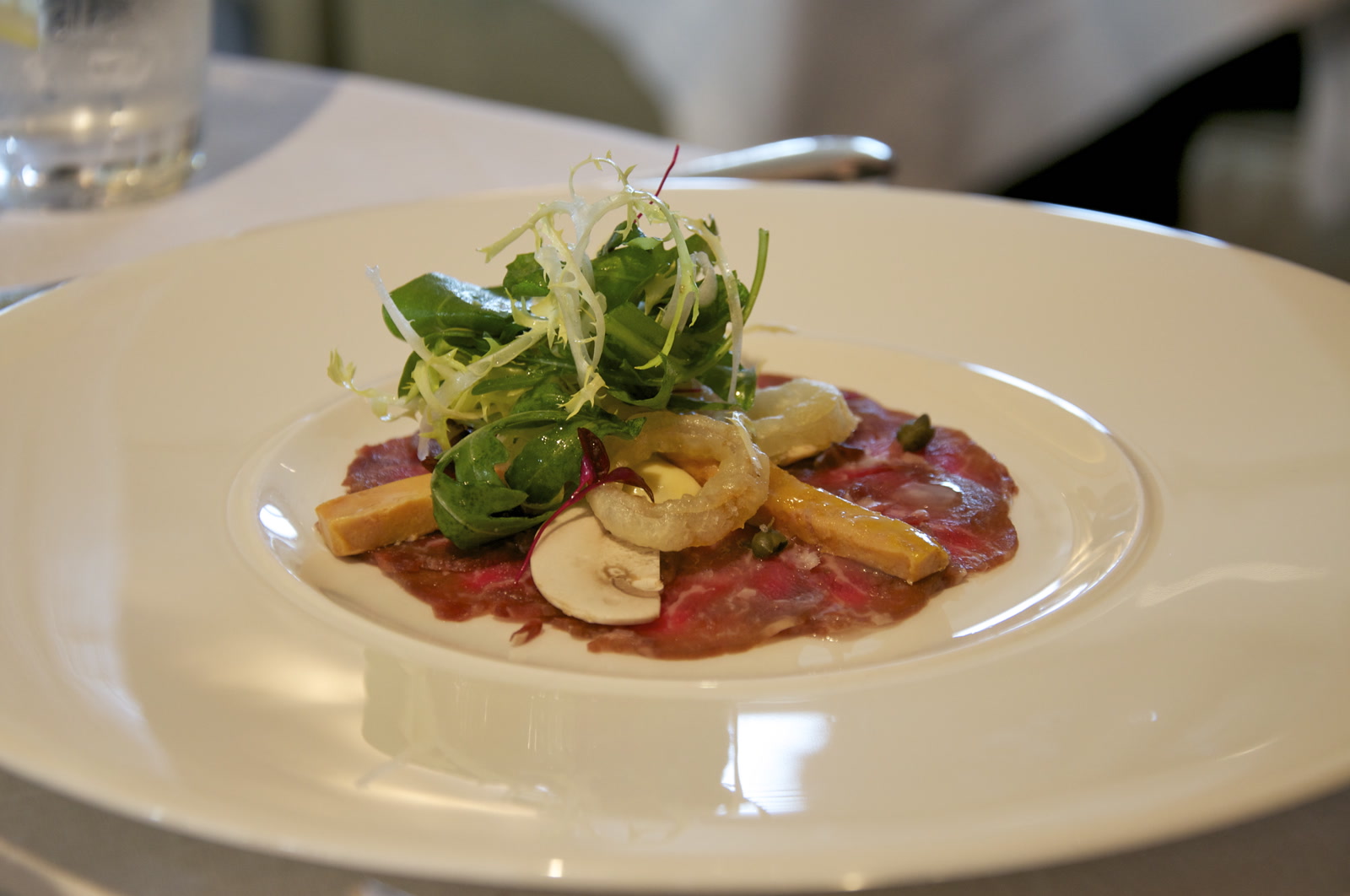
The contemporary photograph above is useful precisely because it is not the canonical Harry's Bar plate.[5] It shows what the category became: raw beef as a composed restaurant object, arranged for the eye before the fork. The original, by contrast, is sharper and more radical because it asks less garnish to do more work. Its drama is not in spectacle. It is in the moment a plate of uncooked meat stops feeling unfinished.
That is why carpaccio remains more than a menu word. At its best, it is one of fine dining's cleanest tests of confidence. Heat can rescue many things. Butter can flatter many things. Carpaccio has almost nowhere to hide. It succeeds when rawness feels not primitive, but poised.
Sources
- Cipriani, "Carpaccio" - official heritage account of the dish's invention, Countess Amalia Nani Mocenigo, the sauce, and the Vittore Carpaccio naming story.
- Cipriani, "Harry's Bar Venice" - official Harry's Bar history, opening date, service identity, and 2001 National Landmark note.
- La Cucina Italiana, "Everybody Loves Carpaccio," 2020 - recipe structure and summary of how the term broadened beyond raw beef.
- Colleen Barry, Associated Press, "Carpaccio the artist, not the appetizer, now getting his due," 2022 - context on Vittore Carpaccio's renewed art-historical attention and the dish's popular-name shadow.
- Wikimedia Commons, "File:Beef Carpaccio at Petrus.jpg" - real photograph of beef carpaccio used as the article image.