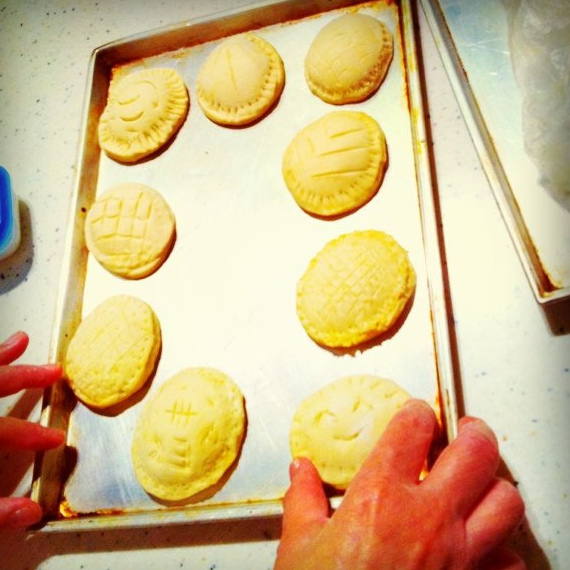
The pithivier looks almost too composed to be dramatic. No flame rises from it. No server presses it under silver. No rare ingredient announces the bill. It is simply a round, domed pastry, glazed and scored, usually carrying almond cream between two disks of puff pastry. That simplicity is exactly why it deserves fine-dining attention.
A pithivier exposes pastry work in public. Larousse's recipe is spare enough to make the stakes legible: 500 grams of puff pastry, 400 grams of almond cream, one egg, two 20-centimetre disks, a 1.5-centimetre margin around the filling, sealed edges, egg wash, scoring, and a 45-minute bake.[1] There is little room for decoration to rescue weak craft. If the dough was warm, the butter leaks. If the edge is badly sealed, the cream escapes. If the scoring cuts too deeply, the dome opens where it should only speak.
That is why the dish sits between patisserie and fine dining rather than belonging wholly to either. It can be sold as a bakery classic, eaten warm or cold, and understood as a Loire-region pastry with an old town name.[1][3] But in a dining room, the pithivier becomes something more pointed: a test of whether the kitchen can make richness behave with restraint. The guest sees the answer before tasting it. A good pithivier rises evenly, keeps its roundness, shows a clean pattern, and offers enough gloss to feel deliberate rather than lacquered.
The round is not decorative
The first fine-dining lesson is geometry. CooksInfo describes the classic pithiviers as a large French pastry about 10 inches wide, with puff pastry above and below, a dense creme d'amandes filling inside, and a rounded top slashed in a starburst pattern.[4] Those details sound descriptive, but they are really constraints. The bottom must support the filling without becoming wet cardboard. The top must stretch over a dome without cracking. The scored pattern must invite expansion without turning into vents that empty the pastry.
Great British Chefs' practical guide makes the engineering clearer. The base circle is cut around 20 centimetres, the filling is shaped into a dome, the top circle is made slightly wider, the edge is moistened and sealed, and the whole piece rests in the refrigerator before glazing and scoring.[2] None of that is fussy ritual. It is risk management. Cold pastry cuts cleaner, holds butter better, and gives the cook time to score the surface without dragging the layers into paste.
The pithivier is therefore not a pie with a pretty lid. It is a laminated pastry structure that has to inflate, brown, and stay sealed around a concentrated centre. That makes it a useful counterpoint to tasting-menu desserts that hide technique behind gels, powders, and broken compositions. A pithivier does not hide. The line of the edge, the height of the dome, and the crispness of the scoring all give evidence.
Almond cream is the quiet pressure
The classic sweet version can seem modest because almond cream is familiar. That is misleading. Taste France notes that the specialty developed into a version with a generous amount of almond cream between two disks of puff pastry, the top golden and decorated with curved lines; it also points out that modern pithiviers often move into savoury territory with poultry, pork, vegetables, or other fillings.[3] The shift is useful because it shows the form's range, but the almond version remains the cleanest reading of the dish.
Almond cream creates pressure without visual noise. It is dense enough to give the pastry a centre, rich enough to justify the butter in the dough, and quiet enough that the diner still notices lamination. In a badly made pithivier, the filling dominates as sweet paste and the pastry becomes a wrapper. In a good one, the almond cream behaves like ballast. It rounds the middle, perfumes the bite, and gives the crisp layers something soft and fragrant to work against.
That balance is what keeps the pithivier from becoming merely rustic. The filling cannot be too loose, or it floods the layers. It cannot be too high, or the top stretches and tears. It cannot be too sweet, or the butter and almond lose detail. Fine dining often talks about balance in abstract language; the pithivier makes balance physical. You can see whether the middle was loaded with judgment.
Scoring is a promise, not a pattern
The most tempting mistake is to treat the surface lines as ornament. They are beautiful, but their job is not only beauty. Larousse tells the cook to trace a diamond or rosette pattern with the tip of a small knife after egg washing the top.[1] Great British Chefs gives a related instruction: make a small hole in the centre and score curved lines from top to bottom before baking.[2] In both versions, the marks manage expansion. They tell steam and lift where to go.
That is why the knife matters. The score should be shallow enough to leave the pastry sealed, decisive enough to remain visible after the dough rises, and even enough to make the dome look intentional. A hesitant score disappears. An aggressive score cuts through the pastry's skin and lets the filling betray the structure. The ideal mark is a controlled wound that becomes decoration because the cook understood the material.
This is also why pithivier photographs well when the dish is right. The scored top is not a garnish added after success. It is the trace of the method. The diner reads it the way a cook reads grill marks, a chocolatier reads temper, or a saucier reads sheen. The surface records discipline.
Savoury fashion did not erase the pastry
The modern savoury pithivier has given the form new restaurant life. Taste France frames the contemporary interest partly through British and London pie culture, with chef Calum Franklin recalling a scallop pithivier built from hand-dived scallop, truffled scallop mousse, spinach, and puff pastry, a construction that had to be cooked accurately so the scallop at the centre stayed right.[3] Great British Chefs likewise uses chicken, squash, sage, ox cheek, and pigeon examples to show how the format can move away from dessert.[2]
Those savoury versions are not betrayals. They prove the form's seriousness. Meat, fish, or vegetable fillings make the timing even less forgiving because the pastry and centre have different cooking needs. A scallop must not overcook while the crust reaches crispness. A meat filling must be rich without wetting the base. A vegetable filling must avoid steaming the dome from inside until it collapses.
But the sweet almond pithivier remains the best lens because it strips the problem to essentials: butter, flour, almond, egg, heat, and time. The savoury restaurant version may carry more luxury signals. The almond version carries the argument more cleanly. It asks whether the kitchen can make a round object feel alive without adding complexity for its own sake.
Where the dish fails
Pithivier fails when it becomes either too precious or too casual. The precious version scores elaborate lines on pastry that eats tough, greasy, or underbaked. The casual version treats the form as a convenient covered pie and forgets that lamination is the point. Both miss the same truth: the dish is not valuable because it is old, French, or photogenic. It is valuable because every visible feature is tied to function.
The best service is direct. Serve it warm enough that the almond cream feels aromatic, not hot enough that the structure slumps. Cut it with confidence so the layers break cleanly. Do not drown it in sauce unless the sauce has a reason to sharpen the pastry rather than cover it. A little fruit acidity can help; a heavy pool of sweetness usually makes the dish less articulate.
The pithivier belongs in fine dining because it makes restraint legible. It turns a short ingredient list into a difficult sequence: laminate, chill, fill, seal, score, glaze, bake, rest, cut. Each stage leaves evidence in the finished round. When it works, the diner does not merely taste almond and butter. The diner tastes judgment held inside pastry.
Sources
- Editions Larousse, "Pithiviers" - Pierre Herme recipe from Larousse des desserts covering puff pastry, almond cream, disk size, margin, sealing, egg wash, scoring, baking time, and service temperature.
- Great British Chefs, "How to make the perfect pithivier" - practical guide on rolling thickness, circle sizing, domed filling, sealing, chilling, glazing, scoring, baking temperatures, and savoury serving examples.
- Taste France Magazine, "Why you need to know about Pithiviers pie - and have some!" - overview of the Loire/Pithiviers origin frame, almond-cream feuillete version, curved top decoration, savoury evolution, and Calum Franklin's scallop-pithivier example.
- CooksInfo, "Pithiviers" - reference note on the pastry's typical width, puff-pastry top and bottom, creme d'amandes filling, rounded/slashed top, sealed edges, chilling variants, and town-of-Pithiviers attribution.
- Wikimedia Commons, "File:Pithivier.jpg" - real photograph originally posted to Flickr by Lim Ashley, showing a scored pithivier and used as this article's image.