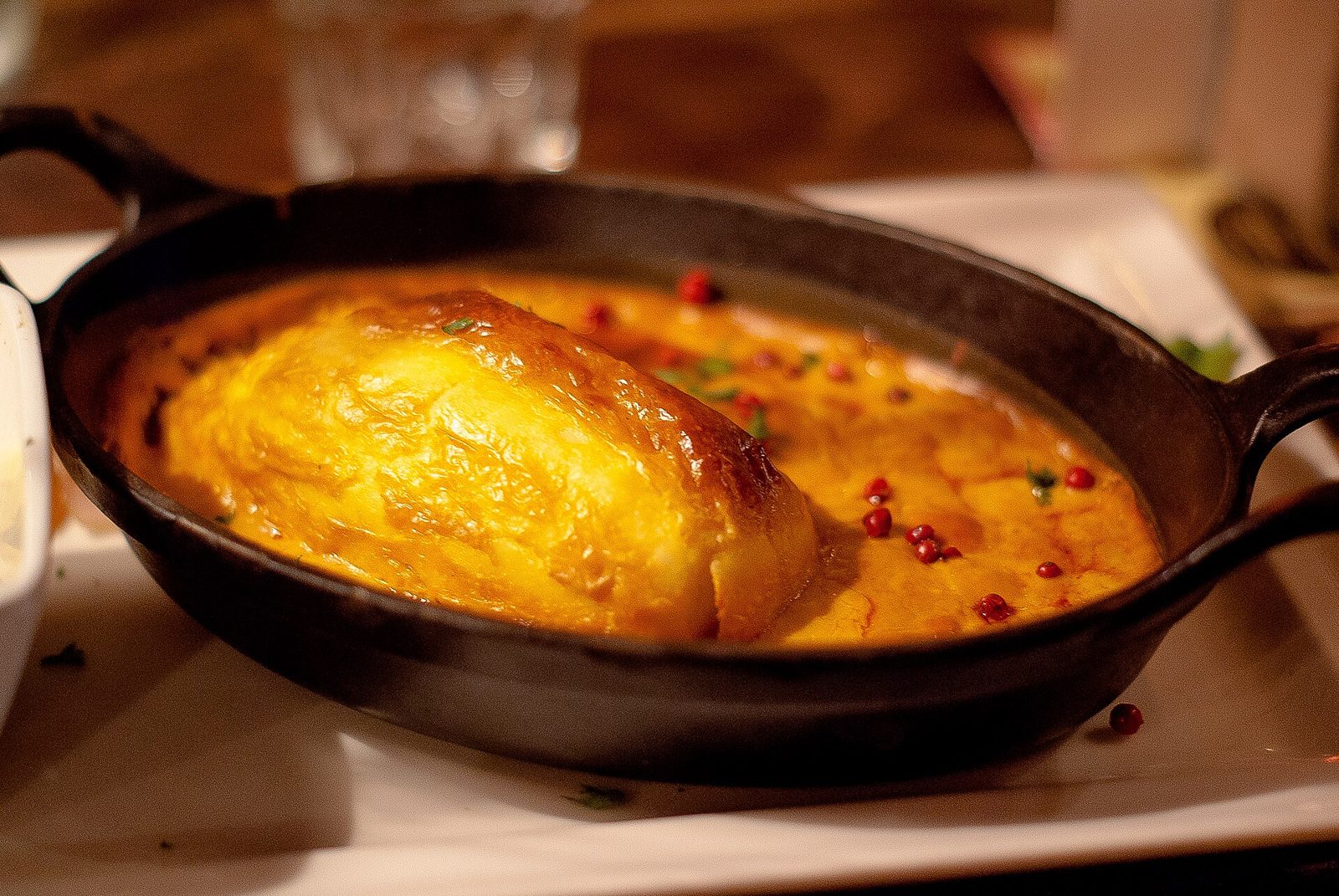
The pike quenelle looks too soft to carry much argument. It arrives oval, pale, swollen by heat, and usually half-submerged under orange Nantua sauce. There is no caviar sparkle, no tableside flame, no cut of meat that can announce cost by itself. Yet this is exactly why the dish is still a serious fine-dining test. A pike quenelle has nowhere to hide. If the mousse is coarse, the shape slumps. If the binder is heavy, the fish disappears. If the sauce is thin or harsh, the whole plate turns into hotel nostalgia.
That is the craft lesson inside the Lyon/Nantua classic. The dish is not just "fish dumpling with sauce." Larousse's recipe makes the construction plain: pike flesh is worked with a cooled panade and butter, then the shaped quenelles are served with a Nantua sauce built around crayfish.[1] Haut-Bugey Tourisme describes the local Nantua version through a more regional lens: durum wheat semolina paste, pike fillets, beef fat, fresh eggs, and no coloring or preservatives, with a threshold that distinguishes a true pike quenelle from a merely pike-based one.[2] Between those accounts, the dish becomes legible as a problem of structure. It must taste like fish, but behave like a hot mousse.
Image context: the cover uses a real photograph of quenelles de brochet sauce Nantua, served at Restaurant A la Traboule in Old Lyon. The image is not decorative food wallpaper. It shows the exact technical bargain discussed here: a gently inflated fish mousse carrying a concentrated shellfish sauce without losing its shape, sheen, or sense of lightness.[5]
Panade is the quiet architecture
The first mistake is to treat the panade as filler. In a weak quenelle, it is. In a good one, it is the hidden architecture that gives the fish enough body to be shaped, cooked, and sauced. Larousse's method cools the panade before combining it with pike and butter, which matters because the mixture has to bind without cooking the fish prematurely or turning greasy.[1] The panade is not there to stretch expensive product. It is there to make a delicate fish preparation survive heat.
This is why the dish belongs in fine-dining craft rather than only in regional nostalgia. A kitchen can buy excellent pike and still fail. The question is whether the fish, starch, fat, and egg are dispersed finely enough that the finished oval eats as one tender mass. Too little structure and the quenelle breaks. Too much and it becomes a loaf. The ideal texture sits in the difficult middle: elastic enough to lift from the spoon, light enough to expand, and moist enough that the sauce feels like a partner rather than a rescue operation.
That middle zone also explains why old-fashioned recipes can feel more modern than their appearance suggests. A tasting-menu kitchen that makes fish mousse, scallop mousse, poultry farce, steamed custard, or savory souffle is working the same boundary. The quenelle simply removes the distractions. The diner meets the texture directly.
Pike matters because it resists smoothness
Pike is not a neutral white fish. It is lean, freshwater, and famously bony, which makes it awkward as a luxury ingredient unless the cook has a reason to transform it. Quenelle technique gives it that reason. The fish is broken down, mixed, shaped, and made gentle without pretending to be something else.
Haut-Bugey's manufacturing note is useful because it makes the regional standard tangible. The true Nantua version includes pike fillets in a semolina-based paste with beef fat and eggs, and it states that the "quenelle de brochet" name requires at least 22 percent pike; below that, the product is described differently.[2] That threshold is not a guarantee of greatness, but it protects the central claim: pike must remain more than a label.
Fine dining often struggles with this kind of humble precision. It is easy to make a dish luxurious by adding a rarer ingredient. It is harder to make a familiar structure persuasive by keeping the main ingredient audible after binding, shaping, and saucing. The pike quenelle asks for the second kind of intelligence. The fish should not shout. It should give the mousse a faint freshwater firmness, a clean flavor under the butter and egg, and a reason for the crayfish sauce to be there.
Spoon shaping is more than a pretty groove
The oval shape is not incidental. Giraudet's public savoir-faire page, describing a house associated with quenelles since 1910, frames spoon molding as a signature gesture: a groove left by the spoon, preserved as part of the craft.[3] That sounds romantic until you think about what the gesture actually does. Spoon shaping standardizes portion, surface tension, and cooking behavior. It gives a soft mixture a repeatable form.
The groove also announces that the quenelle is handmade or at least hand-coded in its identity. In a dining room, that matters less as rustic theater than as technical evidence. A clean oval means the mixture had enough cohesion to be handled. A swollen oval after baking means the mixture held steam and expansion without splitting. A quenelle that arrives torn, dense, or flattened has already told you what went wrong before you taste it.
This is where the dish differs from many contemporary small plates. It is not assembled from separate precise components on the plate. Its precision has to be built earlier, inside the mixture. Once the quenelle is shaped, the cook has fewer ways to correct it. Heat will reveal whether the emulsion was right.
Nantua sauce must flatter without burying
Nantua sauce can make the dish famous and ruin it at the same time. Larousse's recipe builds the sauce around crayfish, using the shellfish element to bring color, sweetness, and depth to the quenelles.[1] Giraudet's recipe page keeps the service logic practical: put the quenelles well spaced in a gratin dish, cover them with Nantua sauce diluted with a little water or cream, bake hot for 30 to 35 minutes, and serve immediately after the oven.[4]
Those instructions are plain, but they reveal the stakes. The sauce is not ladled over a finished dumpling at the last possible second. It helps create the final baked condition. The quenelle absorbs heat inside a wet, rich environment; the sauce thickens and clings; the top edge may gratinate; the center must remain tender. Spacing matters because the quenelles need room to swell. Immediate service matters because the dish is at its best before the mousse settles and the sauce dulls.
The best Nantua sauce does not taste merely creamy. It should carry shellfish sweetness, fat, and a quiet roasted-shell depth without making the pike seem irrelevant. If the sauce is too aggressive, the quenelle becomes a bland sponge. If it is too weak, the plate becomes beige comfort. The classic version works when the sauce supplies bass notes and the mousse keeps the melody.
Why this old dish still teaches modern kitchens
Pike quenelle is not fashionable in the obvious way. It does not fit neatly into the current language of fire cooking, fermentation rooms, farm narratives, or hyper-seasonal foraging. Yet it remains useful because it teaches a less visible discipline: how to make a fragile preparation coherent from inside out.
That discipline runs through serious restaurants even when the dish itself is absent. A chef making a scallop farce, a poultry mousse, a custard set just below curdling, or a sauce held at the edge of splitting is solving the same class of problem. The work is not maximum intensity. It is controlled tenderness. A great quenelle proves that the kitchen can make softness precise.
The regional frame keeps that precision from becoming sterile. Lyon's bouchon culture, Nantua's crayfish sauce identity, and Bresse-area makers such as Giraudet all keep the dish attached to place, craft, and repeatable pleasure rather than to technique for technique's sake.[2][3] The point is not to modernize the quenelle until it disappears. The point is to notice that it was already a sophisticated object: fish transformed by panade, fat, egg, spoon, heat, and sauce into a single edible structure.
That is why the dish deserves attention beyond nostalgia. A pike quenelle is luxurious only if the cook resists making it heavy. It is regional only if the pike and Nantua logic remain legible. It is fine dining only if the softness is intentional. Done badly, it is a damp dumpling under a rich sauce. Done well, it is one of the cleanest demonstrations of a kitchen's control over texture: a hot mousse that rises, holds, receives sauce, and still tastes like the fish that made it necessary.
Sources
- Editions Larousse, "Quenelles Nantua" - recipe describing the pike, cooled panade, butter, shaping, and crayfish-based Nantua sauce construction.
- Haut-Bugey Tourisme, "Recipe and instructions" - regional Nantua guidance on semolina paste, pike fillets, beef fat, fresh eggs, and the pike-content threshold for quenelles de brochet.
- Giraudet, "Un geste, une signature" - official page on spoon-molded quenelle craft, the house's 1910 heritage, and ingredients such as durum wheat semolina, Bresse butter, and Dombes pike.
- Giraudet, "Quenelles moulees cuillere de brochet sauvage a la sauce Nantua" - practical recipe page covering spacing in a gratin dish, Nantua sauce, hot baking, timing, and immediate service.
- Wikimedia Commons, "File:Quenelle de brochet sauce Nantua.jpg" - real 2012 photograph by Fryke27 of a pike quenelle with Nantua sauce served at Restaurant A la Traboule in Old Lyon, used as the article image.