Opheem is easy to misread if the bill is treated as a simple ranking device. Two Michelin stars usually invite the same exhausted question: is it worth it? At Aktar Islam's Birmingham restaurant, the better question is narrower and more useful: what kind of access is the restaurant trying to protect, and what does the diner actually receive for each step up the ladder?
As of May 31, 2026, Opheem's public menu presents a serious but unusually legible price architecture. The full tasting menu is GBP 195, with a GBP 195 wine flight. A shorter five-course tasting menu is GBP 145, with a matching GBP 145 flight, and is unavailable at Friday and Saturday dinner. Friday and Saturday lunch adds a separate a la carte path at GBP 75 for two courses or GBP 95 for three, with snacks in the lounge and a bread course included before the listed courses begin.[1] That is not cheap dining. It is also not the opaque, one-price-only luxury format that forces every guest into the longest possible evening.
The value case begins there. Opheem is not selling a bargain version of two-star dining. It is selling several degrees of commitment inside one house style: long-form dinner for the guest who wants full immersion, a shorter tasting sequence for the guest who wants the argument without every chapter, and a lunch format that lets the kitchen compress the signature grammar into a smaller spend and shorter day.
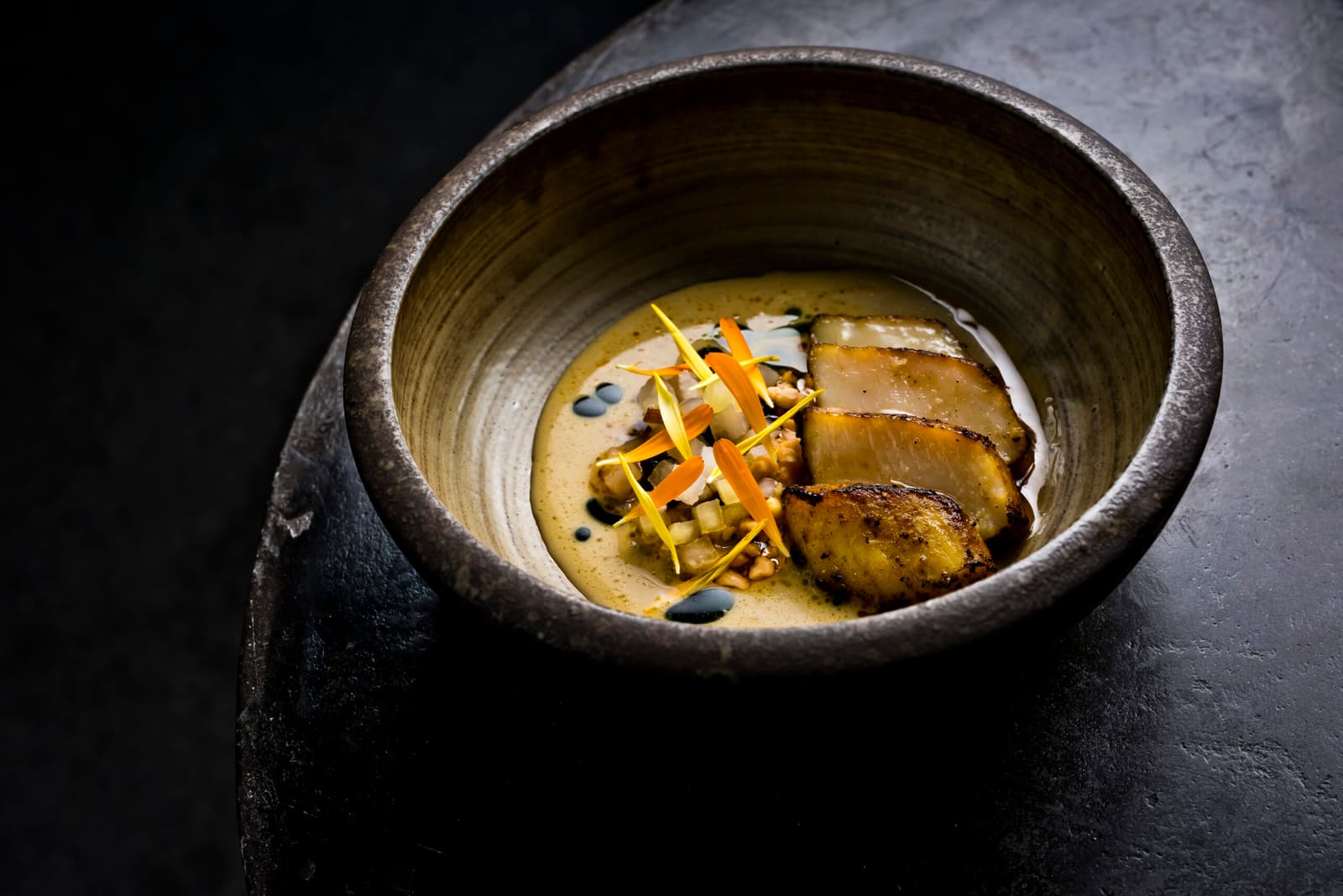
Image context: the cover uses a real official Opheem photograph from the restaurant's own media library. The image is not a generic fine-dining placeholder. It shows the kind of sauced, highly controlled plate that makes the restaurant's pricing argument tangible: the money is meant to buy intensity, polish, and a specific modern Indian vocabulary, not just a star count.[5]
The star matters, but it is not the whole product
Michelin's listing gives the headline. Opheem holds two stars in Birmingham, and Michelin describes Islam as a locally born chef-owner who has built an evolving dining experience around progressive Indian cooking.[2] The guide's language matters because it separates Opheem from two common shortcuts. This is not a heritage restaurant trading only on memory, and it is not a luxury room using Indian flavor as a decorative accent.
RestaurantOnline's 2024 interview makes the distinction sharper. Islam described Opheem as a restaurant in its own lane, built around his culinary heritage, British produce, and Birmingham's appetite for spice. He also framed Indian food through balance: acidity, sweetness, salinity, and heat, rather than heat alone.[3] That balance is important for value. A diner is not paying a premium because spice is loud. The premium is justified only if the kitchen can make spice structural: a sauce that lands in layers, a snack that opens with brightness before heat arrives, a meat or vegetable course where salinity and acidity keep richness from flattening the palate.
This is where the current menu reads better than a bare price list. Dishes point to places and memories without behaving like a survey. Aloo tuk brings pink fir potato and tamarind; marag pairs Wye Valley asparagus with onion bhaji, wild garlic, and mint; wazwan uses laminated paratha, hogget belly, and shorba; saagwala moves through guinea fowl, seekh kebab, bharta, and wild garlic; kheer finishes with Alphonso mango, rice pudding, and Bengali lime.[1] The geography is not ornamental. It tells the diner how to read the plate: region, technique, ingredient, and personal translation share the same line.
The useful comparison is not "cheap versus expensive"
The common error is to compare Opheem's lunch with its full dinner as if they were two versions of the same product. They are not. The two-course lunch at GBP 75 is an access lane. It gives the guest the room, the lounge snacks, the bread course, and a direct route through the kitchen's flavor logic, but it cannot provide the accumulation that a full tasting menu is designed to create.[1]
The five-course menu at GBP 145 is the more revealing middle tier. It includes recognizable anchors from the longer menu, but the constraint changes the evening. A shorter sequence has to make fewer promises and recover faster between courses. It is a strong format for guests who want to understand the restaurant without treating dinner as the only event of the day. It is also a useful hedge for diners who love spice and sauce but do not want the fatigue that can come when a long tasting menu keeps pressing the same register.
The full GBP 195 menu is where Opheem has to justify itself hardest. At that level, the bill is not paying for novelty course by course. It is paying for duration, sequencing, labor, and the confidence that the room can carry intensity without making the night feel heavy. The matching wine flight doubles the stated food price, so the real decision for many guests is not GBP 195 versus GBP 145. It is whether the drinks program is central to the way they want to read the food. Opheem's menu copy says the pairing is designed to move around the globe while working with bold flavors.[1] That is a real technical problem: tannin, sweetness, acidity, aromatic lift, and alcohol weight all have to deal with tamarind, wild garlic, shorba, mango, mint, and heat.
Margin is part of the story
The most unusual thing about Opheem's value argument is that Islam has spoken publicly about the economics underneath it. In 2024, after the second star, he said he did not plan to raise prices in response to the award. He also described the restaurant as difficult to make profitable on food alone, pointing to labor costs and the need for alcohol sales and support from other businesses.[3] Those comments are not just hospitality gossip. They explain why the pricing feels deliberate rather than accidental.
Two-star restaurants are labor machines. They require prep time, service polish, dishwashing capacity, reservations administration, wine buying, training, and enough experienced people in the room to make the guest feel held without making the table feel managed. Great British Chefs' interview with Islam after the second star emphasizes the human side of that system: Opheem's young kitchen, the desire to support chefs and hospitality professionals, and Islam's sense that the restaurant can help build a future pipeline for the industry.[4]
That matters because a diner often sees only the plate and the bill. Opheem's price stack also buys repetition. It buys the possibility that the Wye Valley asparagus course tastes intentional on a busy Friday, that a short lunch still gets a proper entrance, that a guest with dietary constraints is handled seriously inside the boundaries of a spice-and-sauce-heavy menu, and that the kitchen has enough staff depth to keep precision from depending on one heroic cook. Opheem's own allergen note is blunt about limits: some ingredients, including tomato, onion, garlic, dairy, and ginger, are so central to the sauces that the restaurant cannot accommodate every restriction.[1] That kind of boundary can feel severe, but it also protects the actual product being sold.
Birmingham is not background scenery
Opheem's price/value equation would be weaker if it floated above its city. Islam grew up in Aston, worked in his father's restaurant as a teenager, and frames Opheem partly through the experience of immigrant families whose food culture in Britain could become frozen by nostalgia even as their lives became permanently British.[4] That origin story can be over-romanticized, but here it helps explain the restaurant's refusal to behave like a generic luxury Indian room.
The Birmingham setting gives the spice argument teeth. In the RestaurantOnline interview, Islam explicitly connects Opheem's intensity of flavor to a city known for loving spice.[3] That is not the same as saying the restaurant cooks for local stereotypes. It means the restaurant's modernity does not require sanding down heat, acidity, or salinity for a supposedly more prestigious palate. The room's ambition is to make those forces precise enough for two-star scrutiny without turning them polite.
This is the part of the bill that can be hardest to price. A London or Paris luxury room can charge for address, scarcity, and inherited theater. Opheem charges for a different sort of conversion: Birmingham restaurant memory, Bangladeshi family history, British produce, Indian regional reference points, and Michelin-level technique compressed into one tasting-room language. When it works, the value is not that the guest gets "Indian food, upgraded." It is that the guest gets Indian cooking treated as a complete fine-dining operating system.
The right order depends on the diner
For a first visit, the lunch route is not a compromise if the goal is calibration. The GBP 75 or GBP 95 lunch gives a diner enough of the room's rhythm to decide whether Opheem's spice, sauce texture, and service style are personally compelling before committing to the larger evening spend.[1] It is the right move for the guest who is curious, local, or traveling through Birmingham rather than building a trip around one dinner.
The five-course menu is the sharper recommendation for a serious diner who wants the restaurant's full grammar without the weight of the longest sequence. It is also the best value test. If the shorter tasting menu feels complete rather than reduced, the kitchen is probably editing well. If it feels like a teaser for the GBP 195 menu, the value case weakens.
The full tasting menu makes sense when the guest wants Opheem at maximum resolution. That means arriving ready for a long-form meal, taking the spice architecture seriously, and deciding in advance whether the wine flight is part of the night or whether the better value is a more selective bottle or glass strategy. The danger at this level is not that the restaurant lacks ambition. It is that the guest buys the most expensive format when the shorter one would have delivered more pleasure per pound.
That is why Opheem's access strategy is interesting. The restaurant has two stars, but it has not turned the star into a single locked door. It lets the diner choose the scale of encounter. The value is not only in the food on the table. It is in the fact that a Birmingham restaurant with a highly personal, spice-forward, progressive Indian grammar still offers more than one way in.
Sources
- Opheem, "Menu" - current public menu pricing, tasting-menu tiers, lunch format, wine flights, sample dishes, and allergen boundaries.
- The MICHELIN Guide, "Opheem - Birmingham" - Michelin listing, two-star status, address, and guide description of the restaurant.
- Joe Lutrario, "Accessibility is key for us: Aktar Islam on why winning two Michelin stars won't mean price rises at Opheem," RestaurantOnline, February 9, 2024 - interview on second-star pricing, flavor balance, bookings, labor cost, and restaurant economics.
- Lauren Fitchett, "'We're nowhere near finished': Aktar Islam on his second Michelin Star," Great British Chefs, February 9, 2024 - profile and interview covering the second star, Opheem's opening history, staff development, and Islam's Birmingham background.
- Opheem media image, "DSC_5403" - official restaurant photograph used as the cover image.