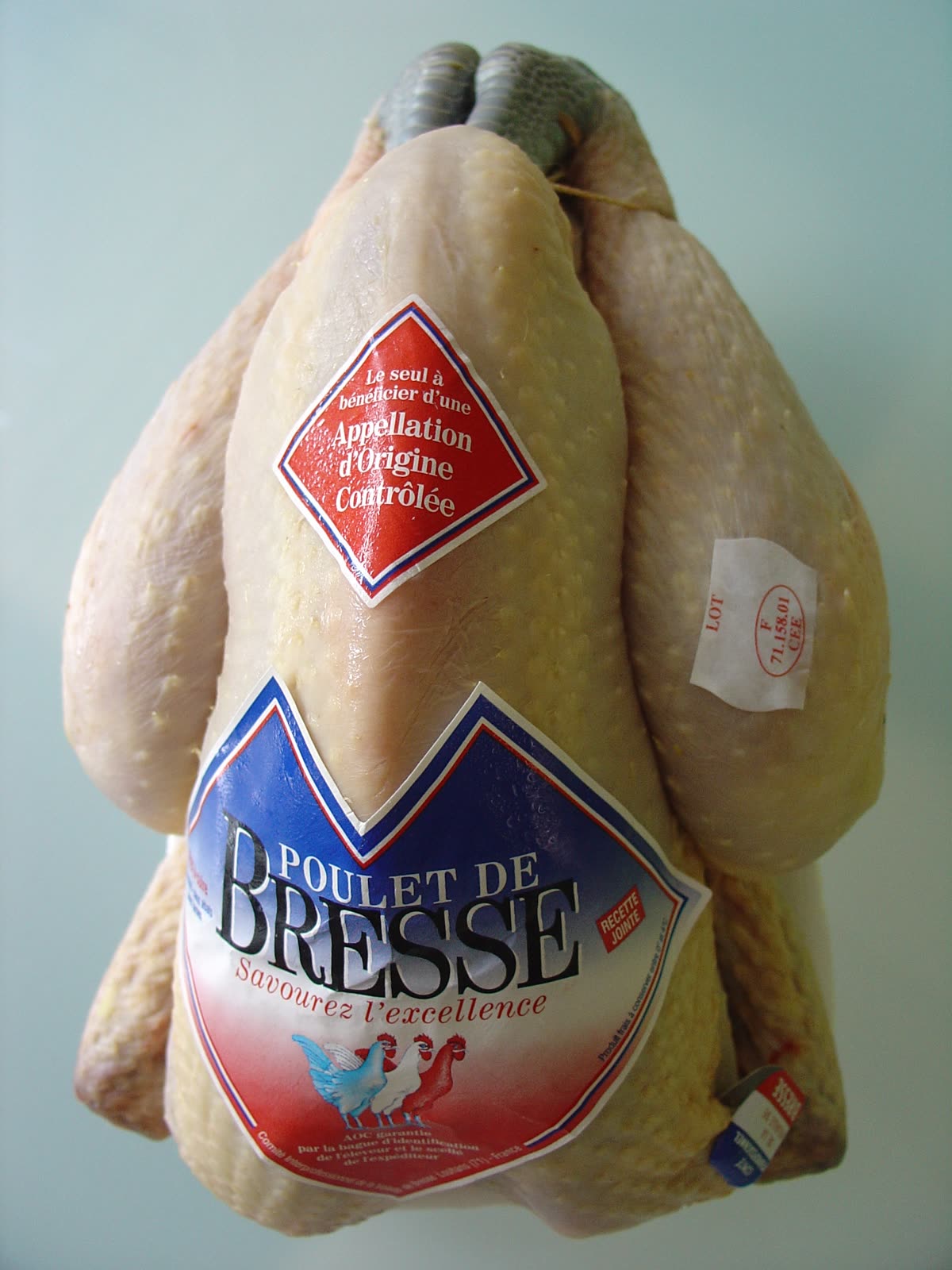
Poulet de Bresse is easy to flatten into a status ingredient: the famous French chicken, the expensive chicken, the bird chefs name when ordinary poultry would sound too modest. That shorthand is not wrong, but it is too small. The real luxury is not simply breed, price, or reputation. It is a production contract that makes the pasture, feed, finishing period, slaughter geography, and identification system part of the ingredient itself.
That is why Bresse chicken still matters in fine dining. It gives the kitchen something rarer than a premium protein. It gives the kitchen an ingredient whose origin has been made operational. The official Bresse poultry body frames the AOP around three linked facts: the White Bresse Gauloise bird, a geographically defined production area, and traditional expertise protected first through French AOC recognition and then European AOP status.[1] The current French specification makes the same point in harder administrative language: the appellation covers Volaille de Bresse, Poulet de Bresse, Poularde de Bresse, and Chapon de Bresse, and it defines the animal, the geography, the production stages, the finishing rules, and the marks that follow the bird to market.[2]
Image context: the cover shows a live Bresse chicken rather than a roasted bird. That choice is deliberate. For this ingredient, the visible identity of the animal and the outdoor system behind it are not decorative backstory. They are the reason the name can carry weight on a serious menu.[1][2][6]
The appellation begins with a body
The Bresse chicken has one of the clearest visual signatures in food. CIVB describes the poultry as entirely white, with smooth blue legs, a red comb and wattles, and white skin and flesh.[1] The official specification repeats those identifying traits with legal precision: white plumage, fine smooth blue or bluish legs, a simple comb, red wattles, white or red-speckled ear lobes, fine skin, and white flesh.[2] This matters because the ingredient is not only a region attached to a product. It is a region attached to a specific animal form.
That body is not interchangeable with the phrase "heritage chicken." The French document specifies that Bresse poultry belongs to the white variety of the Gauloise or Bresse breed, then sets minimum ages for different market forms: 108 days for chicken, 140 days for poularde, and 224 days for capon.[2] Those numbers change how a cook should read the meat. This is not the quick-growing commodity bird dressed up with a place name. It is a slower animal asked to develop frame, flesh, and fat under a defined schedule.
For a fine-dining kitchen, that schedule is the first useful constraint. A chef does not merely buy "better chicken." The chef buys a bird whose growth has already been edited by time. That helps explain why the best preparations often avoid burying the flavor under too many signals. Cream, vin jaune, morels, truffle, foie gras, and sauce work can all belong with Bresse poultry, but the bird has to remain legible. If the garnish becomes the point, the appellation work has been wasted.
Meadow space is not pastoral decoration
The most important sourcing detail may be the least glamorous: space. CIVB states that Bresse poultry receives at least 10 square meters of grass meadow per bird, with a henhouse density capped at 12 chickens per square meter.[1] The official specification puts the same growth-period access rule into its control table: more than 10 square meters of outdoor range per bird, with a multi-species pasture at least one year old.[2]
That is not rustic imagery for brochures. It is an eating condition. CIVB says the birds scavenge roughly a third of their own food outdoors, hunting for earthworms and insects and eating grass alongside their supplied feed.[1] In other words, the meadow is not just where the chicken exercises. It is part of the diet and therefore part of the flavor argument.
This is where Bresse's luxury differs from the luxury of rarity alone. A rare ingredient can still be stupidly used. A tightly specified ingredient gives a kitchen less room to fake the premise. If a restaurant names Poulet de Bresse, it is invoking a whole production ecology: Bresse soil and meadow, outdoor movement, white breed standard, local cereals, dairy feeding, finishing, and traceability. The guest may not taste each element separately, but the dish is trading on the belief that they have acted together.
Feed turns geography into flesh
Bresse poultry is sometimes described through the appealing image of birds roaming in grass, but the feed rules are just as important. CIVB says the diet includes GMO-free wheat and corn produced in the area, plus plenty of dairy products.[1] The French specification is stricter and broader: feed materials must come from the geographic area where required, genetically modified crops are banned on farms producing poultry for the appellation, and the control framework tracks cereal origin as one of the key points.[2]
The dairy detail is not incidental. Michelin's guide to chicken types summarizes the culinary reputation in plain terms: Bresse chicken's distinctive status is tied both to outdoor life in clay-rich Bresse and to a cereal-and-milk-heavy diet that helps produce a fatty, rich-flavored bird.[4] The official Bresse site then supplies the finishing mechanism. During the final stage, the birds spend at least 10 days in a wooden cage called an epinette, where they can eat cereals freely.[1] The specification gives the control minimums by category: at least 10 days of finishing for chickens, 21 days for poulardes, and 28 days for capons.[2]
To a diner, that can sound like an odd mix of freedom and confinement. To a sourcing report, it is the key technical tension. The bird grows through range, movement, and foraging, then finishes through controlled feeding and reduced movement. The point is not to romanticize either stage. The point is that the eating quality depends on the sequence: outdoor maturity first, finishing discipline second.
Traceability is part of the taste contract
Fine dining loves origin stories, but origin only matters when it can survive the supply chain. The Bresse specification is blunt about this. It requires the bague, or ring, identifying the breeder; a seal identifying the slaughterer; a specific label; and additional identification seals for poulardes and capons.[2] It also explains why cutting and packaging operations remain inside the geographic area: the local handling, control system, and shorter transport chain reduce fraud risk and protect a fragile finished product.[2]
That is the quiet administrative work behind the glamour. A restaurant can put "Bresse chicken" on a menu because an external system has made the name auditable. The INAO product page is useful here because it identifies Volaille de Bresse or Poulet de Bresse as an AOP product and points directly to the official specification behind the name.[3] The value of the appellation is not only prestige. It is that the kitchen is not left to invent trust from adjectives.
This matters more as fine dining becomes more global. Many places outside France raise excellent chickens. Some even use Bresse Gauloise genetics or market "Bresse-style" birds. Those may be delicious. They are not Poulet de Bresse in the appellation sense unless they belong to the protected French system. The distinction is not snobbery; it is the whole point. The name protects a place-method-animal contract, not just a flavor profile.
Chefs keep the bird from becoming a museum object
The danger with an appellation ingredient is that it can become static: protected, admired, and boring. Bresse chicken avoids that partly because chefs have kept using it as a living medium. Michelin's recipe feature on Bresse chicken from the three-star Swiss restaurant B. Violier calls the bird prized for deep flavor and succulent skin, notes its AOC status, and gives a restaurant-grade preparation with baguette as a partner rather than as a garnish afterthought.[5]
Georges Blanc's own restaurant pages show the regional end of the same story. His gastronomic restaurant says he pays tribute to the Bresse region and names Bresse chicken among the emblematic products he handles through his mastery of sauces.[7] The more casual Ancienne Auberge page is even more direct: it presents the cuisine of Bresse through Bresse PDO chicken, frog legs, and pike quenelle, explicitly linking the dish to the "Meres cuisinieres" lineage that shaped the region's cooking.[8]
That range is important. Poulet de Bresse does not need to appear only as a trophy course in a hushed room. It can sit inside haute cuisine, brasserie memory, regional cream sauce, or a modern tasting-menu dish. The protected system gives the bird coherence; cooking gives it life. A kitchen that treats the bird as a logo will make a dull dish. A kitchen that understands the system can decide whether to emphasize skin, breast, leg, sauce, broth, fat, or ceremony.
What the ingredient teaches
The Bresse lesson for fine dining is not "buy the most famous chicken." It is that luxury becomes more persuasive when the production system is as disciplined as the plating system. The bird's white plumage and blue legs make it recognizable. The meadow gives it movement and foraging. Local cereals and dairy shape fat and flavor. The epinette finish tightens the last stage. The ring, seal, and label keep the chain legible. The chef's job begins only after all of that has happened.[1][2][3]
That is why Poulet de Bresse still earns attention even in an era full of more dramatic ingredients. It is not rare in the caviar sense, not theatrical in the tableside-spectacle sense, and not exotic in the lazy global-menu sense. Its force is quieter and more demanding. It asks whether a restaurant can cook a familiar animal seriously enough that origin, husbandry, fat, sauce, and restraint remain in the same sentence.
When Bresse chicken works, the plate tastes less like luxury added to chicken than like chicken protected from becoming generic. That is the real appellation achievement. It makes the pasture part of the recipe, then asks the dining room not to forget it.
Sources
- Comite Interprofessionnel de la Volaille de Bresse, "Bresse Poultry, the only poultry with the European protected designation of origin" - official English overview of AOC/AOP status, White Bresse Gauloise traits, meadow space, feed, foraging, dairy, and epinette finishing.
- French Ministry of Agriculture / INAO, "Cahier des charges de l'appellation d'origine Volaille de Bresse ou Poulet de Bresse..." - 2022 official specification covering breed traits, minimum ages, geography, feed rules, range requirements, finishing periods, cutting/packaging rules, and identification marks.
- INAO, "Volaille de Bresse ou Poulet de Bresse" - official product page for the AOP product and specification reference.
- MICHELIN Guide, "Your Guide To The Types of Chicken in the Culinary World" - overview placing Poulet de Bresse in culinary context and explaining outdoor life, regional conditions, and cereal-and-milk feeding.
- MICHELIN Guide, "Recipe: Bresse Chicken With French Baguettes" - fine-dining use case from B. Violier and description of Bresse chicken's AOC status, deep flavor, skin quality, and price context.
- Wikimedia Commons, "File:Poulet de Bresse - Bresse Chicken.jpg" - real 2005 photograph by Kweniston used for the article image.
- Georges Blanc, "Georges Blanc Gourmet Restaurant" - official restaurant page connecting Georges Blanc's cuisine to the Bresse region, Bresse chicken, and sauce mastery.
- Georges Blanc, "L'Ancienne Auberge" - official page presenting Bresse regional cuisine, Bresse PDO chicken, frog legs, pike quenelle, and the Meres cuisinieres lineage.
Editor’s Pick Review
This was the strongest eligible 24-hour pick because it turns an expensive ingredient into a working system rather than a luxury label. The article has a clean fine-dining spine: breed, protected geography, pasture space, cereal-and-dairy feeding, finishing rules, market identification, and chef use all remain connected to the plate. Its source base is unusually strong for a sensory piece, with official appellation material, product specification, producer context, and chef-facing references supporting the argument instead of decorating it.
The image also clears the stricter visual bar. It is not an analytical diagram, taste wheel, or symbolic luxury visual; it is a real, topic-specific photograph of Poulet de Bresse with its identifying marks, exactly the material object the article asks readers to understand. The Chinese version preserves that same contract in fluent sensory prose, especially around 生产契约, 牧场空间, 收尾育肥, and 身份识别系统, so the piece works as both ingredient reporting and bilingual editorial craft.