The easiest way to misread Piazza Duomo is to file it under white-truffle luxury and move on.
Alba certainly encourages that shortcut. The town is one of Europe's most legible food destinations, and autumn truffle season can make every serious table look like a premium extraction machine. Piazza Duomo is doing something more precise. What Enrico Crippa has built is a flagship where room design, garden logistics, and wine philosophy all serve the same larger project: turning the landscape of Alba and the Langhe into a meal that feels edited rather than merely abundant.[1][2][3][5]
That is why the restaurant still reads as sharp in 2026. Michelin continues to list Piazza Duomo as a Three Stars: Exceptional cuisine house in Alba in the 2026 Italia guide.[4] On the 50 Best Discovery profile, it remains a current World’s 50 Best mainstay, ranked No. 32 in 2025 after No. 39 in 2024.[5] Those are status signals. The stronger reason to pay attention is structural: few restaurants make place feel this intentionally composed from first glance to last sip.[1][2][3]
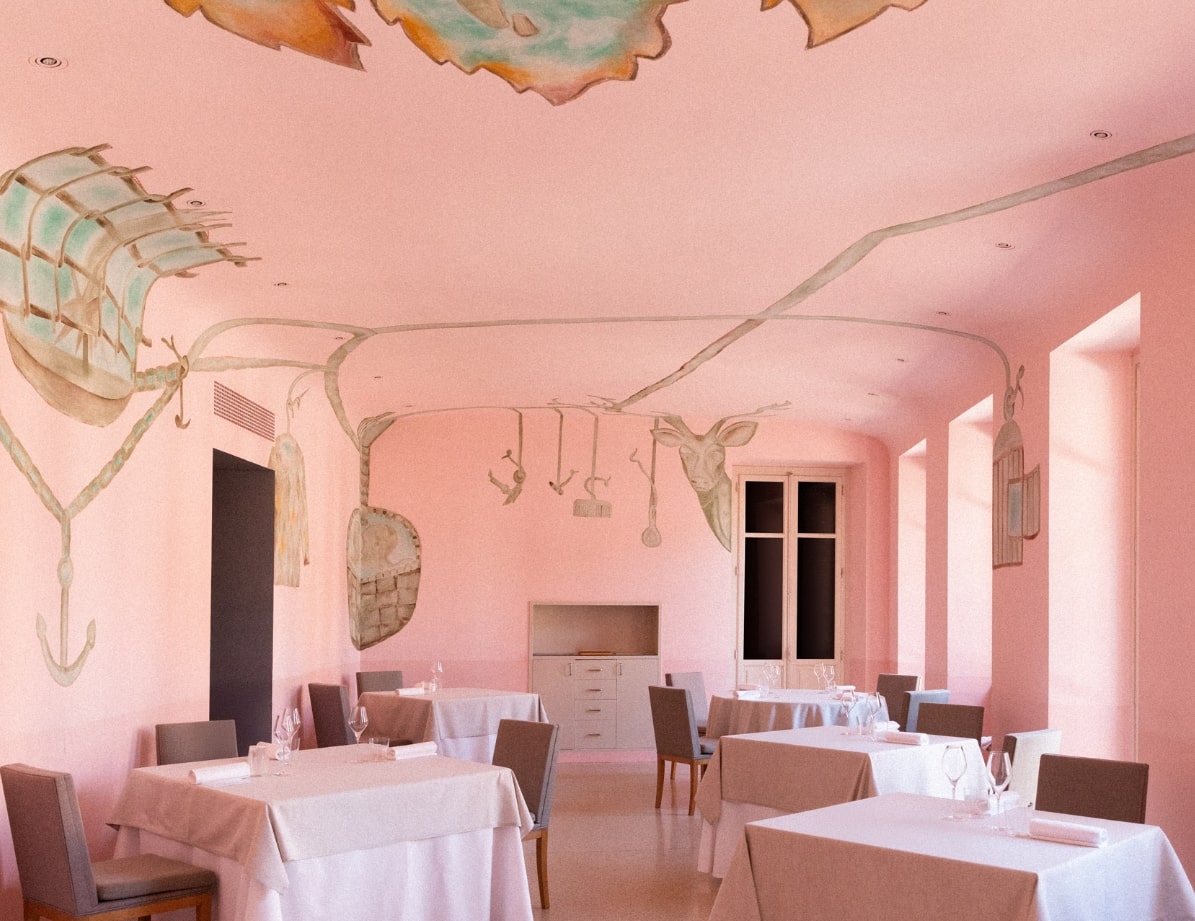
Image context: the cover image shows Piazza Duomo's frescoed pink room in Alba. It is the right visual anchor because the restaurant's luxury is inseparable from how the room stages perception before the first course arrives.
The room tells you this is not rustic theater
The official restaurant page gives away the argument immediately. Piazza Duomo describes the main dining room as a pink room lit by natural light and wrapped in Francesco Clemente's frescoed walls, while the smaller Louise Nevelson room turns more intimate and alludes to Alba's square and cathedral.[1] That matters because the restaurant is not trying to simulate peasant authenticity or farmhouse warmth. It is using art and architecture to filter the region.
This is where the house separates itself from a lot of destination fine dining. Many regional flagships try to reassure diners with obvious cues: stone walls, pastoral nostalgia, visible abundance, or a heavy-handed local script. Piazza Duomo feels narrower and more modern. Even 50 Best Discovery reduces the entire place to one unforgettable physical clue, calling it a marshmallow-pink dining room on one of Alba's historic side streets.[5] The description is memorable because it is accurate. The room is dreamlike, but not vague. It tells the guest that the meal ahead will be interpretive rather than rustic.
That interpretive layer is central to Crippa's identity. On the chef page, the restaurant frames him as a cook who joins visual art and taste, and whose cuisine changes in real time with the rhythms of harvest.[1] In other words, Piazza Duomo is not selling "the best of Piedmont" as a static greatest-hits package. It is selling a curated reading of Piedmont.
The garden is the operating system
If the pink room sets the tone, the kitchen garden explains why the restaurant does not drift into pure aestheticism.
Piazza Duomo's garden page is unusually revealing. The garden sits a few kilometres from Alba on the Monsordo Bernardina Estate, spans three hectares outdoors plus 500 square metres indoors, and grows around 400 vegetable varieties from multiple continents.[2] Ingredients can reach the kitchen in up to three deliveries a day.[2] Those are not decorative sustainability facts. They describe a production model built around immediacy, small variations, and daily editorial choice.
That model helps explain why 50 Best Discovery describes Crippa's menus through raw or fermented vegetables from the restaurant's own farm before it ever gets to white truffles.[5] Truffle season is still crucial in Alba, and the profile notes an autumn eight-course white-truffle celebration.[5] But the deeper signature is vegetable intelligence. The garden gives Crippa a wider vocabulary than a classic luxury pantry could. It lets the kitchen work with ripeness, texture, bitterness, and fragility at a level that feels more like composition than provisioning.[2][5]
This is also why the restaurant avoids reading like truffle tourism with better service. Alba can attract diners who want one prized ingredient to do all the emotional work. Piazza Duomo appears more ambitious than that. It uses the region's most famous luxury product when the season calls for it, but the restaurant's daily muscle sits in how it edits a much larger natural larder into sequence.[2][5]
Crippa's background explains the calm precision
The official biography on the restaurant page fills in the longer logic. Crippa trained with Gualtiero Marchesi, spent three years in Japan after Marchesi's Kobe opening in 1996, and then opened Piazza Duomo in 2005 with the Ceretto family.[1] Michelin stars followed fast: first in 2006, second in 2009, third in 2012, with a Green Star added in 2022.[1]
That timeline matters because it helps decode the restaurant's particular kind of discipline. Marchesi explains the technical seriousness. Japan helps explain the sensitivity to season, freshness, and surface detail. Alba provides the agricultural and cultural field on which those habits can be applied.[1][2] The result does not feel French in disguise, nor does it feel trapped in regional reenactment. It feels like a chef taking a famously rich territory and tightening its signals until the guest can read them clearly.
That clarity is part of why Piazza Duomo has stayed current rather than becoming a legacy shrine. The restaurant's identity is not pinned to one old signature or one historical era of avant-garde cooking. The house keeps renewing itself because the core material, harvest itself, keeps changing underneath it.[1][2]
The cellar keeps the restaurant from becoming doctrinaire
The cellar page adds one more useful piece. Piazza Duomo states bluntly that it does not embrace the technical concept of pairing and instead values interpretive freedom, treating wine as an ingredient that should interact freely with the dish and leave room for the taster's own reading.[3] That is a revealing choice.
In many elite restaurants, pairings can become a second system of control layered on top of the first. Piazza Duomo's public language suggests the opposite instinct. The cellar is personal, seasonal, and tied to producers and territory, but it is not trying to turn every guest into a captive of one exact narrative.[3] Wine director Jacopo Dosio also frames the program around lasting relationships with producers and around acting as ambassadors for the region while still searching beyond it.[3] That balance fits the rest of the house. Alba remains central, but never provincial.
This matters because Piazza Duomo could easily become too self-contained. The pink room, the chef's authorship, the private garden, the truffle calendar, the global acclaim: all of that could harden into a closed prestige object. The cellar philosophy stops that from happening. It reintroduces movement and interpretation, which keeps the meal alive.
Why Piazza Duomo is worth booking now
The strongest case for Piazza Duomo in 2026 is not simple reputation maintenance. It is that the restaurant still offers a coherent answer to a hard fine-dining question: how do you make a famous food region feel newly legible without severing it from its own ground?
Crippa's answer is stronger than most because every major layer pushes in the same direction. The pink room tells you the region will be filtered through art.[1][5] The garden tells you the kitchen works from living material rather than from luxury cliche.[2][5] The cellar tells you the house values interpretation over doctrinal pairings.[3] Michelin and 50 Best then confirm that this system is not a beautiful side project. It is one of the world's top working flagships.[4][5]
Book Piazza Duomo if you want Alba translated into a highly controlled contemporary language. Think twice if your ideal destination meal depends on obvious grandeur or on one luxury ingredient carrying the whole night. This restaurant looks strongest when read as an edible landscape machine: elegant, exact, and always in motion.[1][2][3][5]
Sources
- Piazza Duomo Alba official restaurant page, including the pink room, Louise Nevelson room, Crippa biography, Michelin timeline, and house positioning.
- Piazza Duomo Alba official kitchen garden page, including scale, harvest logistics, biodiversity, and daily delivery details.
- Piazza Duomo Alba official cellar page, including the wine philosophy, anti-pairing stance, and Jacopo Dosio's producer-focused program.
- MICHELIN Guide, "Piazza Duomo – Alba - a MICHELIN Guide Restaurant" (2026 Italia guide listing).
- The World's 50 Best Discovery, "Piazza Duomo - Alba - Restaurant" (current profile and ranking context).