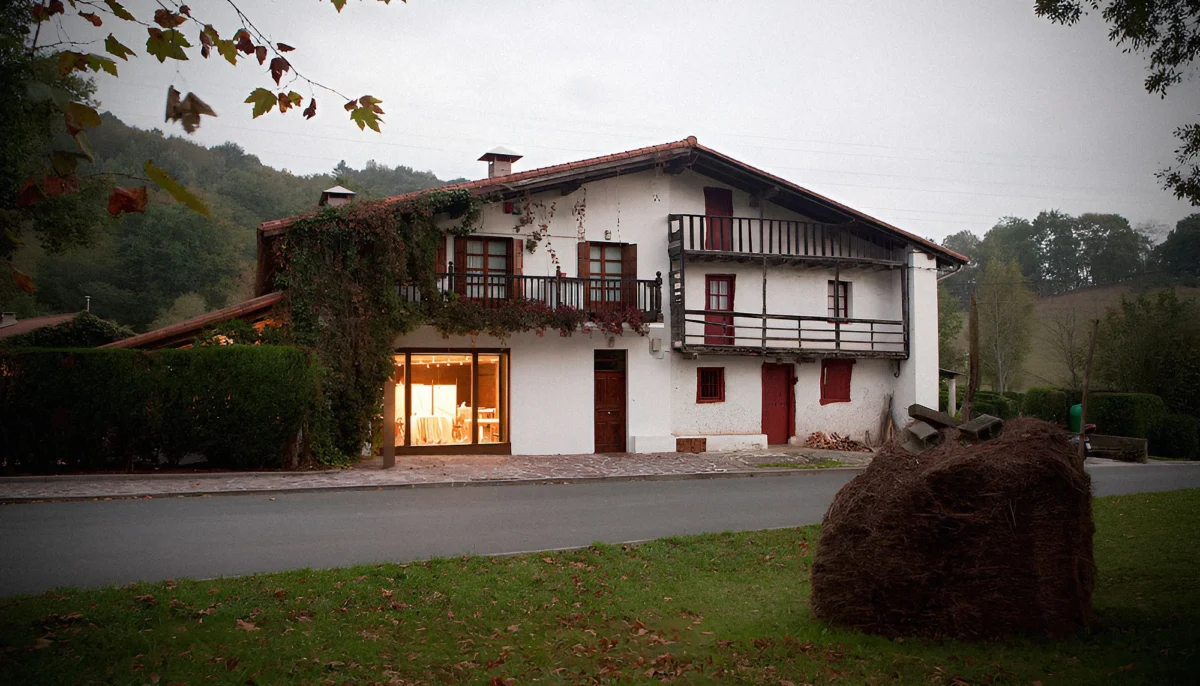
Most restaurant profiles begin with a signature dish. Mugaritz is easier to understand if you begin with a protected condition instead: uncertainty. The restaurant outside San Sebastian has spent more than two decades refusing the usual luxury guarantees of comfort food, obvious sequencing, and instant recognizability, then turning that refusal into one of fine dining's most durable identities.[1][2][5] In 2026, that still feels unusual. Plenty of elite restaurants claim creativity. Very few build an operating calendar, a booking policy, and a guest contract that all exist to keep creativity unstable on purpose.[1][3]
That is why the right way to read Mugaritz now is not as a relic of early-2000s experimental gastronomy and not as a simple "bucket-list" temple near San Sebastian. It is better understood as Andoni Luis Aduriz's frontier machine: a restaurant that keeps reserving time, money, and guest attention for ideas that may be provocative, awkward, beautiful, or all three in the same hour.[1][4][5]
1. The core product is not a dish but a frontier
The restaurant states its thesis unusually plainly. On the official About page, Mugaritz explains that muga means frontier in Basque and describes itself as a leader defined by courage, experimentation, and an ability to connect cuisine with worlds outside the kitchen.[1] That is more than brand language. It tells you what the house believes it is selling.
Most fine-dining restaurants use research to support service. Mugaritz structures service around research. The official description breaks the year into two six-month halves: six months "to search" and six months "to share."[1] That split matters because it protects reinvention from becoming a weekend hobby squeezed between service blocks. Half the year is for introspection, R&D, collaborations, and reformulation; half the year is when guests encounter the results as an experience.[1]
This is one reason the restaurant still feels distinct even after the broader industry absorbed many of the tricks once associated with avant-garde dining. Textural play, conceptual plating, and rule-breaking menus are no longer rare by themselves. What is rare is the willingness to organize an entire business around the idea that next season should not harden into last season's greatest hits.[1][5]
2. Aduriz's real achievement is making experimentation institutional
Andoni Luis Aduriz's biography matters here, but not only in the predictable celebrity-chef sense. The official chef page positions him as a San Sebastian-born cook shaped by early training in Gipuzkoa and a formative period at El Bulli before opening Mugaritz in 1998.[4] That history explains the restaurant's technical confidence. It does not fully explain its durability.
The more important point is that Aduriz turned experimentation into an institution rather than a one-time rebellion. Mugaritz has held two Michelin stars since 2006, according to the restaurant's own materials, and the house emphasizes that it spent 14 consecutive years in the global top ten of The World's 50 Best Restaurants.[1] The current 50 Best list page places it at No. 87 in the 2025 extended ranking, far from the old peak but still firmly inside the global conversation after more than 25 years.[6]
That arc tells you something valuable. Mugaritz is no longer the shock of the new, but it is also not a nostalgia case. It remains a reference point because Aduriz kept the restaurant from becoming a museum of his own past. The 50 Best Icon Award profile from 2023 describes a six-month season, roughly 30 courses, and a format that has long refused standard restaurant grammar: no bread course, no dessert, and a willingness to play with temperatures, textures, and even discomfort if that helps the idea land.[5] Plenty of restaurants can break rules for a few seasons. Very few can keep rule-breaking legible for a quarter century.
3. The guest contract is now clearer than the mythology
The most useful thing about Mugaritz in 2026 is that its public-facing mechanics are easier to read than its legend. The booking system for the 2026 season states the operational basics without romantic fog: the season runs from May 1, 2026 to October 25, 2026; the menu is EUR 319 per guest including VAT; confirming the booking requires a EUR 145 deposit credited against the final bill; and current reservations are structured around Friday-to-Sunday lunch and dinner arrivals.[3]
That clarity matters because Mugaritz is not a spontaneous detour meal. It is a scheduled encounter with a system. The FAQ page says the menu usually includes around 25 to 30 proposals, takes about 2.5 hours, and is personalized around allergies, restrictions, and dislikes communicated in advance.[3] The same page makes clear that the restaurant offers one tasting format rather than an a la carte menu and that beverage service can be built by the glass, by the bottle, through multiple pairing options, or through a non-alcoholic route.[3]
Read together with the Experience page, the promise becomes remarkably direct: this is "a proposal that is ephemeral," built without bread or dessert, with hardly any cutlery, no common order, and a stated ambition to question culinary certainties rather than soothe them.[2] Even before the 2026 menu theme is publicly described in detail, the operating contract is already visible. You are booking into a restaurant that wants your attention, not just your appetite.[2][3]
4. Why the restaurant still matters now
There is a simple reason Mugaritz still matters in 2026: it protects a lane that many high-end restaurants gesture toward but do not fully fund. A lot of elite tasting rooms now talk about narrative, research, and interdisciplinarity. Mugaritz still commits actual calendar structure to those words.[1][4] The six-month closure is not a marketing slogan. It is a budgetary and organizational decision that says reinvention is part of the product, not backstage ornament.[1]
That decision also keeps the restaurant culturally useful even for diners who may never go. Mugaritz keeps asking what a meal can do once you stop treating dinner as a ladder from snacks to fish to meat to sugar. The current public Experience page, still framed around the 2025 theme of "Transparency," describes the meal as an invitation to look beyond the visible surface of things and to treat flavours, textures, and meanings as connected rather than separate.[2] Whether the next season ends up gentler or harsher than that language suggests, the important thing is the method. Mugaritz keeps rebuilding from a question, not from a proven hit.
That is why the restaurant keeps exerting influence beyond rankings. Even the 50 Best Icon Award piece, which is obviously celebratory, is most revealing when it describes how improbable Mugaritz's survival has been: a difficult start, a fire, a pandemic, and a business model that deliberately resists standard restaurant certainty.[5] Its endurance is not proof that experimentation always wins. It is proof that experimentation can be institutionalized if the restaurant is disciplined enough to protect it.
5. Who should book, and who should stay away
Book Mugaritz if you want a meal that behaves like authored inquiry.[2][3] Book it if you enjoy being made slightly unstable by a dining room, if you want texture and sequence to do argumentative work, and if you value the chance to experience one of modern fine dining's clearest anti-routine systems while it is still alive and changing.[1][5]
Think twice if your idea of luxury depends on obvious abundance, classical progression, or the security of leaving with one "best dish" you can summarize in a sentence. Mugaritz's official language makes clear that the kitchen is trying to move beyond the recognizable, and that ambition has always divided diners.[1][2] The reward is not comfort. The reward is contact with a restaurant that still believes dinner can be a frontier rather than a showroom.
Bottom line
Mugaritz still matters in 2026 because it has kept the hardest promise experimental fine dining can make: not simply to surprise, but to keep surprise from turning into formula. Aduriz's achievement is not one famous edible stone or one era-defining stunt. It is the slower and more difficult accomplishment of building a restaurant where closure, research, service, and booking mechanics all defend the same idea.[1][3][4]
That makes Mugaritz a strong booking for diners who want authorship more than reassurance. It also makes the restaurant one of the clearest remaining answers to a question that fine dining still cannot quite settle: how much uncertainty can a meal hold before it stops being dinner and becomes something more interesting?
Sources
- Mugaritz official About page. Basque "frontier" framing, two-star status, and the six-month search/share operating model.
- Mugaritz official Experience page. Current public dining philosophy, the no-bread/no-dessert format, 2.5-hour framing, and the 2025 "Transparency" concept note.
- Mugaritz official FAQ and booking system. The FAQ covers menu structure, duration, and beverage options; the booking system at https://reservas.mugaritz.com/reservas-detalles/nueva-reserva/en provides the 2026 season dates, current arrival windows, and deposit framing.
- Mugaritz official Andoni Luis Aduriz biography. Training background, 1998 opening, and broader institutional role around innovation and culinary education.
- The World's 50 Best Restaurants, "Memories of the future: how 25 years of Mugaritz made Andoni Luis Aduriz an icon." Survival history, six-month season, 30-course scale, and the house's long anti-conventional dining grammar.
- The World's 50 Best Restaurants 2025 list page for Mugaritz. Current placement at No. 87 in the extended ranking.