Restaurant Pearl Morissette has the kind of 2025-2026 trophy stack that can make a restaurant harder to see. Canada's 100 Best put the Jordan Station restaurant at No. 1 for 2025; Michelin promoted it to two stars in September 2025; North America's 50 Best ranked it No. 3 in its inaugural 2025 list; and on April 15, 2026, 50 Best announced RPM as the 2026 Art of Hospitality Award winner before the full regional list reveal set for May 28.[3][4][5][6] Those are useful signals, but they are not the most interesting thing about the room.
The stronger story is that Pearl Morissette has made Niagara fine dining feel like a system rather than a destination vanity project. The restaurant sits on the top floor of Pearl Morissette winery, on a 42-acre property with a regenerative farm, vegetable and flower gardens, an herb plot, and a peach orchard in view.[1][2] Its kitchen, led by Daniel Hadida and Eric Robertson, uses a French-leaning tasting-menu grammar, but the meal is really about what happens when a Canadian pantry, a working winery, a farm crew, a service team, and guest communications all have to move in the same direction.
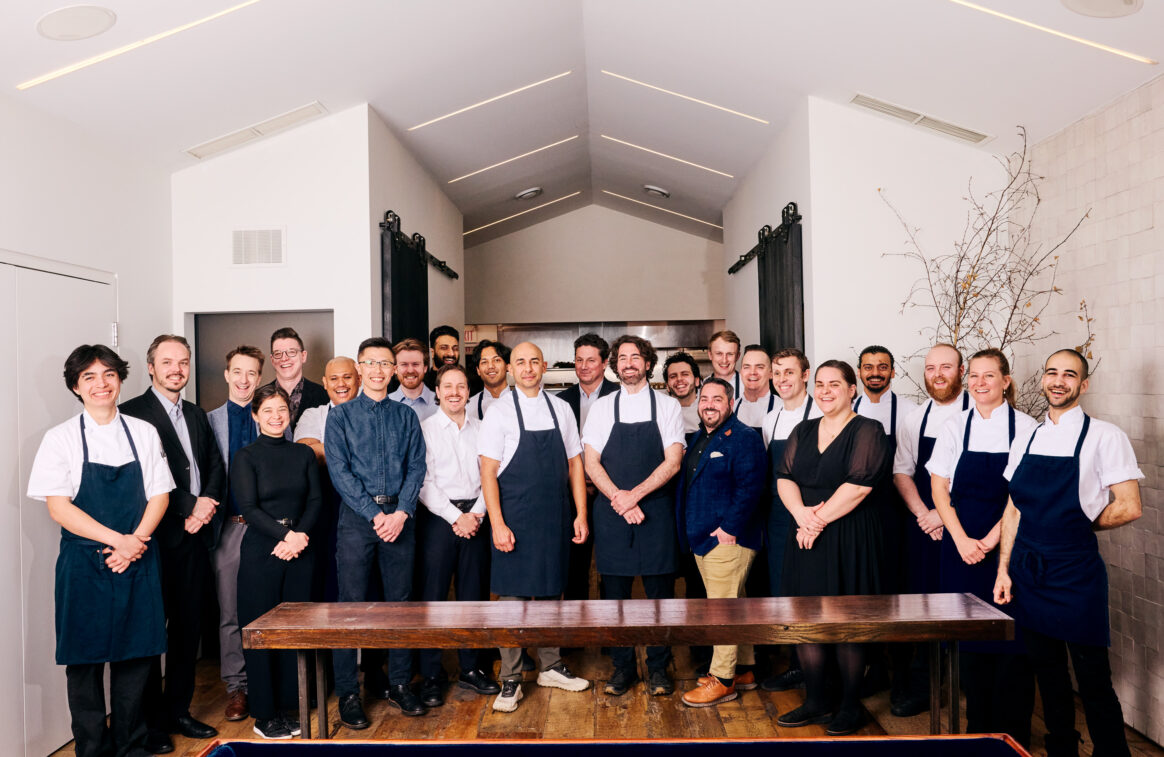
Image context: the cover photograph is a group portrait rather than a dish shot. That choice matters because RPM's current profile is not only about technique or terroir. The restaurant is being recognized for the way a full cast - chefs, service, wine, garden, and guest-experience work - turns a rural dining room into an unusually complete hospitality machine.[4][6]
The Farm Is The Constraint
Pearl Morissette's official language starts with a holistic approach: regenerative practices, regional purveyors, food and wine as a reflection of the local ecosystem and the land the restaurant inhabits.[1] That could sound like familiar farm-to-table copy until the details close in. The restaurant lists dozens of partners, from YU Ranch and Tamarack Farms to 1847 Stone Milling, Affinity Fish, Afishionado Fishmongers, Upper Canada Cheese Company, St. Brigid's Creamery, and its own Garden Pearl Morissette.[1]
The important move is not simply naming producers. The important move is making those relationships shape the menu's behavior. RPM says its prix fixe menu is ever-changing and built from regional ingredients, with farmers, ranchers, foragers, and fisherfolk from Ontario, the Great Lakes, and Canada's West and East Coasts feeding the kitchen.[1] Canada's 100 Best frames the same structure from the outside: the menu still runs 10-plus courses, but the experimentation has become more precise, with seafood relationships reaching both coasts and a kitchen willing to replace citrus and chocolate with Canadian alternatives such as pickled green peaches or black-koji cookie logic.[4]
This is where the restaurant's polish gets interesting. A farm restaurant can become picturesque very quickly: pretty windows, orchard romance, a little story about soil. Pearl Morissette works better because the farm is also a constraint. The room has floor-to-ceiling windows, but the view is not just scenery. It is pressure. If the meal claims to represent this corner of Niagara, the sourcing, wine, garden, and service have to keep proving it course by course.[1][2]
The Winery Changes The Meal's Center Of Gravity
RPM is not a restaurant that happens to sit near wine country. The dining room is above Pearl Morissette Estate Winery, and the wine program is one of the ways the property turns into a full experience.[1][5] The official approach page says the list includes Pearl Morissette cuvees and back vintages no longer generally available, alongside international producers that share the winery's low-intervention ethos.[1]
That matters because it shifts the meal away from the usual imported-luxury register. The private dining material describes the experience as an ever-evolving tasting menu with wine pairings, guided by chefs, sommelier, and hospitality team, with possible tours of the regenerative farm, gardens, vineyards, and winery.[2] The wine is not merely a supplement. It is another way of moving through the same property.
The 50 Best profile captures the same double track: the tasting menu may include West Coast geoduck, Acadian sturgeon caviar, goat, parsnip, and blackened barley koji, while the pairing logic can include Pearl Morissette back vintages and non-alcoholic garden pairings built from fruit, vegetables, and herbs.[5] The best version of that idea is not "local wine with local food" as a slogan. It is a meal where the glass, garden, cellar, and plate keep returning the diner to the same landscape from different angles.
Hospitality Starts Before The Drive
Pearl Morissette's 2026 Art of Hospitality Award is useful because it points to the soft machinery around the meal. The 50 Best story focuses on Robin Mednick, the restaurant's curator of guest experience, who often meets diners first by phone or email, confirming celebrations, proposals, dietary needs, and the details that shape the evening before anyone reaches the black barn.[6]
That kind of work can sound invisible until it fails. At a remote destination restaurant, the margin for guest anxiety is high. People drive from Toronto or farther, plan around limited lunch and dinner windows, and often attach the meal to an anniversary, birthday, proposal, or long-deferred reservation.[2][6] The official contact page is frank about the logistics: the property is about an hour southwest of Toronto, road signage is limited, the entrance is marked by a big red bird at the gateway, and no transit line takes guests directly to the property.[7]
So hospitality at RPM begins before the first pour. It begins when a guest understands how to arrive, where to park, what dietary needs can be handled, whether the evening has a celebration hidden inside it, and what kind of pacing the room can support. The 50 Best article describes a team that may invite diners into the kitchen or down to the cellar, turning behind-the-scenes movement into part of the memory rather than a VIP afterthought.[6]
The Accolades Make Sense Because The System Is Coherent
Michelin's 2025 note is compact but revealing. It describes RPM as a 42-acre destination with restaurant, winery, orchard, farm, and bakery, then emphasizes Canadian ingredients, seasonality, spontaneous tasting-menu dishes, a serious juice pairing, and a warm team keeping the meal moving at a friendly clip.[3] That last phrase matters. A restaurant can have ambition and still make the guest feel trapped inside its ambition. RPM's current reputation rests on making the ambition hospitable.
Canada's 100 Best reaches a similar conclusion through a different door. It describes Hadida and Robertson as conductors of a 100-plus-piece band of fisherfolk, farmers, foragers, ranchers, millers, servers, chefs, and sommeliers.[4] The metaphor works because it recognizes that the restaurant's achievement is distributed. A rural tasting menu at this level is not one chef's mood imposed on ingredients. It is a logistics problem, a training problem, a producer-relations problem, a garden problem, a wine problem, and a service-memory problem.
That is why Pearl Morissette feels more compelling as a profile than as a simple rankings story. The rankings explain why people are looking now. The restaurant itself explains why the attention holds. A 42-acre property gives it scenery; Canadian sourcing gives it a boundary; French technique gives it grammar; the winery gives it depth; and the guest-experience team gives the whole thing a human front door.[1][3][5][6]
What The Meal Is Really Selling
The easiest mistaken reading is to treat RPM as Canada's arrival in the global luxury tasting-menu class. There is truth there: two Michelin stars, a No. 1 Canada ranking, and a No. 3 North America ranking all put the restaurant in that conversation.[3][4][5] But the more useful reading is smaller and warmer. Pearl Morissette is selling the feeling that a farm, winery, garden, kitchen, cellar, and service desk can agree on what the evening is for.
That agreement is not sentimental. It takes producer discipline, timing, staff trust, wine storage, guest notes, dietary accommodation, parking directions, farm work, and enough culinary nerve to make a Canadian pantry feel complete without leaning on the world's most obvious luxury shortcuts. When it works, the diner does not just remember a course. The diner remembers being absorbed into a property with a point of view.
That is the quiet force behind Pearl Morissette right now. The restaurant has trophies, but the trophies are not the room's engine. The engine is the system: a Niagara farm restaurant that has learned to turn constraint into welcome, and welcome into the final course.
Sources
- Restaurant Pearl Morissette, "Approach" - official philosophy, partner list, regional purveyor model, 42-acre property context, dining room location, food approach, and wine program.
- Restaurant Pearl Morissette, "Private Dining & Events" PDF - venue description, private dining capacity, tasting-menu format, chef/sommelier guidance, property tours, and transportation context.
- Michelin Guide via GlobeNewswire, "MICHELIN Guide honors Toronto & Region with new Two Starred restaurant in 2025 selection" - September 18, 2025 promotion of Restaurant Pearl Morissette to two stars and inspector notes.
- Canada's 100 Best, "Restaurant Pearl Morissette" - 2025 Best Restaurant Award profile, No. 1 placement, sourcing and technique notes, service description, and Suech and Beck photography used for the article image.
- North America's 50 Best Restaurants, "Restaurant Pearl Morissette" - 2025 No. 3 profile, chef background, farm and winery context, tasting-menu examples, and pairing details.
- The World's 50 Best Stories, "Restaurant Pearl Morissette's dedication to deeply personal hospitality" - April 15, 2026 Art of Hospitality Award story and guest-experience reporting.
- Restaurant Pearl Morissette, "Contact" - official address, lunch and dinner hours, approach-to-property directions, transit limitations, parking cue, and local stay context.