

The easiest way to flatten Beta KL is to call it "modern Malaysian" and leave the sentence there. That label is not wrong, but it is too loose for what the restaurant is actually trying to do. Beta's own site says each dish is meant to tell a story about Malaysia's diverse cultural heritage, and the current menu page strips that ambition into a useful operational fact: this is a Tour of Malaysia dinner built to unfold over about 2.5 hours.[3][4] That time limit matters. A country is being translated into a route. The meal does not aim to display everything Malaysia has ever cooked. It aims to make a large, mixed culinary field readable in one sitting.
That is why Video Collection is the right mode here. In the MICHELIN Guide short, chef and co-owner Raymond Tham frames the project with blunt clarity: the goal is to take diners around Malaysia in two and a half hours so they can taste the country's flavors in sequence.[1] The FirstClasse feature gives the broader editorial frame, describing Beta as a restaurant that puts Malaysian ingredients front and center while combing north to south for a truly local exploration.[2] Put together, those two videos explain Beta better than a generic restaurant profile can. One gives the menu its time signature. The other gives it its cultural rationale.
The written sources help stabilize the argument. Beta's official pages stress storytelling, cultural heritage, and a tasting format priced at RM630++, with beverage and non-alcoholic pairings offered as separate tracks.[3][4] The 2026 MICHELIN Guide page confirms the restaurant's One Star status in Kuala Lumpur.[5] The World's 50 Best Discovery profile makes the room and plate language more concrete: a theatrical interior, regional classics reworked with modern technique, and dishes such as blue swimmer crab with rice noodles and chilli oil, lamb with koji and buah keluak, and jackfruit with homemade rice wine, sweet soy, and chilli kampung.[6] Those details make the key point clearer. Beta is not building a museum of national dishes. It is editing a map.
That editing matters because "national tasting menu" is a risky format. At the weak end, it collapses into brochure cuisine: too many references, too little sequencing, and a room that mistakes patriotism for atmosphere. Beta seems sharper than that. The restaurant understands that a dinner built from federal diversity needs discipline twice over. It needs flavor discipline, so the palate can move across different ingredients, sauces, and memory triggers without burning out. And it needs narrative discipline, so the diner feels motion instead of accumulation.[1][2][3][6]
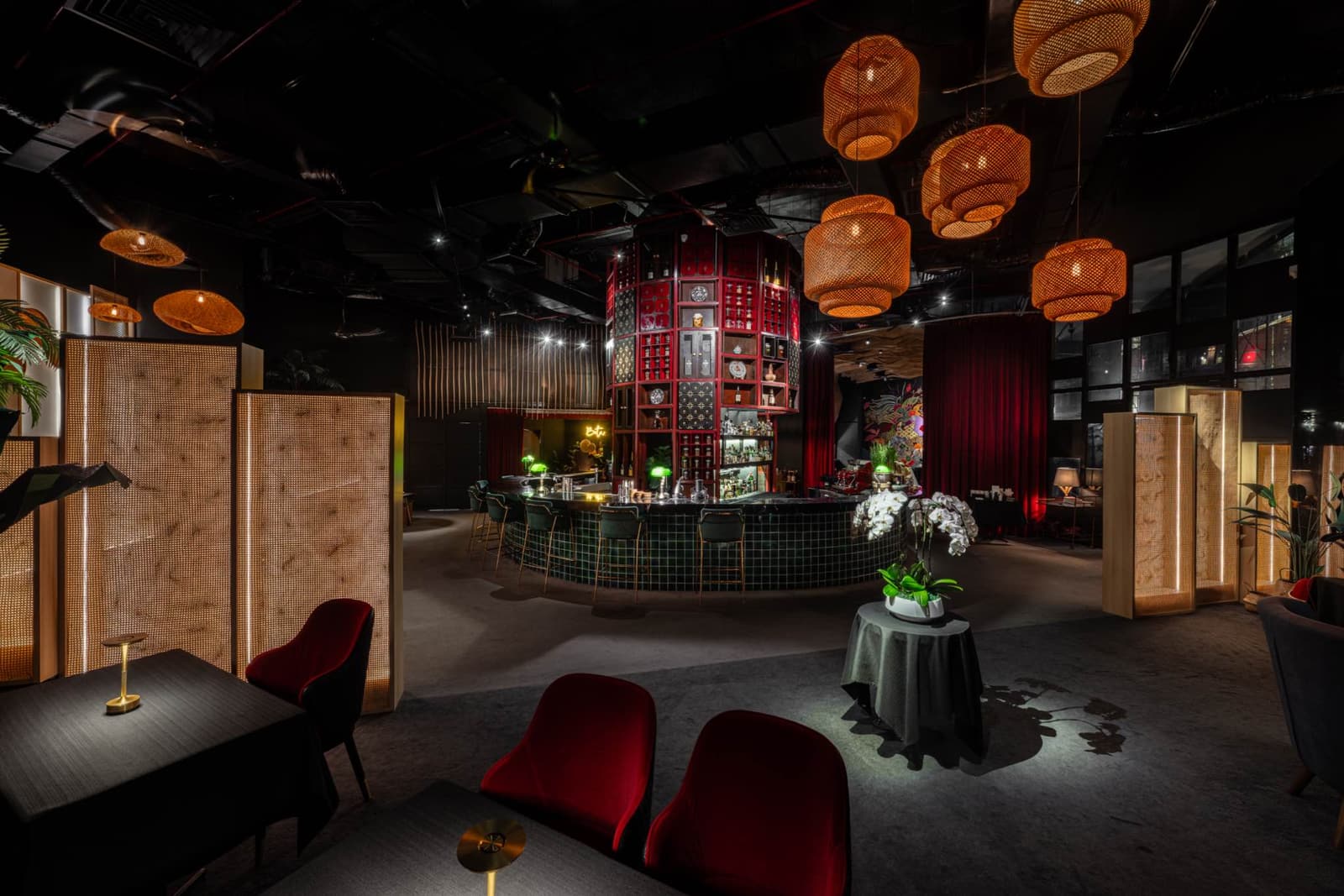
Image context: the lead image uses a real interior photograph from Beta KL's official gallery. It is the right visual anchor because this article is about stagecraft as much as cuisine. The dining room's dark envelope, woven pendant lights, and central bar explain how Beta can turn many regional references into one coherent evening rather than a messy display of symbols.[6][7]
Video 1: the MICHELIN short makes Beta's route legible by reducing the country to one controlled line
The MICHELIN Guide clip is brief, but that brevity is useful because it forces Beta's proposition into plain language before the plating can distract from it.[1]
The most revealing thing in the video is not glamour. It is the restaurant's insistence on timing and reduction. Tham explains that Beta wants diners to move around Malaysia in roughly two and a half hours, which immediately tells you that the menu is conceived as a line rather than a heap.[1] This sounds simple, but it solves the central fine-dining problem of regional cuisine. Once a chef decides to represent a whole country, excess becomes the default risk. Too many dishes, too many references, too much reverence, and the meal stops traveling. It just crowds the table. Beta's short film suggests that the kitchen knows this and has built against it from the start.[1][4]
The clip's other strong detail is a pairing that sets luxury against staple life. In the subtitles, Tham describes one signature combination by starting with abalone as the luxury product and then deliberately pairing it with rice, the more common daily anchor.[1] That choice is more important than it first appears. Beta is saying that Malaysian memory cannot be expressed only through prestige ingredients. A national route has to move through ordinary starches, common textures, and the kinds of ingredients that actually hold a cuisine together day after day. In other words, the tasting menu earns its elevation only if it keeps returning to staples.
That is where the article's title phrase, clear broths, comes in. The MICHELIN description says water provides Tham with the fundamental building blocks for the odyssey.[1] Read next to the official menu's promise of a structured tour, this sounds less poetic and more technical. A dinner that wants to move across Malaysia needs moments of reset. Stocks, broths, lightly handled grains, and clean liquids are not filler. They are routing tools. They stop regional memory from becoming sensory traffic. The diner has to keep understanding where the meal is going.
This is also why Beta feels more contemporary than restaurants that simply plate heritage dishes more elegantly. The goal here is not to embalm classics. The goal is to re-sequence them. A staple can sit beside a luxury product. A familiar sauce can become a hinge instead of a headline. A dish can suggest one state or one cooking lineage without demanding that the diner treat it like an anthropology lesson.[1][3][4] The MICHELIN short gives the concept its cleanest form: make the route short enough to remain intelligible, then use contrast to keep it alive.
Video 2: the FirstClasse feature shows that Beta's map is also a self-portrait
The second video widens the frame. Where the MICHELIN clip compresses Beta into route logic, the FirstClasse feature explains why the restaurant wanted that route in the first place.[2]
Its opening lines are strong because they frame the restaurant in terms of ingredients before prestige. The feature describes Beta as putting Malaysian ingredients front and center while traveling north to south for a genuinely local exploration.[2] That wording matters. It means the dinner is not merely themed Malaysian. It is ingredient-led in a way that tries to preserve geography inside the tasting format. Even if the diner cannot name every regional cue, the meal is supposed to carry an internal sense of direction.
More revealing still is the video's explanation of why Beta exists as a separate restaurant identity. In the subtitles, Tham contrasts the earlier, more European-facing Skillet model with the decision to build something that could feature "ourselves, our story, our culture" to diners.[2] That is the point where Beta stops being a market trend and becomes a self-portrait. Plenty of restaurants today promise locality. Fewer are willing to admit that locality becomes interesting only when it is attached to voice. Beta does not simply source from Malaysia; it wants the menu to sound Malaysian in public.
That helps explain why the written sources keep returning to theatricality without making the room seem superficial. The World's 50 Best Discovery page describes jewel tones of emerald and ruby, glossy black surfaces, and abstract art, then ties that setting to artful dishes built from regional classics and modern technique.[6] The official homepage uses an even softer metaphor, saying ingredients are like yarns woven into a fabric of taste.[3] Those two descriptions are more connected than they first look. Beta needs a room that can absorb variety without becoming visually noisy. The dinner asks the guest to move across many references. The space keeps that movement ceremonial and contained.
The dish examples on the 50 Best page make the benefit of that containment obvious. Blue swimmer crab with rice noodles and chilli oil, lamb with koji and buah keluak plus debal sauce, and jackfruit with homemade rice wine and sweet soy are not random luxuries.[6] They read like waypoints. Coastal, fermented, colonial, festive, domestic, spicy, and sweet all start touching the same menu. In a weaker restaurant, such variety could feel like a checklist. Beta's gamble is that if the route is edited tightly enough, the diner reads connection instead of scatter.
That is the collection's key insight when watched after the MICHELIN video. Beta's national map works because it is not trying to prove total coverage. It is trying to make Malaysia feel traversable. One video gives you the compressed line. The other gives you the motive behind it: to present culture, ingredients, and self-understanding in a form guests can actually move through.[1][2][3][6]
What the collection reveals when watched together
Seen together, these videos make a more precise claim than the phrase "modern Malaysian" can hold. Beta's real fine-dining move is editorial clarity. The MICHELIN short shows the restaurant reducing a national brief into a timed route held together by staple ingredients, liquids, and controlled contrast.[1][4] The FirstClasse feature shows why that reduction matters culturally: the menu is intended to carry story and self-representation, not just local sourcing or fashionable nationalism.[2][3]
The written sources then show how Beta prevents that idea from collapsing under its own ambition. The room is theatrical, but it is also legible.[6][7] The menu is broad, but it is still clearly bounded in duration and price.[4] The dishes are regionally suggestive, yet modern enough to avoid cosplay.[5][6] All of that points to the same conclusion. Beta does not treat Malaysia as a sampler platter of icons. It treats the country as a route that can be paced, staged, and clarified for a diner in one room in Kuala Lumpur.
That is what makes the restaurant worth embedding in video form. Video shows motion, and Beta is fundamentally about motion: one dish handing off to another, one memory registering against another, one state or cooking logic briefly appearing before the dinner moves on. The strongest national tasting menus do not win by collecting the most references. They win by deciding what kind of movement the diner should feel. Beta's answer, at least in this collection, is unusually disciplined. Malaysia becomes a journey you can follow before it becomes a statement you are asked to applaud.[1][2][6]
Sources
- MICHELIN Guide, "A Moment of Clarity with Beta's Raymond Tham," YouTube video.
- FirstClasse Malaysia, "Chef on Chef 4 Episode 4: Beta KL," YouTube video.
- Beta KL official homepage - restaurant concept, "diverse cultural heritage" framing, and dining-room identity.
- Beta KL menu page - current Tour of Malaysia format, 2.5-hour timing note, and published pricing.
- MICHELIN Guide, "Beta - Kuala Lumpur - a MICHELIN Guide Restaurant" - 2026 One Star listing and current restaurant page.
- The World's 50 Best Discovery, "Beta KL" - dining-room description and examples of regionally framed dishes.
- Beta KL gallery page containing the official interior photograph used as this article's lead image.