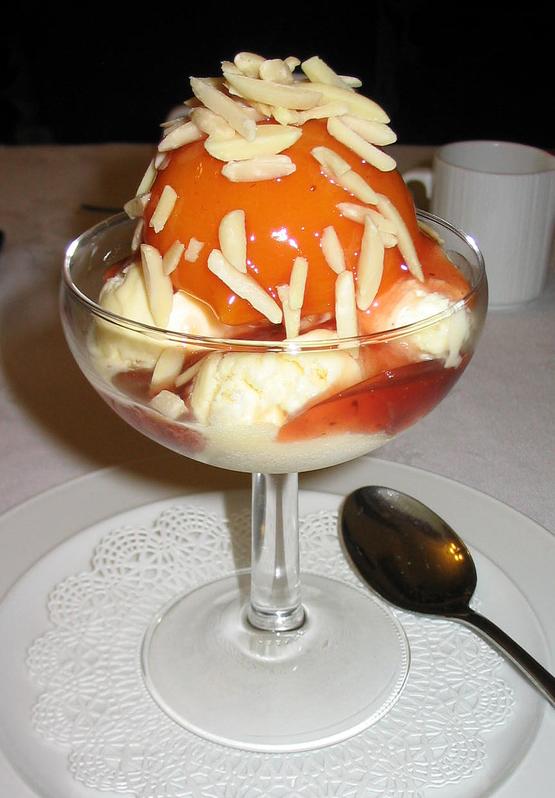
Peach Melba looks almost too simple to explain its own survival. A peach, vanilla ice cream, and raspberry puree should have been a seasonal dessert, admired for a summer and then replaced by the next grand hotel flourish. Instead it became one of the rare named restaurant sweets that still makes sense more than a century later. Its power is not complexity. Its power is that Auguste Escoffier made celebrity service edible.
The usual origin is tidy: Escoffier created Peach Melba at the Savoy in London in honor of the Australian soprano Nellie Melba, who liked peaches and ice cream while staying there in 1893.[1] The Escoffier Museum gives a slightly different and more revealing sequence: after hearing Melba sing Elsa in Wagner's Lohengrin, Escoffier created a "Peach Swan" for her in 1894, and the dessert became Peach Melba at the Carlton Hotel's London opening in 1899.[2] The mismatch is useful rather than fatal. It tells us that the dessert belongs to a live hotel culture where dishes moved between performance, guest memory, menu revision, and public naming.
That is the first fine-dining lesson in Peach Melba: the named plate was a social instrument. It did not merely feed a guest. It translated a guest into a repeatable act of hospitality. Nellie Melba was not an incidental label. Britannica identifies her as Helen Mitchell, born near Melbourne in 1861, later one of the most popular coloratura sopranos of her age, active at Covent Garden and the Metropolitan Opera, and eventually a Dame of the British Empire.[5] A dessert bearing her name carried opera-house glamour into the dining room without needing a program note.
The Hotel Did The Work
Peach Melba could not have emerged from just any kitchen. The Savoy was built for precisely this kind of gesture. Historic Hotels Worldwide describes its 1889 opening as a technological and luxury reset: electric lighting, electric lifts, speaking tubes, many private baths, Cesar Ritz in management, and Escoffier running the kitchens.[6] That matters because the dessert is a hotel product before it is a recipe. It depends on a room that can recognize celebrity, source fruit, freeze excellent ice cream, strain a sauce, plate quickly, and turn a private compliment into a public signature.
The dish also sits in the shift from Victorian abundance toward Escoffier's calmer modernity. A grand dessert could have meant sugar architecture, pastry towers, spun sugar, molded creams, and service equipment meant to impress before it tasted good. Peach Melba does the opposite. It makes luxury legible through subtraction. The fruit remains fruit. The ice cream stays cold and plain. The raspberry puree supplies color, acid, and a little theater without turning the plate into a construction project.
That restraint is why the dish still reads as fine dining rather than merely old-fashioned. The restaurant's labor is hidden inside clarity. The peach has to be ripe enough to perfume the plate but firm enough to poach. The syrup has to carry vanilla without making the fruit taste candied. The raspberry puree has to be smooth, bright, and tart enough to sharpen both peach and cream. Nothing is technically obscure, but everything is exposed.
The Recipe Is A Grammar
Escoffier's own published instruction in Le Guide culinaire is strikingly short. The Internet Archive text records the method as poaching peaches in vanilla syrup, arranging them in a timbale on vanilla ice cream, and covering them with raspberry puree.[3] That brevity is the point. This is not a pastry formula that depends on hidden layers or exact architectural assembly. It is a grammar: cold vanilla base, tender fruit, red fruit sauce, immediate service.
CooksInfo's traditional construction preserves the same service logic in fuller language: the peach is halved, poached, skinned, cooled, and arranged over ice cream, while the raspberry sauce is strained, sweetened, chilled, and drizzled at service.[4] That sequence explains why the dish survives. Peach and vanilla can become soft and round to the point of blandness. Raspberry, especially when kept clean and sharp, keeps the dessert awake.
This is also why Peach Melba is harder than it looks. A weak version is a bowl of ice cream with canned fruit and red sweetness. A strong version has three temperatures of memory at once: the remembered warmth of poaching, the actual cold of the ice cream, and the fresh sharpness of raspberry. The plate should not feel busy. It should feel timed.
Celebrity Without Noise
Fine dining often gets celebrity wrong. It can chase famous names so hard that the food becomes souvenir merchandise. Peach Melba avoids that trap because the tribute is embedded in service logic. Melba's fame matters, but the guest does not have to know opera history to understand the dessert. The name gives the plate an aura; the sauce and fruit still have to do the work.
That balance explains the dessert's portability. It can travel from a grand London hotel to a restaurant trolley, a summer menu, a pastry-school demonstration, or a home kitchen without losing its basic identity. It does not require Escoffier's whole brigade to be recognizable. But the better the dining room, the more the original logic returns. The server can present the fruit cleanly. The sauce can be poured with restraint. The ice cream can arrive before it slumps. The plate can read as a small act of care rather than a nostalgic label.
The origin disputes even help here. Whether the decisive moment was the Savoy in 1893, the "Peach Swan" after Lohengrin, or the Carlton in 1899, all versions place the dessert inside the same triangle: opera, hotel, and chef.[1][2] That triangle is more important than a single theatrical anecdote. Escoffier was not inventing a fruit combination in isolation. He was turning a performance culture into a dining-room form.
Why It Still Works
Peach Melba has outlived many grander dishes because it gives restaurants a durable pattern. Honor the guest, but do not let the tribute smother the food. Use luxury technique, but leave the ingredients recognizable. Make the plate memorable, but keep it light enough that a diner can finish it after a full meal.
That pattern is visible in modern fine dining far beyond this dessert. Restaurants still build signature dishes around the same moves: one seasonal anchor, one cold or creamy base, one bright counterpoint, one story that explains why this plate belongs in this room. Peach Melba is not the most complex ancestor of that habit, but it is one of the clearest. It shows how little a restaurant needs when the relationships are exact.
There is a reason the dessert is more persuasive than many heavier monuments to Escoffier. It does not ask the diner to admire history from a distance. It lets history arrive as a spoonful: peach, vanilla, raspberry, and the faint sense that a hotel once knew how to turn an opera star's presence into hospitality without shouting. That is Peach Melba's lineage. Not just a recipe, not just a name, but a model of how fine dining can make elegance repeatable.
Sources
- Encyclopaedia Britannica, "Peach Melba" - concise reference on the dessert's Savoy origin, Escoffier attribution, 1893 setting, and Nellie Melba dedication.
- The Escoffier Museum of Culinary Art, "Auguste Escoffier" - museum biography covering the Savoy, Nellie Melba, the Peach Swan account, and the later Carlton naming of Peach Melba.
- Internet Archive, Auguste Escoffier, Le Guide culinaire, aide-memoire de cuisine pratique (1903) - primary cookbook text recording the short Peches Melba method.
- CooksInfo, "Peach Melba" - traditional construction notes, poached peach and raspberry sauce sequence, and historical account of the Peach Swan becoming Peach Melba.
- Encyclopaedia Britannica, "Dame Nellie Melba" - biographical reference for Melba's name, career, dates, and later association with Peach Melba and Melba toast.
- Historic Hotels Worldwide, "The Savoy London" - hotel history covering the Savoy's 1889 opening, luxury technologies, Ritz and Escoffier roles, and Melba as an early guest.
- Wikimedia Commons, "File:Peach Melba.jpg" - dessert photograph used as the article image, showing the peach, vanilla ice cream, and raspberry-sauce structure discussed in the piece.