The easy way to remember Ernst is as a tiny Berlin restaurant that closed too soon. That is not wrong, but it is too sentimental. Ernst mattered because it made an operational bet that most luxury restaurants avoid: it treated instability as the product rather than as a problem to be hidden.
The restaurant's own site now makes the ending part of the evidence. It says Ernst would be closed from the beginning of November and preserves a long conversation in which Dylan Watson-Brawn rejects the idea that the closure was simply a financial failure. His explanation is more revealing: the restaurant had an impermanent nature, and that impermanence was tied to what Ernst was trying to do.[1] The World's 50 Best Restaurants 2024 extended list caught the same final-year pressure from outside, urging diners to book before Ernst shuttered at the end of 2024, while still placing it at No. 75 and describing the room as a nine-seat counter in Berlin's Wedding neighborhood.[4]
That combination is the point. Ernst was not a scalable format waiting for better margins. It was a small machine designed to resist scale.
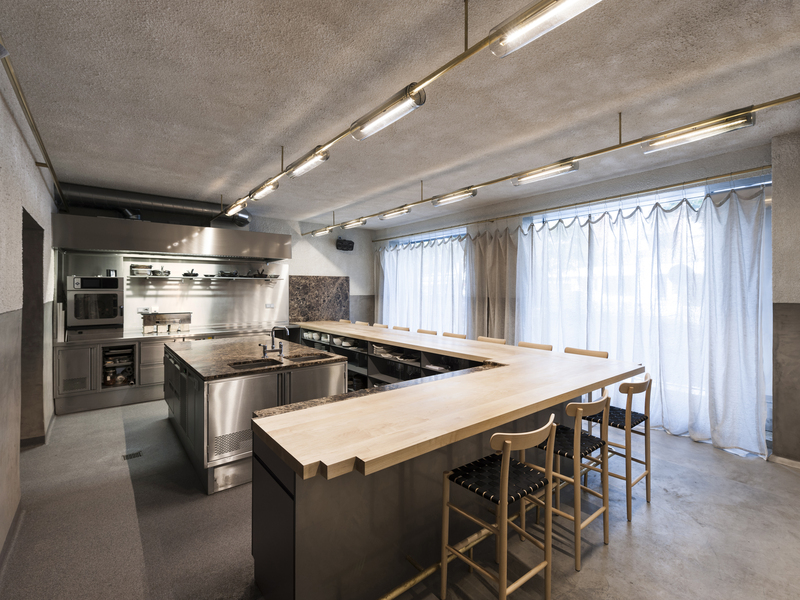
Image context: I used a real 2017 interior photograph by Thomas Meyer/Ostkreuz, published by Stylepark for Gonzalez Haase's design of Ernst. The photo matters because this article is about service operations, not plate aesthetics. The counter, the visible stainless-steel kitchen, and the stripped room show how little distance the restaurant allowed between cooking and receiving.[3][6]
The Counter Made Control Public
At Ernst, the room was not a neutral container. Gonzalez Haase's project page describes the Berlin-Wedding restaurant as intimate, sensory, and built around the careful selection of food, with light and material handling doing much of the atmospheric work.[2] Stylepark's 2017 design article is more concrete: the architects placed an open stainless-steel kitchen at the center and wrapped it with an L-shaped counter, so that nothing stayed hidden in the cooking or the architecture.[3]
That arrangement changed the usual service contract. In many high-end dining rooms, the kitchen controls the meal by disappearing. The guest receives finished objects, and the staff smooths away the labor. Ernst did the opposite. The guest sat close enough to watch the sequence being made, close enough to feel pace as a physical fact, and close enough for the austerity of the room to become part of the meal's pressure.[3]
This is not only design criticism. It is operations. A nine-seat counter reduces table variation, compresses explanation, and lets cooks see how the room is receiving the food. It also removes hiding places. If timing is off, the counter knows. If a course depends on a tiny product difference, the explanation cannot be outsourced to vague menu poetry. The format makes precision more exposed, which is risky, but it also makes trust more direct.
No Fixed Plan Was The Plan
The strongest operational sentence on the Ernst site is the one that says many people did not realize every day began anew, without a fixed plan or idea of what the menu might become.[1] That could sound romantic if it floated alone. Stylepark's earlier reporting gives it a practical base: the set meal was determined by what products were available in the best quality and freshness that morning.[3]
Put those two claims together and Ernst becomes easier to read. The restaurant was not improvising because it lacked discipline. It was building discipline around a different unit of control. The unit was not a signature dish, a laminated seasonal menu, or a stable luxury ingredient ladder. The unit was the day's usable product, the team's response to it, and the counter's ability to carry many small decisions quickly.
World's 50 Best described a 25-course menu with examples as specific as raw cuttlefish with white peach and squash, Austrian wagyu with beef fat and bone marrow, and a drinks pairing leaning toward natural wine.[4] Those examples matter less as a checklist than as evidence of range. Ernst could move between delicacy and intensity because the service model was built for short, concentrated arrivals rather than for a classical arc that had to reassure the diner at every turn.[4]
That is why repetition would have weakened the place. A restaurant built on daily product reading cannot let yesterday's success become tomorrow's template too easily. The team can learn, but the learning has to stay alert instead of hardening into a program.
Discomfort Was A Hospitality Tool
Watson-Brawn's conversation on the Ernst site is unusually explicit about guest discomfort. He says guests sat in a row, courses came in rapid progression, and there was too little time to analyze the food in the usual controlled way.[1] He also frames the restaurant through a beginner's-mind idea: experience was useful only if it did not become a shield against seeing the present situation clearly.[1]
That is a sharp hospitality claim. Most luxury restaurants sell comfort as proof of care: slower pacing, thicker chairs, more choice, softer narrative. Ernst was warm, but it did not make comfort the final value. It asked the diner to be present inside a sequence that could not be fully controlled from the seat.[1]
The design intensified that request. Stylepark notes the harsh contrast of the entrance area, the raw surfaces, and the almost brutal austerity of the interior against the delicacy of the food.[3] In a different room, that might read as affectation. At Ernst, it matched the service. The restaurant was stripping away the normal buffers: no distance from the kitchen, no stable menu promise, no leisurely analytical pause, no plush old-world cues telling the guest exactly how to behave.
Fine dining often borrows the language of surprise while keeping the guest fundamentally protected from surprise. Ernst's stricter lesson was that surprise changes the body only when the room gives it nowhere easy to go.
Japanese Influence Became A Constraint, Not Decoration
The restaurant's own summary says its philosophy and techniques were grounded in Japanese cuisine, with a strong focus on produce sourcing.[1] Stylepark links that orientation to Watson-Brawn's apprenticeship at Tokyo's RyuGin and then to work at Noma and Eleven Madison Park.[3] The point is not that Ernst was a Japanese restaurant in Berlin. It is that Japanese technique and counter discipline gave the restaurant a way to make restraint feel active.
That distinction matters because "Japanese-influenced" can become a lazy luxury label. At Ernst, the influence appears to have worked as a constraint system: product first, minimal necessary components, direct visibility, and respect for fleeting condition.[1][3] World's 50 Best's short description supports that reading by emphasizing seafood and vegetables treated with unusual care, alongside occasional ingredients that could unsettle the guest rather than flatter easy prestige expectations.[4]
The room did not need a long cultural explanation to make that logic visible. The counter did it. A small product arrived, was handled in front of the guest, and disappeared. The next one followed. The service style made seasonality feel less like a menu note and more like a series of short-lived events.
The Afterlife Is Not A Replacement
The Michelin Guide's listing for Julius, Watson-Brawn and Spencer Christenson's younger sibling restaurant, is useful because it shows what survived nearby after Ernst: a visible counter kitchen, creative cooking, a more laid-back atmosphere, and a broader day-to-night format.[5] Julius should not be read as a simple substitute. Its value is different. It proves that some of the Ernst grammar could move into a more accessible room without pretending the original counter could continue unchanged.[5]
That helps clarify why Ernst's closure is not only a sad ending. Some restaurants close because the market rejects them. Others close because the form has completed the argument it was built to make. Ernst's public explanation points closer to the second case: the ending was not separate from the restaurant's method but part of its refusal to become permanent machinery.[1]
For contemporary fine dining, that is the lasting lesson. Ernst did not matter because it was small. Smallness is easy to fetishize. It mattered because every part of the operation made smallness do work: the nine seats, the counter, the morning product decisions, the rapid progression, the sparse architecture, the Japanese-grounded technique, and the willingness to let a meal feel unstable without becoming careless.[1][2][3][4]
In that sense, Ernst's closure does not make the restaurant less relevant. It makes the argument cleaner. A restaurant devoted to immediacy left behind an unusually precise record of what immediacy costs: repetition had to be distrusted, comfort had to be limited, and service had to become a live encounter rather than a polished delivery system. Ernst made impermanence operational. That is why it still feels current after the door has shut.
Sources
- Ernst official site - current closure note, nine-seat counter description, Japanese-grounded philosophy, sourcing focus, counter interaction, and Dylan Watson-Brawn conversation on impermanence, daily reset, rapid pacing, and beginner's mind.
- Gonzalez Haase AAS, "Ernst" - project page covering the 2017 Berlin-Wedding restaurant design, address, collaboration credits, sensory material concept, and Thomas Meyer/Ostkreuz photography credit.
- Stylepark, "Raw and unadulterated" - 2017 design article on Ernst's Wedding location, ticketed set-menu format, product-led morning decisions, RyuGin/Noma/Eleven Madison Park background, L-shaped counter, open stainless-steel kitchen, and raw interior.
- The World's 50 Best Restaurants, "The World's 50 Best Restaurants 2024: the 51-100 list revealed" - Ernst at No. 75, nine-seat Wedding counter description, 25-course Japanese-influenced menu examples, natural-wine pairing note, and end-2024 closure context.
- MICHELIN Guide, "Julius - Berlin" - current listing identifying Julius as the younger sibling of Ernst from Dylan Watson-Brawn and Spencer Christenson, with visible counter kitchen and creative dining format.
- Stylepark image asset, "Restaurant-ErnstBerlinGonzalez-HaaseStylepark01.jpg" - source of the article's real photographic cover image, credited on the Stylepark article to Thomas Meyer/Ostkreuz.